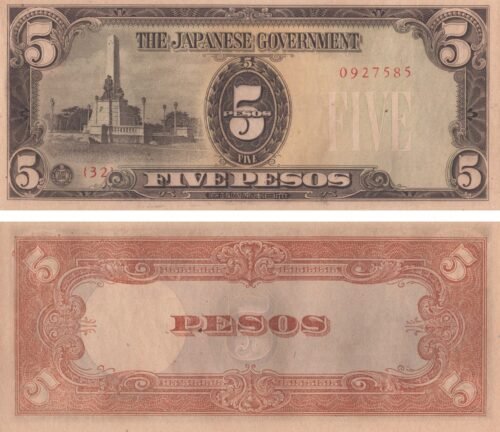
Greater Japan Imperial Government

Greater Japan Imperial Government is a catalogue attribution used for selected Japanese wartime issues, especially occupation currency. It identifies imperial government responsibility or imprint evidence, but should not be presented as the verified name of a separate commercial printing company.
Quick Facts
Official name: Greater Japan Imperial Government
Alternative names: Imperial Japanese Government; Japanese Government; 大日本帝國政府; catalogue printer attribution
Country: Japan
Headquarters: Japan; no separate printing-facility address is established by the reviewed catalogue evidence
Established: Not applicable as a separate printer; the term records a wartime government imprint and catalogue attribution
Status: Historical attribution; not an active printing organisation
Institution type: Government authority and catalogue-level printer label
Ownership or parent: Government of the Empire of Japan
Institutional Identity
The wording corresponds to the wartime Japanese state and appears in English or Japanese form on military currency. In banknote catalogues it can occupy the printer field because the issue itself does not identify a conventional named contractor.
That practice creates an important distinction: government authority, issuing channel and physical printer are not necessarily the same institution. WBN preserves the recognised catalogue term while stating the limit of what it proves.
Military currency depended on a chain of authority: the Japanese state authorised the monetary system, military administrations imposed it in occupied territories, designated financial institutions distributed notes and production facilities manufactured them. A catalogue may compress this chain into a single printer entry when no commercial press is identified. The profile exists to preserve that catalogue relationship without turning an administrative label into an unsupported factory history.
The wording also needs to remain separate from Greater Japan Imperial Printing Bureau. The latter describes a state-printing bureau imprint used on documented Japanese notes; Greater Japan Imperial Government is broader and can indicate the wartime state behind occupation currency. Similar English translations do not make the terms interchangeable.
Historical Development
Japanese occupation currencies were prepared for territories brought under military administration during the Pacific War. In the Philippines, notes began to circulate in 1942 and were issued first through the Yokohama Specie Bank and later through the Southern Development Bank.
The imperial government wording remained an authority marker across material produced for wartime use. Japan’s defeat in 1945 ended that monetary system, leaving the term as a historical attribution rather than a successor institution.
Japanese military notes were tailored to the monetary units of different occupied territories. Philippine issues used centavos and pesos, while other regions received dollars, rupees or local unit names. This approach facilitated forced currency replacement without presenting the notes as ordinary yen circulating everywhere under occupation.
As the war continued, production quantities rose and monetary discipline weakened. In the Philippines the expanding issue contributed to severe inflation, and later high denominations reflect that collapse. These economic consequences belong to the authority’s history even though the catalogue printer label does not identify every physical production location.
Role in Banknote Production
The Banknote Book uses Greater Japan Imperial Government as the printer attribution on selected occupation issues. The entry supports cataloguing at the level of government responsibility, but it does not identify the exact press, plant or subcontractor that handled every production stage.
This profile is therefore linked only where that specific catalogue attribution is supplied. Notes issued under Japanese occupation should not be assigned automatically, since other named printers or state bureaus occur in related series.
The attribution is strongest when the catalogue explicitly places the government term in its printer field. It should then be retained verbatim at the taxonomy level, accompanied by a profile that explains the evidential scope. If another source names a bureau or commercial firm for the same issue, both statements require reconciliation before the record is changed.
A wartime government inscription on the face is not automatically a printer imprint. Some notes state the issuing authority while remaining silent about manufacture. WBN therefore does not derive printer data solely from visible wording on the note.
Security and Technology
Many occupation notes were produced rapidly by lithographic or other economical processes, often without conventional serial numbers and with modest security compared with peacetime central-bank currency. Design and paper vary by territory and denomination.
No single technical specification can be assigned to the Greater Japan Imperial Government label. Security features must be described from the individual note rather than inferred from the authority name.
Occupation issues often relied on repeating geometric backgrounds, simple vignettes, lettered blocks and denomination colours. Many lack the elaborate intaglio portraiture, watermarks and full serial systems associated with peacetime central-bank notes. This reflects speed, scale and administrative purpose rather than a single uniform technical standard.
Counterfeits, propaganda copies and post-war replicas exist in the wider field. Authentication should consider printing method, paper, dimensions and design details for the exact territory. The government attribution by itself offers no universal test.
For Collectors
For collectors, this attribution is most valuable when its limits are kept visible. Territory, currency, series letters and denomination identify the issue; the government label alone does not locate the printing works.
Catalogue wording should be preserved for cross-reference, while claims about a named factory should be withheld unless a separate source supplies it. This prevents an imprint authority from being mistaken for a corporate printer.
A disciplined description names the occupied territory and printed currency first, followed by series and authority. “Japanese invasion money” is useful as a broad collecting category but too imprecise for an individual catalogue record. The same phrase can otherwise place unrelated territorial issues in one false sequence.
Historical sensitivity is also appropriate. These notes were instruments of occupation and economic control, not neutral souvenirs. Explaining their administrative purpose gives the object more meaning than repeating only wartime dates and a printer label.