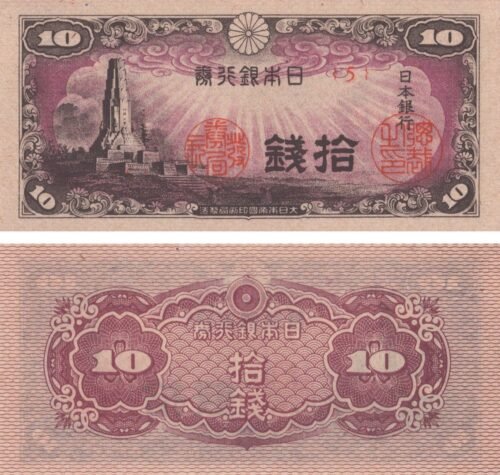
Greater Japan Imperial Printing Bureau

Greater Japan Imperial Printing Bureau is the catalogue rendering of a Japanese imperial state-printer imprint found on wartime notes. It belongs to the institutional lineage that began with the government Paper Money Office in 1871 and continues today through the National Printing Bureau.
Quick Facts
Official name: Greater Japan Imperial Printing Bureau
Alternative names: Imperial Japanese Printing Bureau; Japanese Government Printing Bureau; 大日本帝國印刷局; catalogue rendering
Country: Japan
Headquarters: Tokyo, Japan
Established: Historical state-printing lineage began with the Paper Money Office in 1871; the exact English catalogue title reflects a later imperial-era imprint
Status: Historical name; the state-printing lineage continues through Japan’s National Printing Bureau
Institution type: Government security-printing bureau
Ownership or parent: Government of Japan
Official website: npb.go.jp
Institutional Identity
The title is best understood as an English normalisation of Japanese state-printer wording, not as the registered English name of a separate private company. The bureau formed part of the government apparatus responsible for currency and other secure documents.
Japan’s current National Printing Bureau traces its origins to the Paper Money Office established in 1871. Official names and administrative placement changed repeatedly, so catalogue terminology should be tied to the imprint and period.
Japan’s government printer passed through several names and administrative structures after 1871. The current National Printing Bureau’s official history provides the continuous institutional framework, while the imperial-era English phrase used by catalogues is a translation convention tied to the wording found on particular notes.
That distinction matters for taxonomy design. A collector needs the catalogue label to match specialist references, but the profile must explain that it represents a period in the state bureau’s lineage rather than an independently documented corporation called exactly “Greater Japan Imperial Printing Bureau” in English.
Historical Development
Japan initially relied on foreign assistance for modern paper currency but developed domestic manufacturing rapidly. The government began producing national banknotes in Japan in the 1870s and built a mature engraving and paper-making system.
During the imperial and wartime period, bureau imprints appear on small notes and emergency denominations as well as regular currency. Post-war reforms changed the institution’s name and legal form without ending the state-printing lineage.
The early Meiji government created the Paper Money Office to develop sovereign currency manufacture. Domestic note printing began in 1877 after technical expertise, engraving and papermaking capacity had been built. Later administrative renamings reflected changes in the Japanese state rather than repeated creation of unrelated printers.
During wartime, pressure on materials and demand led to smaller formats, simplified notes and shared production with private firms. The bureau remained important, but it was one participant in a wider manufacturing network that included Toppan plants.
Role in Banknote Production
The Banknote Book attributes Japan’s 1944 10-sen note and other issues to the Greater Japan Imperial Printing Bureau. WBN preserves that wording for catalogue compatibility while linking it to the historically documented state-printing tradition.
The term is not applied to every Japanese wartime note. Toppan plants, other printers and government-authority attributions occur in neighbouring catalogue entries.
The 1944 10-sen note is a useful example of the bureau attribution on low-value wartime money. Government authority, issuing responsibility and bureau production align more closely here than in occupation currencies, but the fields remain conceptually distinct.
Catalogue entries should govern the exact relationship. A Japanese note dated in the imperial period may have been made by Toppan or another facility, and a government inscription does not by itself identify the bureau.
Security and Technology
The bureau’s long development included engraving, security paper, fine-line printing and controlled numbering. Wartime small-change notes could use simplified formats and materials because speed and resource constraints differed from peacetime requirements.
Technical features must be read by issue. The institutional lineage alone cannot establish which press, paper mill or production method created a particular note.
The state printer developed domestic engraving, specialist paper and increasingly sophisticated reproduction in the decades after the Meiji reform. By the twentieth century these capabilities supported banknotes and a wide range of official securities.
Wartime fractional notes did not always deploy the full technical range. Limited denomination, short expected life and material scarcity favoured economical production, so their simpler appearance should not be used to judge the bureau’s overall capacity.
For Collectors
For collectors, the Japanese imprint and catalogue printer line are the safest identifiers. The English phrase is useful for indexing, but it should not be treated as proof of a separately incorporated company.
Comparing wartime government-bureau notes with Toppan-produced issues reveals how Japan distributed production under pressure. Printer, serial suffix and date can all define separate varieties.
The profile is most useful when read beside the Toppan printer page. Notes of similar period and value can be separated by catalogue attribution or serial-ending conventions, revealing how state and commercial facilities divided production.
Collectors should retain the full serial and examine the exact Japanese imprint where visible. Translated names vary, and the approved WBN slug provides one stable archive for evidence that may appear under several English forms.