
Harrison & Sons

Harrison & Sons was a major British security printer whose long commercial-printing tradition developed into international stamp, banknote and protected-document production before its acquisition by De La Rue in 1997.
Quick Facts
Official name: Harrison & Sons Limited
Alternative names: Harrison and Sons; Harrison & Sons; H&S; Harrison and Sons Limited
Country: United Kingdom
Headquarters: Historical principal works at High Wycombe, Buckinghamshire, United Kingdom; earlier operations in London and Hayes
Established: Printing business founded in 1750; Harrison & Sons Limited records cover 1920–1997; acquired by De La Rue in 1997
Status: Historical printer; no longer an independent company following its 1997 acquisition by De La Rue
Institution type: Historical private security printer specialising in stamps, banknotes and protected documents
Ownership or parent: Acquired by De La Rue in 1997; previously controlled by Lonrho
Institutional Identity
Harrison & Sons Limited was a British printing and engraving company with a history extending from an eighteenth-century printing business to a twentieth-century security printer serving governments and issuing authorities. The National Archives preserves company records for the limited company from 1920 to 1997 and identifies the longer institutional history through the firm’s own 1750–1950 history. Its best-known public work included official publications and postage stamps, but its international portfolio also encompassed banknotes, passports and other products requiring controlled origination and printing.
For catalogue purposes, Harrison must be treated as the physical manufacturer rather than the issuer. A banknote printed at High Wycombe remained a liability of the named central bank or government. Harrison could translate an approved design into finished notes, yet it did not acquire monetary authority, determine the legal-tender status of the currency or automatically own the design. This separation is particularly important for low-denomination Nicaraguan notes whose issuer, printer and national symbolism belong to different institutional layers.
The company ceased to be an independent printer when De La Rue acquired it in 1997. Its historical production should therefore remain under a Harrison page rather than being retrospectively relabelled as De La Rue. Corporate succession explains archival ownership and later operations; it does not change the printer attribution of notes manufactured before the acquisition.
Historical Development
The archival history begins with a printing business founded in 1750. Over the following centuries the firm operated under several Harrison names and built a reputation in official and high-volume printing. By the twentieth century, Harrison & Sons Limited had become closely associated with government work, postage stamps and security products. High Wycombe developed into the principal name attached to the company’s later security-printing output.
Security printing was not a single technique. Harrison’s work ranged from publishing and stamp production to banknotes, where controlled artwork, plate or cylinder preparation, colour registration, numbering and inspection had to be integrated into a secure workflow. The firm’s experience in photogravure and other industrial printing processes is part of its wider technical history, but the exact process used for any banknote must be established from the note or issue documentation rather than inferred from the company’s stamp production.
In 1997 De La Rue acquired Harrison & Sons. The National Archives records the takeover, and De La Rue’s own corporate history lists the acquisition among its major security-printing expansions. This is the correct endpoint for Harrison as an independent company. Later production at inherited facilities belongs to De La Rue’s operating history unless a specific note or contract still identifies Harrison as the printer.
Role in Banknote Production
A Harrison banknote contract could involve adaptation of issuer artwork, preparation of production material, background printing, numbering, inspection, cutting and secure packing. The precise division of responsibility varied by customer. Designers, engravers, paper mills and security-feature suppliers could be separate organisations even when the completed note carried a Harrison imprint or catalogue attribution.
WorldBanknotes.eu currently links Harrison to four Nicaraguan centavo notes dated 1991: 1, 5, 10 and 25 centavos. These formed the lowest denominations associated with the third córdoba or córdoba oro period. Banco Central de Nicaragua provides the authoritative currency history and issuer context; specialist catalogues identify Harrison & Sons Limited as the printer of the four linked notes. No public issuer-side printer statement was located for each denomination, so the page presents the attribution as well-supported catalogue evidence rather than as a quoted central-bank contract record.
The group is useful because the four denominations share format and institutional context while still requiring individual inspection. Similar design language does not prove that every note in the wider 1991 programme came from the same works. Each denomination should retain its own printer field, date, Pick reference and evidence trail.
Security and Technology
The 1991 centavo notes demonstrate how security printing can be scaled to very small face values. Their protection depends less on a single spectacular device than on the interaction of controlled paper, multicolour line work, official emblems, serial numbering and consistent production. Fine patterns and registration can be examined under magnification, while paper response and any ultraviolet activity should be assessed without assuming that all denominations behave identically.
Harrison’s wider security-printing heritage included protected documents and stamps, sectors that require repeatable colour, accurate registration and controlled numbering. These capabilities provide institutional context but do not establish the paper mill, ink supplier or exact press used for a given Nicaraguan note. The printer attribution records the finished-note manufacturer; component attribution requires separate evidence.
Collectors comparing authentic notes should concentrate on line sharpness, clean edges, serial alignment and the relationship between foreground and background layers. The WorldBanknotes.eu guides to banknote security features and practical authentication provide a safer method than relying on one colour or motif.
For Collectors
Harrison & Sons offers a collecting route that connects British security-printing history with the monetary systems of many other countries. Its notes can be studied alongside its better-known stamp production, but the two fields should not be conflated: a printer may use different processes, suppliers and quality controls for each product category.
The four Nicaraguan centavo notes form a compact, coherent set. Their very low denominations and short-lived practical importance make them easy to dismiss, yet they document the restructuring of Nicaragua’s currency after severe inflation. They also show how an international printer produced a visually unified family at a scale far below the main córdoba denominations.
For database work, preserve the historical printer name exactly. Do not replace Harrison with De La Rue merely because De La Rue later acquired the company, and do not treat the Harrison corporate history as proof for unrelated notes. The strongest record combines the issuing authority, exact denomination and date, catalogue reference, printer attribution and direct examination of the note.
Banknotes Printed by Harrison & Sons
-
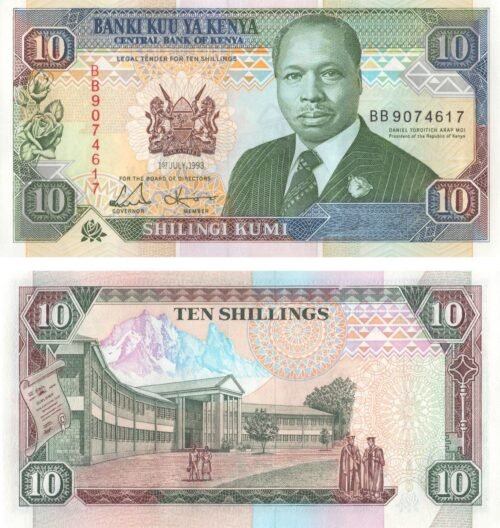
Kenya 10 Shillings 1993, P-24e, UNC
3,99 € -
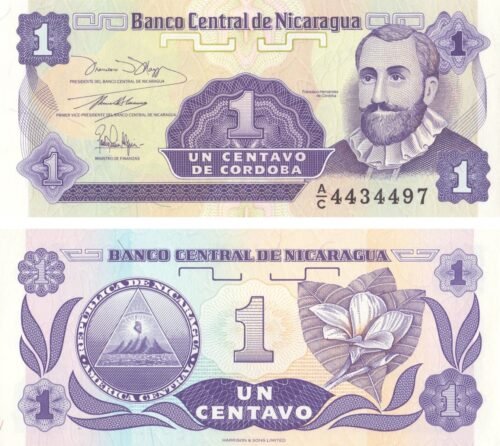
Nicaragua 1 Centavo 1991, P-167, UNC
0,99 € -

Nicaragua 5 Centavo 1991, P-168a(2), UNC
0,99 € -

Nicaragua 10 Centavo 1991, P-169a(1), UNC
1,49 € -

Nicaragua 25 Centavo 1991, P-170a(2), UNC
0,99 € -

Uzbekistan 1 Sum 1992, P-61a(1), UNC
2,49 € -

Uzbekistan 3 Sum 1992, P-62, UNC
2,49 € -

Uzbekistan 5 Sum 1992, P-63a(1), UNC
2,49 € -

Uzbekistan 25 Sum 1992, P-65a(1), UNC
2,49 € -

Uzbekistan 100 Sum 1992, P-67, UNC
5,99 € -
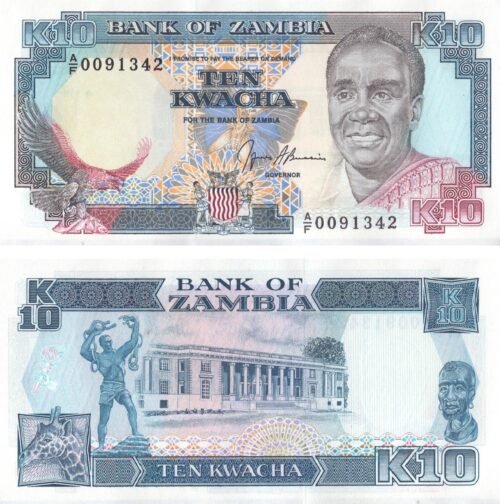
Zambia 10 Kwacha 1990-1991, P-31b, UNC
2,49 €
Selected References
- The National Archives — Harrison and Sons Limited, printers
- De La Rue — Our History
- Banco Central de Nicaragua — Historical Review of the National Currency
- Banco Central de Nicaragua — Financial Bulletin, June 2008
- Numista — Nicaragua 1 Centavo 1991
- Numista — Nicaragua 5 Centavos 1991–1992
- Numista — Nicaragua 10 Centavos 1991
- Numista — Nicaragua 25 Centavos 1991