
Hong Kong Note Printing Limited

Hong Kong Note Printing Limited is the government-controlled Tai Po printer serving Hong Kong’s distinctive multi-bank note-issuing system and selected external security-printing work.
Quick Facts
Official name: Hong Kong Note Printing Limited
Alternative names: HKNPL, 香港印鈔有限公司
Country: Hong Kong
Headquarters: 2–4 Dai Shing Street, Tai Po Industrial Estate, Tai Po, New Territories, Hong Kong
Established: Plant commissioned in 1984; operating as Hong Kong Note Printing Limited since 1996
Status: Active
Institution type: Government-controlled specialist banknote and security printer
Ownership or parent: 55% held through the Exchange Fund; remaining shares held by China Banknote Printing and Minting Corporation and Hong Kong’s three note-issuing banks
Official website: hknpl.com.hk
Institutional Identity
Hong Kong Note Printing Limited operates the specialist note-printing plant at Tai Po. The company is controlled by the Hong Kong Special Administrative Region Government through the Exchange Fund and the Hong Kong Monetary Authority, while China Banknote Printing and Minting Corporation and the three Hong Kong note-issuing banks hold minority interests. Its board accordingly brings together representatives of the monetary authority, the printing sector and the banks whose names appear on circulating Hong Kong dollar notes.
This structure reflects Hong Kong’s unusual currency system. Most circulating Hong Kong dollar banknotes are issued by Bank of China (Hong Kong), HSBC and Standard Chartered Bank (Hong Kong), under arrangements overseen by the HKMA. HKNPL manufactures the notes but is not itself the issuer. The front designs and institutional identities remain associated with the individual banks even when production is carried out at the same plant.
The company also prints passport pages with anti-counterfeit features and has produced banknotes for other jurisdictions. Its institutional identity is therefore broader than a single domestic series, but the Hong Kong currency system remains central to understanding why one printer can manufacture parallel note families carrying three different issuer names.
Historical Development
The Tai Po plant was commissioned in 1984. At that time it produced Hong Kong dollar banknotes for the two authorised note-issuing banks, HSBC and Standard Chartered Bank (Hong Kong), while also undertaking work for other jurisdictions. Bank of China (Hong Kong) joined the note-issuing system in 1994, adding a third institutional design family to the plant’s domestic production.
In 1996 the Hong Kong Government, acting through the Exchange Fund managed by the HKMA, purchased the existing factory, machinery and equipment from Thomas De La Rue plc. The operation was renamed Hong Kong Note Printing Limited. This transition changed ownership and governance without erasing the production history of the site before 1996.
The shareholder structure was broadened in 1997. Fifteen per cent of the issued share capital was sold to China Banknote Printing and Minting Corporation, and ten per cent to each of the three note-issuing banks. The Government retained management control through the HKMA and, by arithmetic, a 55 per cent interest.
Subsequent series have required the company to coordinate consistency across three issuers while preserving their separate visual identities. The 2018 Hong Kong series marked a notable development: reverse-side themes were standardised by denomination across the three banks, and the reverse designs adopted a vertical orientation to improve recognition and distinguish the series from earlier issues.
Role in Banknote Production
HKNPL’s core role is the secure physical production of banknotes from approved issuer and monetary-authority specifications. The plant must reproduce three issuer-specific front designs, common denomination logic and advanced security structures with consistent colour, registration, tactile quality, numbering and machine readability. This is a demanding form of standardisation because the notes must work as one currency system while remaining visibly attributable to different issuing banks.
The printer’s name should not replace the issuer in a catalogue. A Hong Kong dollar note printed at Tai Po remains an obligation of the bank named on the note and operates within the legal and monetary framework supervised by the HKMA. HKNPL’s role concerns manufacture, not monetary issuance.
The WorldBanknotes.eu catalogue currently connects HKNPL with a group of Macau pataca notes. That relationship demonstrates the plant’s external production role, but it does not imply that all Macau notes or all issues of the listed denominations came from HKNPL. Each attribution should remain tied to the specific date, issuer and catalogue variety.
Security and Technology
HKNPL publicly identifies intaglio printing as a major competence. Intaglio creates raised, tactile lines by forcing ink from recessed engraved areas under high pressure. The effect contributes both visual precision and an authentication cue that is difficult to reproduce with ordinary commercial printing.
The company also describes screen printing with optically variable magnetic ink, microprinting, latent-image effects and ultraviolet-fluorescent elements. These methods operate at different levels of authentication: some are designed for immediate public recognition, others for closer inspection or controlled equipment. Accurate registration is critical because optical movement, colour shift and microtext clarity can be lost through small production errors.
A printer profile should present these as HKNPL capabilities, not as a checklist attached to every note. The actual feature set varies by series, issuer and denomination. Issue-level documentation remains necessary before assigning OVMI®, a particular latent image or a specific ultraviolet response to an individual catalogue record.
For Collectors
HKNPL notes illustrate why issuer and printer must be recorded separately. Hong Kong collectors can compare three bank-specific front designs within one denomination and series, while the shared reverse theme and production standards reveal the coordinating role of the common printer. A complete attribution therefore needs both the issuing bank and the printing works.
The 2018 series is especially useful for comparative study because it standardises reverse subjects by denomination and introduces a vertical reverse orientation. Collectors can examine how the printer maintains common size, security placement and denomination recognition while allowing each bank’s front design to retain a separate visual language.
The distinction is explained more broadly in the WorldBanknotes.eu guide Who Issues Banknotes?. For Macau and other externally printed notes, the same principle applies: HKNPL attribution should be based on the specific issue, while the monetary liability remains with the named issuing authority.
Banknotes Printed by Hong Kong Note Printing Limited
-

Hong Kong 20 Dollars 2001, P-201d, UNC
7,49 € -
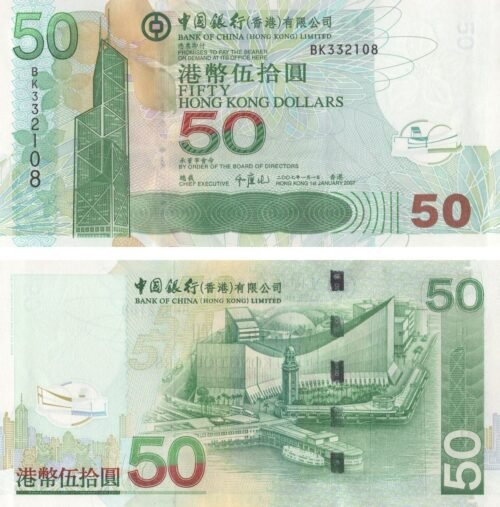
Hong Kong 50 Dollars 2007, P-336d, UNC
14,99 € -

Hong Kong 50 Dollars 2008, P-336e, UNC
14,99 € -

Hong Kong 10 Dollars 2002, P-400a, UNC
4,99 € -

Hong Kong 10 Dollars 2007, P-401a, UNC
3,99 € -

Hong Kong 10 Dollars 2014, P-401d, UNC
3,99 € -

Macau 10 Patacas 2013, P-86, UNC
3,99 € -

Macau 10 Patacas 2014, P-87, UNC
3,99 € -

Macau 10 Patacas 2015, P-88, UNC
3,99 € -

Macau 10 Patacas 2008, P-108a, UNC
3,99 € -

Macau 10 Patacas 2013, P-108b(1), UNC
3,99 € -

Macau 20 Patacas 2008, P-109a, UNC
5,99 € -

Macau 20 Patacas 2013, P-109b(1), UNC
6,99 € -

Macau 10 Patacas 2013, P-116, UNC
3,99 € -
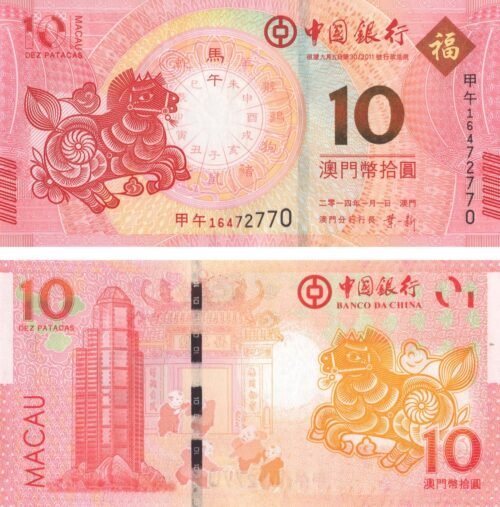
Macau 10 Patacas 2014, P-117, UNC
3,99 € -
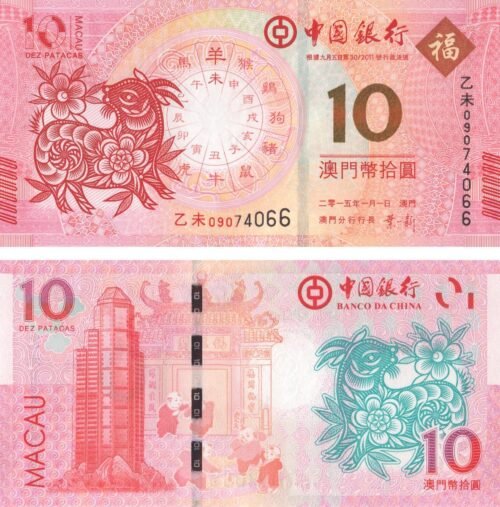
Macau 10 Patacas 2015, P-118, UNC
3,99 € -

Macau 10 Patacas 2020, P-129, UNC
3,99 € -
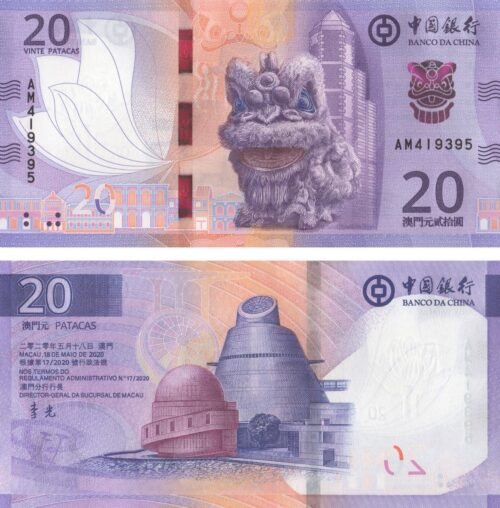
Macau 20 Patacas 2020, P-130, UNC
6,99 € -
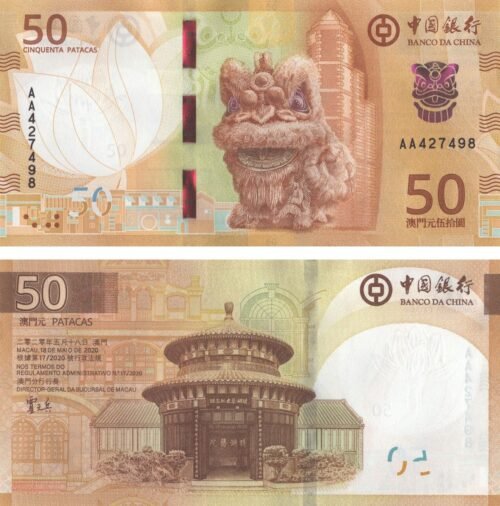
Macau 50 Patacas 2020, P-131, UNC
15,99 €