
Hôtel des Monnaies of the Central Bank of Congo

The Central Bank of Congo’s Hôtel des Monnaies is a domestic security printer inaugurated in 1987, producing banknotes through an integrated design, background-printing, intaglio and quality-control chain in Kinshasa.
Quick Facts
Official name: Hôtel des Monnaies de la Banque Centrale du Congo
Alternative names: Hôtel des Monnaies; BCC Hôtel des Monnaies; Central Bank of Congo Security Printing Works
Country: Congo (Democratic Republic)
Headquarters: Central Bank complex, 563 Boulevard Colonel Tshatshi, Gombe, Kinshasa, Democratic Republic of the Congo
Established: Printing works inaugurated on 7 November 1987
Status: Active
Institution type: Central-bank security printer producing banknotes and protected documents
Ownership or parent: Integrated production institution of the Banque Centrale du Congo
Official website: bcc.cd
Institutional Identity
The Hôtel des Monnaies is the security-printing institution of the Banque Centrale du Congo. The Bank’s official site describes it as specialised in banknotes and protected documents, with production and contact pages integrated directly into the central bank’s structure. It is therefore not an independent commercial company and should not be catalogued separately from its institutional parent as though it were privately owned.
The Banque Centrale du Congo remains the legal issuer of the Congolese franc. The Hôtel des Monnaies manufactures the physical notes and other protected products entrusted to it. This division is especially important in databases because the printer and issuer share the same institutional environment, while the name “Hôtel des Monnaies” is also used by unrelated organisations in other countries.
Its wider product range includes identity documents, passports, driving licences and other valued or security documents. These products demonstrate secure-design and production capability, but they do not make every BCC-issued note a confirmed local printing. Printer attribution must remain tied to the specific issue.
Historical Development
The official historical overview dates the realisation of the project to the inauguration of the printing works on 7 November 1987. The facility therefore began in the late Zaire period. Its production history subsequently crossed major monetary change, including the Nouveau Zaïre and the return of the Congolese franc. The Bank’s production page explicitly presents local activity across these currency eras.
The reintroduction of the Congolese franc in 1998 placed the works within a new national monetary framework. The printer’s institutional continuity is more important than a simple change of name on the notes: designs, denominations, security requirements and the relationship between domestic and external production all evolved across the transition.
The current BCC website continues to maintain dedicated Hôtel des Monnaies pages for presentation, production, products and contacts. That active institutional presence, together with current central-bank procurement and infrastructure material, supports an active status rather than a historical designation.
Role in Banknote Production
The Bank’s official production outline begins with conception and manufacture of the originals, followed by background printing, relief or intaglio printing, control and the remaining finishing sequence. This public process map is valuable because it documents actual responsibilities rather than merely naming possible technologies.
WorldBanknotes.eu currently links the printer to four Congolese-franc notes dated 2002, 2013 and 2022. These examples show continuity across repeat issues and later dates, but the page should not extrapolate from them to every Congolese denomination. Domestic and outsourced production can coexist within one currency programme, and reprints may involve different suppliers.
The printer’s protected-document work reinforces its competence in origination, secure backgrounds, controlled numbering and quality inspection. Even so, a passport or identity-card capability is contextual evidence only. A banknote record requires its own printer evidence.
Security and Technology
The documented production chain combines graphic origination, background printing, intaglio and quality control. These stages create the layered structure expected of a modern banknote: fine line work and colour backgrounds, raised tactile printing, serial information and controlled finishing. The exact feature package differs by denomination and issue.
The Congolese franc notes represented in the catalogue can be examined for guilloche structures, watermarks, threads, microprinting and serial changes. None of these should be treated as a universal Hôtel des Monnaies signature. Paper and security devices may be sourced externally, and a note printed elsewhere may use visually similar technology.
The official public pages do not disclose current machine inventory, annual capacity or all component suppliers. The profile therefore limits itself to the process and products the central bank actually publishes. That evidence is sufficient to describe a serious security-printing works without adding speculative production statistics.
For Collectors
This printer is a valuable reference point for studying domestic production in a currency system marked by repeated reform and re-denomination. Notes connected to the works can be arranged across the Zaire, Nouveau Zaïre and Congolese-franc eras to compare design language, production standards and the changing role of the central bank.
The four current WorldBanknotes.eu examples form a compact group: a 500-franc issue dated 2002 and 50- and 100-franc notes from 2013 and 2022. Collectors should compare repeat denominations for changes in serials, paper, plate wear and security-feature execution while keeping catalogue variants separate from printer evidence.
The name must always include the country or parent bank. The Bank of Algeria also operates an Hôtel des Monnaies, but it is a different institution with a different history and taxonomy term. The controlled value `Hôtel des Monnaies, Congo (Democratic Republic)` and its full slug are therefore essential to prevent cross-country attribution errors.
Banknotes Printed by Hôtel des Monnaies of the Central Bank of Congo
-

Congo (Democratic Republic) 500 Francs 2002, P-96B, UNC
2,99 € -

Congo (Democratic Republic) 50 Francs 2013, P-97A(2), UNC
1,49 € -
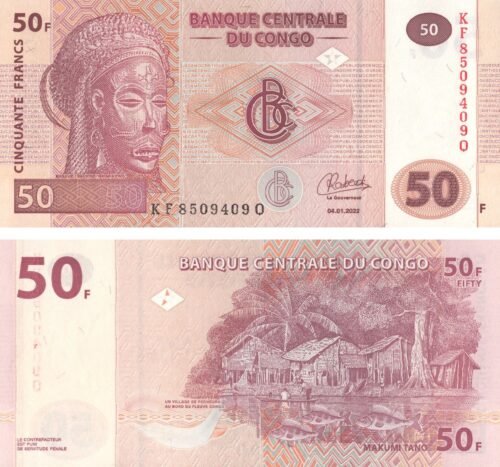
Congo (Democratic Republic) 50 Francs 2022, P-97A(3), UNC
0,99 € -

Congo (Democratic Republic) 100 Francs 2013, P-98b, UNC
1,49 € -

Zaire 50 Zaires 1988, P-32, UNC
2,99 € -
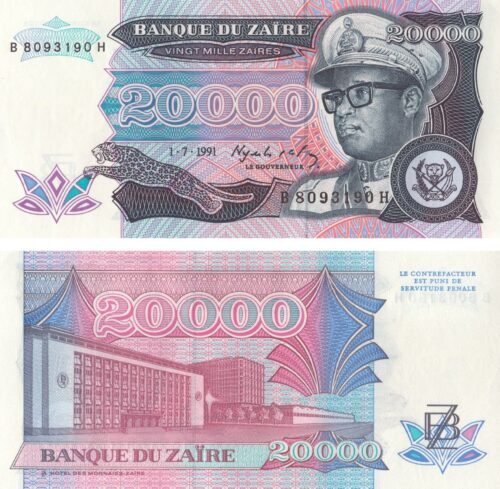
Zaire 20000 Zaires 1991, P-39, UNC
5,99 € -

Zaire 5000 New Zaires 1995, P-69, UNC
3,99 € -

Zaire 100000 New Zaires 1996, P-77, UNC
3,99 €
Selected References
- Banque Centrale du Congo — Hôtel des Monnaies: Presentation
- Banque Centrale du Congo — Hôtel des Monnaies: Historical Overview
- Banque Centrale du Congo — Banknote Production
- Banque Centrale du Congo — Security-Document Production
- Banque Centrale du Congo — Products
- Banque Centrale du Congo — Contacts
- Banque Centrale du Congo — Know the Congolese Franc