
Imprenta de Billetes del Banco de la República

Colombia’s Imprenta de Billetes is not a separate company but the specialised production department through which Banco de la República manufactures the country’s banknotes in Bogotá.
Quick Facts
Official name: Imprenta de Billetes del Banco de la República
Alternative names: Imprenta de Billetes; Banknote Printing Works of Banco de la República
Country: Colombia
Headquarters: Central de Efectivo, Calle 24 Bis #66-90, Bogotá, Colombia
Established: Domestic banknote manufacturing began in 1959; the present Central de Efectivo became operational in the second half of 2005
Status: Active
Institution type: Central-bank banknote-printing department
Ownership or parent: Integrated department of Banco de la República, Colombia’s central bank
Official website: banrep.gov.co
Institutional Identity
The Imprenta de Billetes is the banknote-printing department of Banco de la República. It forms part of the Central de Efectivo in Bogotá, where printing, treasury, industrial-technical and environmental functions are brought together within a controlled cash-production and distribution complex. The printer should therefore be catalogued as an integrated central-bank works, not as an independent commercial company.
Banco de la República is both the issuer and the parent institution, but those functions remain conceptually distinct. The Bank’s constitutional and monetary authority determines the note programme, while the Imprenta manufactures the physical notes required by the Treasury Department. The official mission describes that responsibility directly: producing the banknotes needed by Treasury with specialised technology and personnel, under defined quality and security principles.
This structure differs from an external printer contract. Design approval, manufacturing and treasury logistics all sit within the central-bank organisation, yet separate departments perform them. For collectors, the phrase ‘Banco de la República’ on a note identifies the issuer; the production credit ‘Imprenta de Billetes – Banco de la República’, where documented or visible, identifies the internal manufacturing works.
Historical Development
Banco de la República’s industrial history includes graphical printing from the early 1940s, but domestic banknote manufacture began in 1959. That date marks the start of the banknote works as a production function and should not be confused with the founding of the central bank itself in 1923. The distinction keeps institutional history aligned with the object being catalogued: the printer, not the issuer’s entire history.
By the 1990s, the existing facility faced spatial and logistical constraints. An evaluation associated with the Bank of England found high efficiency and international-quality production, while the central bank developed a replacement complex. The Central de Efectivo project progressed from approval and design through construction, and the transfer and commissioning took place in the second half of 2005.
The new complex integrated the Imprenta with the main Treasury operation and supporting industrial departments. That arrangement reduced handling between production and secure storage and provided a platform for modernised equipment and quality control. The printer remains active: Banco de la República continues to publish production statistics, current institutional information and procurement associated with its banknote-manufacturing function.
Role in Banknote Production
The Imprenta produces banknotes to meet Treasury requirements. Within the integrated central-bank structure, its work includes preparing approved designs for production, printing, numbering, inspection, finishing and secure transfer. The organisation’s official mission is deliberately operational rather than monetary: it makes the physical notes, while the Bank’s governing and treasury functions determine demand and issue them into circulation.
The WorldBanknotes.eu catalogue currently links the Imprenta to four published Colombian notes from the current design family: 1,000, 2,000, 5,000 and 10,000 pesos. These examples provide a focused group for examining contemporary domestic production. They do not prove that every Colombian note, historical or current, was printed in the same plant or under an identical process.
Printer attribution is strongest where the note carries the production text, where Banco de la República publishes issue documentation, or where dependable catalogues identify the works. A shared portrait style, serial-number format or substrate is supporting observation, not conclusive proof. As with other integrated central-bank printers, the issuer’s name must not be treated as an automatic printer mark.
Security and Technology
Banco de la República maintains a formal quality-management system for the Imprenta, with ISO 9001:2015 certification stated on the official page. The policy emphasises standardised and efficient production. Certification is important evidence of process control, but it does not replace note-level attribution or explain every security feature used in a particular denomination.
Modern Colombian notes combine line structures, microtext, tactile relief, serial-number controls, watermarks and threads. The Imprenta’s task is to reproduce the approved design consistently at industrial scale and to reject defective output before secure transfer. Individual features may depend on specialised paper, inks or devices supplied outside the printing department; therefore the finished-note printer should not automatically be credited as inventor or manufacturer of every component.
The Central de Efectivo’s integrated layout is itself a security technology. Production, inspection, treasury storage and distribution are physically and procedurally connected, reducing unnecessary movement of unfinished and finished notes. Collectors can use the WorldBanknotes.eu guides to banknote security features and printing processes to separate visible authentication elements from the documentary question of who printed the note.
For Collectors
The Imprenta de Billetes offers a clean example of an integrated central-bank printer. The issuing authority and printing works belong to the same institution, yet the roles can still be documented separately. This makes Colombian notes useful for learning how legal issue text, signatures, production credit and physical security features occupy different layers of the catalogue record.
The four linked WorldBanknotes.eu notes allow close comparison within one contemporary family. Collectors can examine denomination-specific size, colour, tactile structure, serial numbering and security placement without assuming that every observed difference reflects a different printer. Production changes may result from a revised series, new supplier, replacement plate or updated quality specification within the same works.
Historical study should follow the same discipline. Domestic manufacture began in 1959, while the current Central de Efectivo dates from 2005. A note printed before the move belongs to the institutional lineage of the Imprenta but not to the present facility. Recording both the printer and the relevant production era creates a more useful catalogue entry than a timeless label applied across all Colombian banknotes.
Banknotes Printed by Imprenta de Billetes del Banco de la República
-

Colombia 1 Peso Oro 1964-01-02, P-404b, UNC
6,99 € -

Colombia 1 Peso 1973, P-404e, UNC
3,99 € -
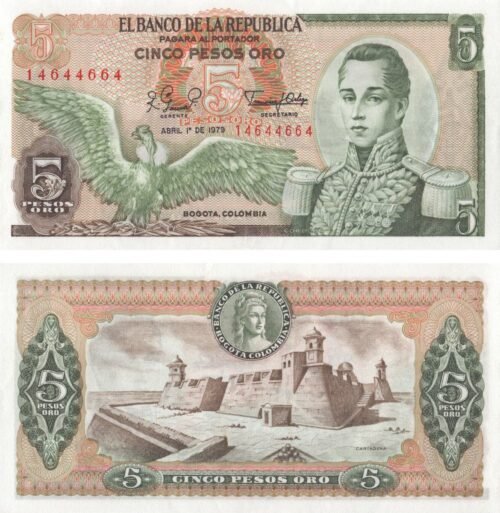
Colombia 5 Pesos Oro 1979, P-406f, UNC
3,99 € -

Colombia 10 Pesos Oro 1980, P-407g, UNC
2,99 € -
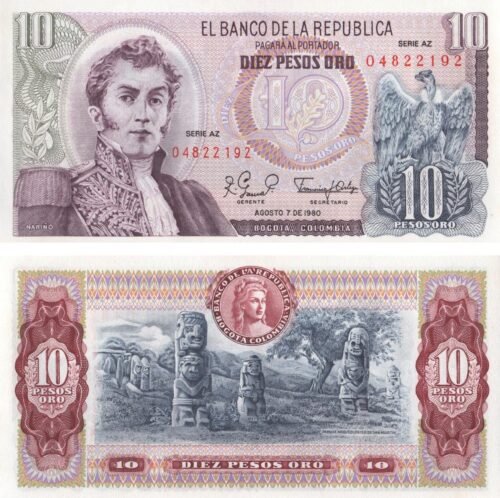
Colombia 10 Pesos 1980, P-407h, UNC
2,99 € -

Colombia 20 Pesos Oro 1983, P-409d, UNC
3,99 € -

Colombia 2 Pesos 1977-01-01, P-413b, UNC
2,99 € -

Colombia 50 Pesos 1984, P-425a, UNC
2,99 € -

Colombia 50 Pesos Oro 1986, P-425b, UNC
3,99 € -
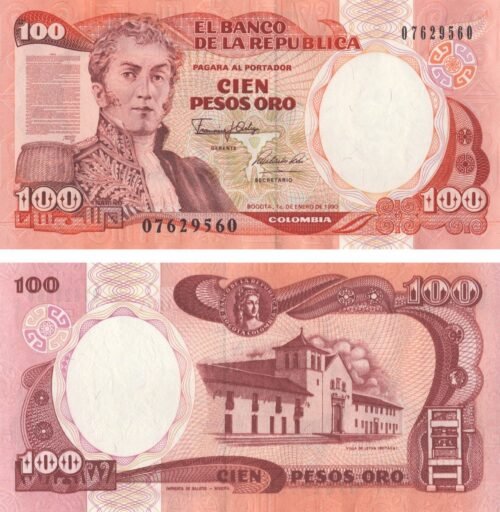
Colombia 100 Pesos Oro 1990, P-426e, UNC
3,99 € -
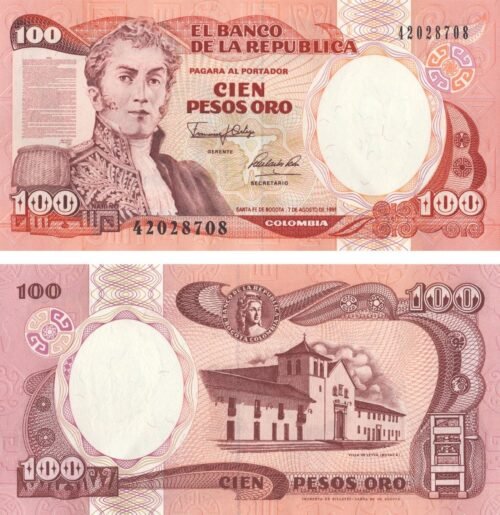
Colombia 100 Pesos Oro 1991, P-426A, UNC
2,99 € -
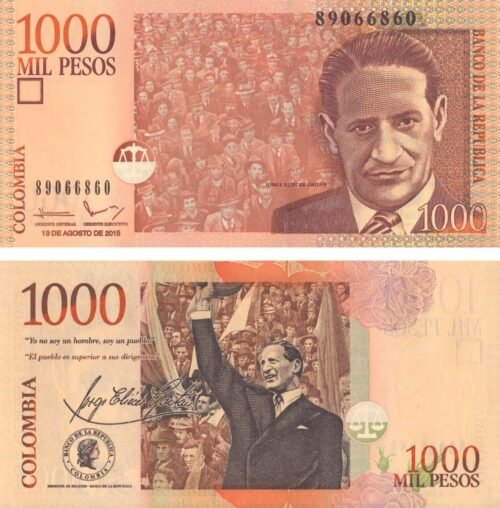
Colombia 1000 Pesos 2015, P-456t, UNC
2,49 € -

Colombia 1000 Pesos 2016, P-456, UNC
2,49 € -

Colombia 2000 Pesos 2015, P-458a, UNC
2,99 € -

Colombia 2000 Pesos 2022-07-26, P-458, UNC
2,49 € -

Colombia 2000 Pesos 2023, P-458, UNC
2,49 € -

Colombia 5000 Pesos 2015, P-459a, UNC
4,99 € -

Colombia 5000 Pesos 2020, P-459, UNC
3,99 € -
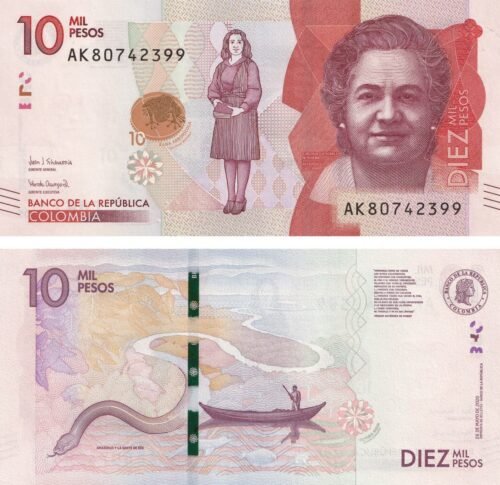
Colombia 10000 Pesos 2020, P-460, UNC
5,99 €
Selected References
- Banco de la República — Imprenta de Billetes
- Banco de la República — Central de Efectivo
- Banco de la República — History of the Central de Efectivo
- Banco de la República — Production and Circulation Statistics
- Banco de la República — Colombian Banknotes and Security Features
- Banco de la República — Institutional Repository