
Impresos de Seguridad

Impresos de Seguridad is Cuba’s documented state security-printing and minting institution, but its public corporate record is unusually limited and requires careful separation of verified facts from catalogue attribution.
Quick Facts
Official name: Empresa Comercializadora Integral de Tecnologías Especiales Desarrolladas
Alternative names: Impresos de Seguridad; Fábrica de Impresos de Seguridad; IS
Country: Cuba
Headquarters: Havana, Cuba
Established: Security-printing factory activity is documented by 2001; the current full legal identity is documented by 2009; an exact founding date was not established in the official sources reviewed
Status: Active in the latest official and state sources reviewed; current corporate disclosure is limited
Institution type: Cuban state security-printing and minting enterprise
Ownership or parent: Cuban state enterprise; detailed current administrative parentage is not clearly published in the official sources reviewed
Institutional Identity
Impresos de Seguridad is the abbreviated public name of the Empresa Comercializadora Integral de Tecnologías Especiales Desarrolladas. Cuban official gazettes use the full legal name and explicitly identify the abbreviated form, while state sources describe the Casa de la Moneda de Cuba as belonging to the institution. Together, these records establish a combined security-printing and minting role within the Cuban state system.
The public record is less complete than for many central-bank or commercial printers. No dedicated current corporate website was identified, and the official sources reviewed do not provide a reliable founding date, detailed ownership chart or comprehensive list of factories. The WorldBanknotes.eu profile therefore states those limits rather than replacing them with dates repeated in unsourced online summaries.
Institutional roles must also remain separate. The Central Bank of Cuba is the monetary authority and issuer. Impresos de Seguridad is the production organisation where documentary evidence supports that role. The Casa de la Moneda is a minting component associated with the enterprise. None of these relationships makes the security printer the legal issuer of the banknotes it manufactures.
Historical Development
A 2001 report in the Cuban state press documented a Fábrica de Impresos de Seguridad within the technical research and development system of the Ministry of the Interior. The report concerned improvements to a new Cuban passport and referred to quality specialists from the factory. This confirms an established secure-document production capability by that date, but it does not disclose when the factory was founded.
Later legal records provide a clearer corporate identity. Official gazettes identify the Empresa Comercializadora Integral de Tecnologías Especiales Desarrolladas, abbreviated Impresos de Seguridad, and authorise work through the Casa de la Moneda de Cuba. A 2017 central-bank resolution, for example, authorised the enterprise to mint and commercialise a commemorative coin and addressed notification to its director general. A 2021 official index records another numismatic authorisation under the same full legal name.
State reporting in 2022 described the Casa de la Moneda as part of Impresos de Seguridad and characterised the institution as responsible for printing and minting official money. These sources support continuity of function, but they do not provide issue-by-issue banknote production data. The profile consequently avoids claiming a complete historical monopoly, an exact corporate formation year or a current administrative hierarchy that the public record does not establish.
Role in Banknote Production
Documented activity covers protected printing, banknote-related production, passports, fiscal or control instruments and minting through the Casa de la Moneda. The practical banknote chain may include design preparation, background printing, intaglio, numbering, inspection and secure finishing, but the available official sources do not publish a detailed modern process map. Those steps should therefore be described as possible production functions, not as a verified list for every Cuban issue.
WorldBanknotes.eu currently links Impresos de Seguridad to six published Cuban notes, including regular peso issues and one foreign-exchange-certificate entry. That relationship is catalogue evidence drawn from the site’s product metadata. The official public sources reviewed for this profile do not provide matching issue-by-issue confirmations for all six notes. This limitation is recorded explicitly because a professional printer reference should distinguish catalogue attribution from independently documented production evidence.
The same caution applies to issuer material. The Central Bank of Cuba publishes security characteristics for circulating notes, but watermarks, threads, microprinting or intaglio do not identify the printer. A feature may have been specified by the issuer, supplied by another specialist and integrated by the printer. Attribution requires a printer mark, official production statement, reliable catalogue or comparable direct evidence.
Security and Technology
The 2001 state report on the Cuban passport documents multi-colour secure-document production and construction changes intended to improve reliability. Official and state records concerning other protected products also refer to holographic bands, microtext, security paper, watermarks and fibres. These examples establish institutional experience with layered document security without proving that every technique appears on every banknote.
For collectors, the most important technical lesson is negative as well as positive: familiar security features are not signatures of a factory. A security thread or watermark may be embedded in externally supplied paper; a hologram may come from a specialist vendor; serial-number systems may change across contracts. The printer’s role is to manufacture the approved product, but its precise contribution must be evidenced rather than inferred from the feature list.
Public corporate disclosure for Impresos de Seguridad is narrower than the standard available for many printers. The profile therefore does not assign proprietary technologies, current production capacity or certification status unless an official source names them. That restraint is part of the content’s value: it gives collectors a defensible evidence boundary instead of a polished but unsupported technical narrative.
For Collectors
Impresos de Seguridad is a useful case study in evidence-led attribution. Cuban notes may carry strong national design continuity, repeated portraits and familiar security structures, yet those visual links cannot establish where a particular printing was made. The collector should move from the individual note outward: inspect imprints and marginal text, identify the issuing authority, consult issue-specific references, and only then record the printer.
The six WorldBanknotes.eu-linked notes provide a practical working group, but they should not be used to populate neighbouring catalogue entries automatically. Date, denomination, certificate status and production series may indicate a different contract or workshop. This is especially relevant to foreign-exchange certificates, whose legal function and production history differ from ordinary circulation notes.
The Selected References deliberately include legal gazettes and state sources rather than commercial summaries. They confirm the enterprise’s legal name, its Casa de la Moneda relationship and documented security work, while also revealing what is not public. Until stronger issue-level sources become available, the correct scholarly position is a qualified attribution with a visible evidence note, not false certainty.
Banknotes Printed by Impresos de Seguridad
-

Cuba 100 Pesos 1991, P-FX25, UNC
2,99 € -

Cuba 1 Peso 1991, P-FX32, UNC
2,99 € -

Cuba 3 Pesos 1991, P-FX33, UNC
2,49 € -

Cuba 20 Pesos 1991, P-FX36, UNC
3,99 € -

Cuba 5 Pesos 2019, P-116, UNC
2,49 € -

Cuba 10 Pesos 2016, P-117, UNC
2,49 € -
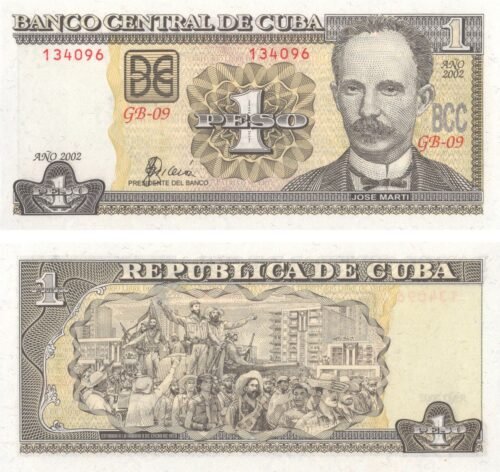
Cuba 1 Peso 2002, P-121b, UNC
2,49 € -

Cuba 3 Pesos 2005, P-127b, UNC
2,49 € -

Cuba 1 Peso 2007, P-128b, UNC
2,49 € -

Cuba 1 Peso 2009, P-128d, UNC
2,49 € -

Cuba 1 Peso 2010, P-128e, UNC
2,49 € -

Cuba 1 Peso 2011, P-128f, UNC
1,49 € -

Cuba 1 Peso 2016, P-128g, UNC
1,49 € -

Cuba 1 Peso 2017, P-128h, UNC
0,99 €