Imprimerie Spéciale de Banque

Imprimerie Spéciale de Banque was a French security printer based in Montreuil. Its catalogue footprint includes the coupon currency prepared for newly independent Ukraine, giving the firm a distinct place in the monetary transition that followed the Soviet Union’s collapse.
Quick Facts
Official name: Imprimerie Spéciale de Banque
Alternative names: ISB; Imprimerie Spéciale de Banque, France
Country: France
Headquarters: Montreuil, France
Established: 1955, according to the reviewed French corporate register record
Status: Historical; the reviewed register records deregistration in 2012
Institution type: Commercial security printer
Ownership or parent: Acquired by Pollard Banknote interests in the late 1990s according to French parliamentary material; later corporate status is historical
Institutional Identity
ISB operated as a commercial printer rather than an issuing authority. Corporate records identify a French company established in 1955, while banknote catalogues preserve its name through issue-level production attributions.
The firm should not be confused with the central banks or governments whose notes it manufactured. Printer credit establishes production responsibility, not monetary liability.
French company information places the historical entity in Montreuil and records commercial security printing as its field. Parliamentary discussion from the period of Pollard’s acquisition supplies an independent public reference to the company and confirms that ISB was more than a catalogue abbreviation.
The available record does not justify assigning every later Pollard contract to ISB or every ISB note to Pollard. Corporate ownership and the name appearing in a banknote catalogue belong to different dates, and the attribution should preserve the producer identified for the actual issue.
Historical Development
The available public record is uneven. French parliamentary material states that Pollard Banknote acquired the company in the late 1990s, and corporate-register data records the Montreuil entity as deregistered in 2012.
Because no complete official corporate archive was found, this profile does not reconstruct ownership changes beyond documented points. Its banknote history is strongest where catalogues name ISB directly.
A 1955 incorporation gives the company a substantial pre-Ukraine history, but public sources do not provide a complete list of clients. The late-1990s acquisition occurred after the Ukrainian coupon contract and therefore should not be used to rewrite the identity of the printer at the time those notes were prepared.
The 2012 deregistration recorded for the Montreuil entity marks an end to that legal record, not necessarily a single-day end to every plant, asset or trade relationship. The profile states the registry outcome without extrapolating beyond it.
Role in Banknote Production
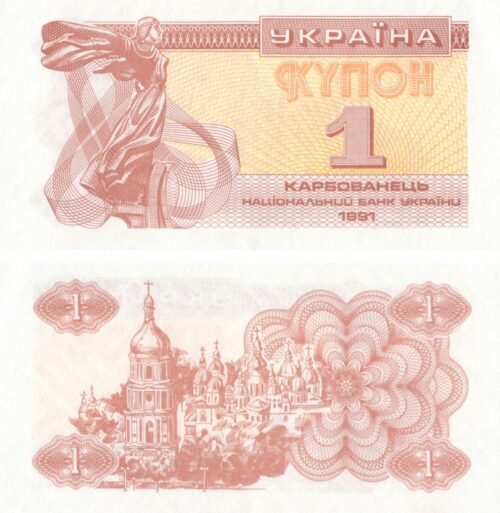
The Banknote Book attributes Ukraine’s 1991-dated coupon notes, introduced in January 1992, to Imprimerie Spéciale de Banque. These temporary coupons helped bridge the period between Soviet currency and the later hryvnia system.
The attribution is significant because it connects an emergency national issue with a foreign commercial producer. WBN applies the printer term only to notes for which that production credit is supplied.
Ukraine’s coupons were dated 1991 but entered use in January 1992, a distinction that matters in both product titles and historical narrative. Their purpose was temporary: they supported an economy leaving the Soviet rouble system before the hryvnia could be introduced in 1996.
An issue-level ISB printer credit connects the physical notes with a French contractor while the National Bank of Ukraine remained responsible for the monetary transition. Date, issuer and printer should therefore occupy separate catalogue fields.
Security and Technology
The Ukrainian coupons were designed for rapid introduction and broad circulation rather than the extended service life of a mature banknote family. Their printing, serial systems and modest security reflect that transitional purpose.
No plant-wide list of ISB technologies was established from the reviewed primary material. Features are therefore described at note level and are not generalised to every product the company may have made.
Coupon notes used repeated ornamental structures and clear denominations across a wide value range. Their changing face values and relatively modest security were consistent with a transitional series expected to be replaced, although some varieties contain paper or ultraviolet distinctions important to specialists.
Without an official ISB technical archive, it would be unsafe to attribute particular inks, paper manufacture or plate processes to the Montreuil plant. Observable note features can be described; proprietary plant claims cannot.
For Collectors
For collectors, the ISB attribution adds production context to Ukraine’s first post-Soviet currency. It should be considered alongside denomination, date, watermark and any latent or ultraviolet variety rather than used as a substitute for them.
The printer’s later ownership history does not change the name recorded on contemporary catalogue attributions. WBN retains the historic term for accurate cross-reference.
The printed year and actual introduction year should both be understood when organising the Ukrainian series. Catalogue subvarieties may depend on latent imprints, ultraviolet response or other features invisible in normal light, and these distinctions remain independent of the shared ISB attribution.
A verified printer field strengthens the object record but should not create false certainty elsewhere. If watermark or UV subtype is untested, that variety must remain open even though the French printer is known.