

KOMSCO is South Korea’s integrated state currency manufacturer, combining banknote printing, security paper, minting, identity products and anti-counterfeiting technology in one public corporation.
Quick Facts
Official name: Korea Minting, Security Printing & ID Card Operating Corporation
Alternative names: KOMSCO; Korea Minting and Security Printing Corporation; Korea Minting and Security Printing & ID Card Operating Corporation
Country: South Korea
Headquarters: 80-67 Gwahak-ro, Yuseong-gu, Daejeon, South Korea
Established: 1 October 1951
Status: Active
Institution type: State public corporation with integrated banknote, security-paper, minting and identity-document production
Ownership or parent: Public corporation of the Republic of Korea established under the KOMSCO Act
Official website: komsco.com
Institutional Identity
KOMSCO is the English acronym used by Korea’s state currency and security-products corporation. Its current legal English title includes minting, security printing and ID-card operation, reflecting a portfolio wider than banknotes. The corporation was created to provide stable domestic production of money and other national security products during the disruption of the Korean War.
The Bank of Korea is the monetary issuer. It approves and issues won banknotes, while KOMSCO manufactures the physical notes and coins ordered for the currency system. The distinction is directly visible in Bank of Korea references, which list issue dates and state “Printed by KOMSCO”. KOMSCO’s role should therefore be recorded as manufacturer, not issuer.
The corporation operates an integrated system covering banknote paper, printing, minting, identity documents, security features and authentication equipment. This vertical structure gives it broad control over production, yet a particular note can still contain externally sourced materials or features. Group capability and issue-level attribution remain separate questions.
Historical Development
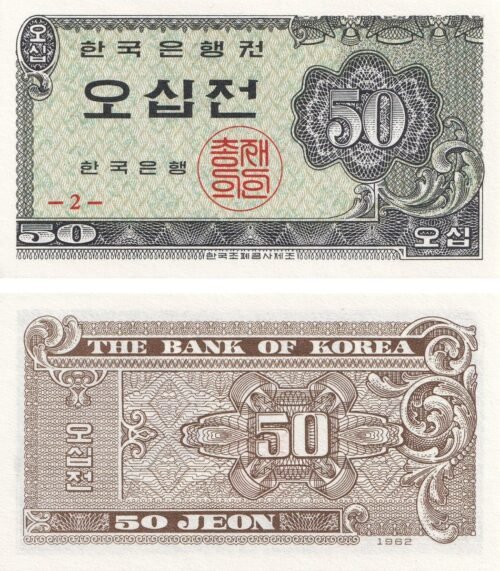
KOMSCO was established on 1 October 1951. Early Korean currency production still relied partly on foreign printers, but the corporation progressively replaced imported production with domestic capacity. Bank of Korea records show that the 50-jeon note issued on 1 December 1962 was printed by KOMSCO, while the 100-won note of August 1965 became the first intaglio-printed note manufactured in Korea.
Industrial integration deepened through specialist facilities. KOMSCO established the Gyeongsan Currency Headquarters in 1975 and produced the “ga” 1,000-won note with Korean technology. The Buyeo Paper Manufacturing Headquarters followed in 1983 with cylinder-mould paper capacity. An ID headquarters opened in Daejeon in 2007, adding electronic passports and identity products to the security portfolio.
International activity began in 1970 and KOMSCO states that it has supplied banknotes, coins, paper, inks, passports and related products to more than forty countries. The export record demonstrates capability but does not justify assigning every Korean-supplied paper or ink product to KOMSCO as the finished-note printer.
Role in Banknote Production
KOMSCO can cover secure paper manufacture, design engineering, plate preparation, offset backgrounds, intaglio, numbering, inspection, cutting and finishing. Its official introduction also identifies special inks, anti-counterfeiting elements and recognition devices. A domestic production system of this scale can coordinate substrate and printing tolerances from the beginning of a project.
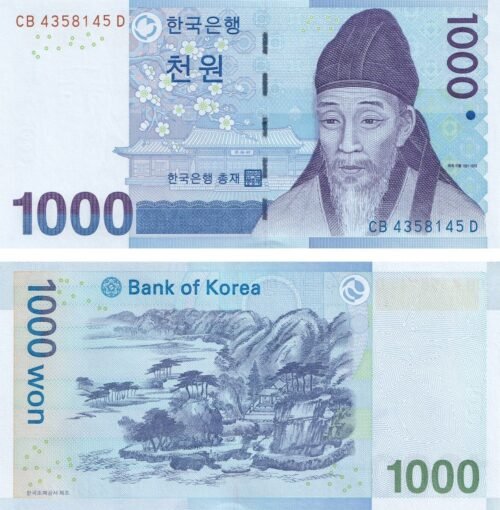
The three WorldBanknotes.eu notes are all supported by Bank of Korea documentation. The 50-jeon note entered circulation in December 1962 and was printed by KOMSCO. The current-design 1,000-won note was first issued on 22 January 2007 and the Bank of Korea again names KOMSCO. The PyeongChang 2018 commemorative 2,000-won note was issued on 17 November 2017 even though its commemorative title refers to the 2018 Games.
These examples span foundational domestic production, modern circulation currency and a commemorative note. They should not be treated as one technical series: each reflects a different production era, purpose and security specification.
Security and Technology
The Bank of Korea’s 2007 documentation lists colour-shifting ink, intaglio latent images, windowed security threads, see-through registers, microlettering, watermarks, fluorescent fibres and intaglio printing on the 1,000-won note. The PyeongChang note adds a hologram, tactile marks and novel numbering. These are issue-specific authorised features, not a generic checklist for every KOMSCO product.
KOMSCO’s own institutional material describes in-house paper with watermarks and embedded threads, special inks and pigments, and security technologies used across banknotes and identity products. The integrated structure makes component attribution especially important: paper or ink made by KOMSCO can be used in a note printed elsewhere, while a KOMSCO-printed note may use a separately sourced device.
Collectors should examine tactile intaglio, thread construction, watermark clarity, microtext and serial systems. Comparison is strongest when it follows official issue chronology rather than assuming that every design change represents a different factory.
For Collectors
KOMSCO’s history mirrors South Korea’s move from wartime dependence to a mature domestic security industry. The 1962 50-jeon note is valuable not only as a low denomination but as an early documented KOMSCO product. The 1965 intaglio milestone provides a nearby technical benchmark even though that note is not currently in the WorldBanknotes.eu group.
The 2007 1,000-won note shows the modern integrated system, while the Olympic commemorative demonstrates how the same manufacturer adapts production to a one-off public event. Collectors should preserve the difference between the note’s commemorative year, printed date and official issue date.
For authentication and cataloguing, use the Bank of Korea’s published dimensions and security features together with direct examination. The WorldBanknotes.eu guides to security features and dating banknotes provide the correct framework for separating issuer, date and printer evidence.
Banknotes Printed by KOMSCO


Selected References
- KOMSCO — Institutional Introduction
- Korea Minting, Security Printing and ID Card Operating Corporation Act
- Bank of Korea — Currency Timeline 1962–1970
- Bank of Korea — Currency Timeline since 2006
- Bank of Korea — PyeongChang 2018 Commemorative Banknote
- Bank of Korea — Current Banknote History
- Bank of Korea — Currency Timeline 1953–1962