Mincovňa Kremnica

Mincovňa Kremnica belongs first to the history of coinage, yet a special Gibraltar paper issue gives this seven-century mint a precise and unusual place in the banknote catalogue.
Quick Facts
Official name: Mincovňa Kremnica, štátny podnik
Alternative names: Kremnica Mint; Mint Kremnica; Mincovňa Kremnica, š.p.
Country: Slovakia
Headquarters: Štefánikovo námestie 25/24, 967 01 Kremnica, Slovakia
Established: 1328; state enterprise of the Slovak Republic since 1 January 1993
Status: Active
Institution type: State mint with specialised secure-printing and custom-production capabilities
Ownership or parent: State enterprise of the Slovak Republic
Official website: mint.sk
Institutional Identity
Mincovňa Kremnica is the historic state mint at Kremnica, founded in 1328 and still operating in the centre of Slovakia. Its core identity is the manufacture of circulation, commemorative and collector coins, medals and related metal products. It is not a conventional national banknote printer and should not be presented as one merely because a paper issue appears in its contract record.
The institution became a state enterprise of the newly independent Slovak Republic on 1 January 1993 and produced the country’s first circulation coins at exceptional speed. It later manufactured Slovak euro coins and has maintained a substantial export coin programme. Alongside minting, the enterprise operates custom-production and printing capabilities, including a printing facility established for excise stamps and other secure printed products.
Its inclusion in WorldBanknotes.eu is deliberately narrow. The profile documents a verified special paper-money assignment while preserving the difference between a mint, a security printer and an issuing authority. Gibraltar’s government authorised the linked note; Mincovňa Kremnica manufactured it.
Historical Development
The mint was founded under the Hungarian crown in 1328, drawing on the rich gold deposits around Kremnica. Across centuries it produced gold florins, silver tolars, coinage for the Habsburg lands and, after the upheavals of the twentieth century, coins for Czechoslovakia. Official history records repeated technical renewal, wartime destruction and post-war reconstruction.
Following the division of Czechoslovakia, Kremnica became a Slovak state enterprise and delivered the first Slovak coins in less than three months. It later struck the national euro coin stock and expanded export production for central banks in Europe, Latin America, Asia and Africa. This long continuity explains the institution’s reputation, but does not by itself demonstrate banknote capability.
The printing dimension developed as an auxiliary secure-manufacturing activity. Official annual reporting states that an excise-stamp printing press was established in 2014 under authorisation from Slovakia’s Ministry of Finance and later expanded to other printed products. The Gibraltar commission belongs to this specialised edge of the mint’s portfolio rather than to a broad programme of circulation-banknote production.
Role in Banknote Production
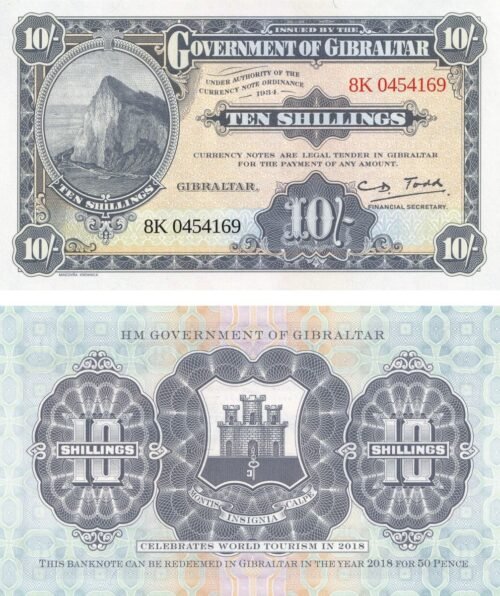
WorldBanknotes.eu links Mincovňa Kremnica to Gibraltar’s 10-shilling note issued for World Tourism Year in 2018. The object is an official replica inspired by Gibraltar’s 1934 10-shilling note, with a temporary redeemable value of 50 pence during 2018. Specialist catalogue evidence names Mincovňa Kremnica as the printer.
This was not a normal replacement denomination within Gibraltar’s circulating banknote family. It occupied a borderland between legal-tender note, commemorative issue and numismatic product. The issuing text, limited redemption period and unique serial numbering are therefore as important as its visual resemblance to an earlier note.
The assignment demonstrates that banknote cataloguing must accommodate specialist manufacturers without inflating their role. Kremnica’s confirmed production of this paper issue justifies a printer page, but not the claim that it operates an integrated banknote paper mill or a continuous high-volume banknote line. Evidence should remain proportional to the contract.
Security and Technology
Kremnica’s principal technical tradition is die engraving, metal preparation and precision striking. Those skills foster a culture of controlled origination, repeatability and inspection that can transfer to medals, stamps and special printed products, but metal minting and banknote printing remain materially different disciplines.
The Gibraltar note is best examined as a specific printed object. Its serial numbering, fine ornamental structures, paper response and ultraviolet activity should be recorded from the exact issue. Specialist sources show UV behaviour, but the manufacturing process and feature suppliers are not fully disclosed in the primary public record reviewed for this profile.
Collectors should resist converting the prestige of a 1328 foundation date into a technical claim about the note. Authenticity comes from the conjunction of official issue status, correct design and serial structure, expected print characteristics and provenance. The guide to banknote production helps separate printing stages from the minting processes for which Kremnica is chiefly renowned.
For Collectors
Mincovňa Kremnica offers one of the catalogue’s most intriguing printer classifications: a medieval mint attached to a modern commemorative paper note. The interest lies in the exception. It shows that institutional categories are useful only when they remain flexible enough to follow verified contracts.
The Gibraltar 10-shilling issue should be collected and described with its unusual legal framework intact. Its face denomination evokes the pre-decimal past, while its redeemable value and validity were defined in pence and limited to 2018. Treating it simply as a standard 10-shilling circulation note would erase the very feature that makes it historically distinctive.
For comparative study, place the note beside both the original Gibraltar design tradition and Kremnica’s medal and secure-print products. Such a comparison reveals how historical imagery, legal tender language and modern collector distribution can meet in one object without making the issuer, designer and manufacturer interchangeable.