
National Bank of Cambodia Printing House

The National Bank of Cambodia is both the guardian of the riel and, for documented issues, part of its physical production history. Created in the mid-twentieth century after the end of the Indochinese issuing system, the bank introduced Cambodia’s national currency and established its own printing capability. Monetary life was violently interrupted during the Khmer Rouge period, when banking and currency circulation were abolished, but the institution was rebuilt and the riel returned in 1980. Modern NBC records continue to identify a Printing House within the central bank’s structure, yet printer attribution must remain note-specific: Cambodia has also commissioned banknotes from major foreign security printers.
Quick Facts
Official name: National Bank of Cambodia
Alternative names: NBC; Banque Nationale du Cambodge; National Bank of Cambodia Printing House; Issue and Printing House Department
Country: Cambodia
Headquarters: Phnom Penh, Cambodia
Established: 1954; re-established in 1979
Status: Active central bank with an in-house printing-house function
Institution type: Central bank and banknote printing house
Ownership or parent: Royal Government of Cambodia
Official website: nbc.gov.kh
Institutional Identity
The National Bank of Cambodia is the Kingdom’s central bank. Its responsibilities include monetary policy, financial-system oversight, currency issuance and the management of banknotes in circulation. The institution does not operate as a commercial printer serving an open international market; its printing-house role belongs within the central bank’s own monetary and administrative structure.
Official NBC history places the bank’s creation in 1954, when Cambodia was building institutions separate from the former French Indochinese monetary framework. The closure of the regional issuing institute and its shared printing arrangements created the conditions for a national bank and a distinct Cambodian currency. The riel appeared shortly afterwards, replacing the piastre in the new sovereign system.
The bank’s name on a note identifies the issuer, but it does not automatically prove that the note was printed in-house. NBC has maintained a Printing House or Issue and Printing House department, while different Cambodian series have also been supplied by external state and private printers. The canonical printer value “National Bank of Cambodia” should therefore be used only where the specific issue is supported by a catalogue, primary record or reliable attribution.
This distinction is especially important because the central bank’s history contains rupture and reconstruction. The pre-1975 National Bank, the post-1979 rebuilding programme and the present institution belong to one national monetary story, but their production environments, equipment and access to foreign partners were not identical.
Historical Development
Cambodia’s modern banknote history began within French Indochina, where a regional issuing system supplied currency across Cambodia, Laos and Vietnam. After independence, Cambodia needed a monetary institution and visual language of its own. The National Bank was formed and the riel was introduced in 1955, carrying Cambodian architecture, rural life, royal and national symbols into everyday exchange.
Official NBC material states that the bank printed its own national currency after the Indochinese printing arrangement was closed. This early domestic role gave the new currency a strong association with institutional independence, even though foreign printers continued to participate in different periods and denominations.
The monetary system was destroyed during Democratic Kampuchea. From 1975, banking institutions were dismantled and ordinary monetary circulation disappeared. When a central-bank structure was restored in 1979, the challenge was larger than issuing a redesigned note: the country had to reconstruct cash operations, accounting, distribution, staff capability and public confidence.
The riel was reintroduced on 20 March 1980. Early post-conflict notes were part of an emergency institutional rebirth, and later series gradually gained more sophisticated engraving, colour, substrate features and anti-counterfeit protection. Currency remained deeply affected by the parallel use of the United States dollar, making the riel both a practical means of payment and an emblem of monetary sovereignty.
Annual reports from the 2000s and 2010s show that the Printing House remained an identifiable NBC operational unit. The reports refer to internal audits of the Printing House, staff training, collaboration with other central banks and study programmes connected with banknote production. In 2009, NBC hosted staff from the Bank of the Lao PDR for a study tour on banknote printing, indicating that the Cambodian institution possessed knowledge and facilities substantial enough to support regional technical exchange.
Recent NBC publications describe continuing improvement in the appearance, durability and security of riel banknotes. The central bank has released new and commemorative designs while promoting greater use of the national currency. Those developments belong to a mixed production environment in which internal capability and foreign contracting must be identified issue by issue.
Role in Banknote Production
NBC’s production role begins with currency authority. It determines the need for denominations, approves designs, issues notes and manages their circulation. Where its Printing House is the documented manufacturer, the institution also participates directly in converting approved artwork and specifications into finished banknotes.
Official annual reports identify an Issue and Printing House structure associated with cash operations, accounting and internal audit. This terminology confirms that printing is not merely a historical memory or an informal attribution; it has existed as a defined administrative function inside the central bank.
The production chain may include design preparation, plate or form management, background printing, numbering, inspection, cutting and packing. Public NBC sources do not provide a complete machine-by-machine description of the current works, so this profile does not assign particular presses, suppliers or capacities without direct evidence.
Cambodia’s banknote series have also involved foreign printers. A note should not be attributed to NBC simply because it bears the central bank’s name, Khmer inscriptions or a familiar national design. The printer field must be based on the documented contractor or the recognised NBC Printing House attribution for that exact type.
The WorldBanknotes.eu printer term currently has no linked products. Its inclusion is nevertheless justified by official evidence of an NBC printing-house function and by confirmed catalogue use for supported Cambodian notes. The page establishes the canonical entity while preserving the requirement for note-level verification.
Security and Technology
Cambodian banknotes use a layered security language that has developed markedly since the reintroduction of the riel. Depending on denomination and series, features may include watermarks, embedded threads, fine-line backgrounds, intaglio relief, microtext, see-through registration, ultraviolet responses, optically variable elements and controlled serial numbering.
The visible design often draws on temples, royal imagery, national institutions, agriculture, infrastructure and scenes of everyday life. Security is woven into this imagery through detailed line work and tonal structures rather than added as a separate decorative layer.
Intaglio, where used, gives portraits, numerals and selected inscriptions a raised tactile surface. Offset or related background processes establish colour and complex line patterns. Serial numbering individualises the note and supports production accounting, while substrate features provide checks in transmitted light.
Public NBC reports emphasise improvement of note quality and anti-counterfeit confidence but reveal limited detail about the present Printing House equipment. Accordingly, this profile discusses feature classes observable on NBC notes and the institution’s documented production role, not unverified claims about proprietary machinery or fully domestic sourcing.
Secure production also depends on controls that cannot be seen on a finished banknote: custody of paper and plates, reconciliation of serial numbers, inspection of sheets, segregation of rejected material and protected storage. Annual-report references to audit and staff development indicate that the Printing House forms part of the central bank’s broader governance system.
For Collectors
For collectors, the National Bank of Cambodia printer attribution adds an industrial layer to the history of the riel. It separates notes produced within the central bank’s own structure from issues commissioned from foreign printers, even when the broader national design language remains continuous.
The strongest Cambodian collections trace rupture and recovery: the first national riel, the abolition of money, the reintroduced currency and the increasingly sophisticated modern series. Printer identity helps show how Cambodia rebuilt not only monetary authority but also technical capability.
Attribution must remain disciplined. The central bank is the issuer across modern series, but it is not necessarily the physical printer of every note. Catalogue evidence, printer imprints where present, specialist references and institutional records should be read together.
Signature combinations, prefixes, issue dates, commemorative purpose and security revisions can all create varieties within one design family. A correct printer entry provides the stable institutional frame in which those smaller distinctions can be catalogued accurately.
Banknotes Printed by National Bank of Cambodia Printing House
-
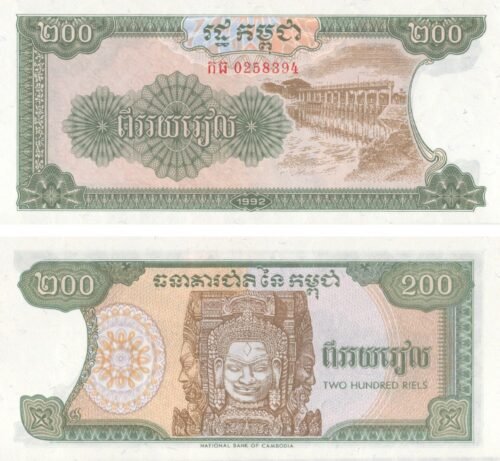
Cambodia 200 Riels 1992, P-37, UNC
3,99 € -

Cambodia 100 Riels 1998, P-41b(2), UNC
1,49 € -

Cambodia 200 Riels 1995, P-42a, UNC
2,49 € -

Cambodia 200 Riels 1998, P-42b(1), UNC
2,49 € -

Cambodia 500 Riels 1996, P-43a, UNC
2,49 € -

Cambodia 15000 Riels 2019, P-72, UNC
8,99 € -

Cambodia 30000 Riels 2021, P-73, UNC
17,99 €
Selected References
- National Bank of Cambodia — Institutional History
- National Bank of Cambodia — Frequently Asked Questions and Currency History
- National Bank of Cambodia — Banknotes in Circulation
- National Bank of Cambodia — Previously Used Banknotes
- National Bank of Cambodia — Annual Report 2007
- National Bank of Cambodia — Annual Report 2009
- National Bank of Cambodia — Annual Report 2010
- National Bank of Cambodia — Annual Report 2013
- National Bank of Cambodia — Annual Report 2023