
National Banknote Printing Plant of Vietnam

Vietnam’s National Banknote Printing Plant is the state production facility associated with modern đồng banknotes and secure monetary printing. Official State Bank regulations place currency-production contracts and technical requirements within a controlled national framework.
Quick Facts
Official name: National Banknote Printing Plant
Alternative names: National Banknote Printing Plant of Vietnam; Nhà máy In tiền Quốc gia; NBPP
Country: Vietnam
Headquarters: Vietnam; the reviewed English-language official material does not publish a concise public visitor address
Established: Founding date not confirmed in the reviewed official public sources
Status: Active
Institution type: State banknote-printing plant
Ownership or parent: Operates within Vietnam’s state monetary-production framework under the State Bank of Vietnam
Official website: nbpp.com.vn
Institutional Identity
The plant is a specialised state producer, not the issuing authority. The State Bank of Vietnam determines monetary policy, note specifications and issuance, while production is carried out under controlled contracts and security rules.
Its Vietnamese name, Nhà máy In tiền Quốc gia, is commonly rendered in English as National Banknote Printing Plant. WBN uses the approved English printer term to keep product attributions consistent.
Vietnamese official material separates the State Bank’s regulatory and issuing powers from the execution of currency manufacture. Production orders specify quantities, technical standards, schedules, acceptance and secure delivery. This arrangement places the plant inside a tightly controlled state framework while preserving the conceptual distinction between the banknote’s issuer and its printer.
English translations of the plant name vary slightly, especially in catalogues and institutional documents. The approved WBN name is used as a stable access point; alternative wording is retained for search and cross-reference rather than treated as a new printer.
Historical Development
Vietnam used several printers during the long development of the đồng, including domestic facilities and foreign partners. Catalogue records increasingly identify the national plant on post-reunification and modern issues, with some series produced jointly or alongside overseas contractors.
The move to polymer banknotes in the 2000s required new substrates, printing systems and quality controls. The plant remains part of the active state infrastructure that supports contemporary Vietnamese currency.
Vietnam’s banknote production cannot be reduced to one uninterrupted plant history. Revolutionary, northern, southern and reunified monetary systems used different facilities and external suppliers. After reunification, domestic capacity expanded while Soviet and other foreign production continued on certain issues, producing a mixed attribution record.
The later transition to polymer required changes in handling, inks, print sequence and quality inspection. Vietnam adopted polymer across major circulating denominations while retaining paper for selected low values, so the plant’s modern output spans more than one substrate and manufacturing workflow.
Role in Banknote Production
The Banknote Book attributes numerous Vietnamese notes to the National Banknote Printing Plant and, for certain historical issues, records combined production involving the Soviet state printer. This confirms that printer identity must be taken from the individual catalogue entry.
WBN links the profile only to notes carrying a supported national-plant attribution. Being issued by the State Bank of Vietnam does not on its own establish the printer.
Catalogue evidence may name the national plant alone, a foreign printer, or a joint production arrangement. Those distinctions matter: they can separate varieties within the same year or connect a note with a particular stage of Vietnam’s industrial development. The WBN record should reproduce the supported attribution instead of simplifying every modern đồng note to domestic origin.
The plant also belongs to a broader supply chain involving substrate, security elements and central-bank approval. Manufacture at the national facility does not imply that every component was produced there.
Security and Technology
Modern Vietnamese notes employ layered offset and intaglio printing, serial numbering, transparent polymer windows on relevant denominations and machine-readable security. State Bank rules govern samples, technical standards, delivery and secure handling.
Public sources do not disclose sensitive production details, and this profile does not infer them. Technology is described only at the level visible on issued notes or documented by the monetary authority.
Polymer issues display transparent windows, complex offset backgrounds, raised intaglio elements, serial numbering and ultraviolet or optically variable features according to denomination. Paper issues use their own combinations of watermark, thread and print processes. These characteristics demonstrate production capability while remaining series-specific.
State regulations focus heavily on custody and acceptance because security includes material accounting as well as visual anti-counterfeiting. Public pages understandably omit plant layouts, tolerances and operational controls; absence of such detail should not be filled with assumptions.
For Collectors
For collectors, the plant attribution helps distinguish domestic production from foreign-printed Vietnamese issues. Substrate, date, signatures, serial prefix and the exact catalogue printer line should be compared.
Polymer and paper versions may share subjects while differing substantially in manufacture. Printer identity should therefore accompany, not replace, the note’s Pick variety and physical specifications.
Attribution is most reliable when the collector starts with the exact catalogue variety and checks whether the printer statement changes between otherwise similar entries. Serial prefix and date can help locate a print run, but neither should be used to infer a plant without a documented range.
On polymer notes, surface haze, ink disturbance and window scratches affect condition assessment differently from folds and fibre damage on paper. Those condition differences are useful, yet they are separate from determining the printer.
Banknotes Printed by National Banknote Printing Plant of Vietnam
-

Vietnam 2 Dong 1980, P-85, UNC
1,49 € -

Vietnam 5 Dong 1985, P-92, UNC
1,49 € -

Vietnam 200 Dong 1987, P-100c(1), UNC
1,49 € -

Vietnam 200 Dong 1987, P-100c(2), UNC
1,49 € -
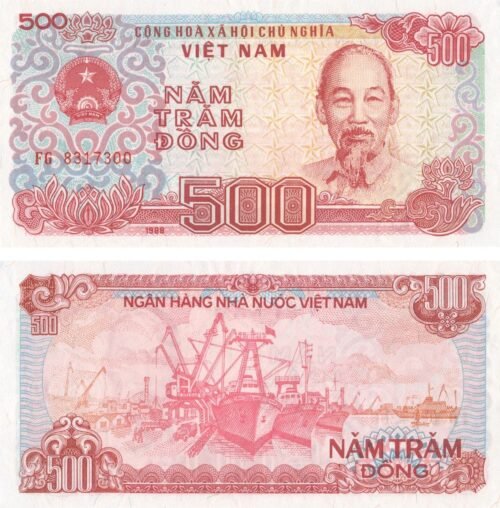
Vietnam 500 Dong 1988, P-101a(1), UNC
1,49 € -
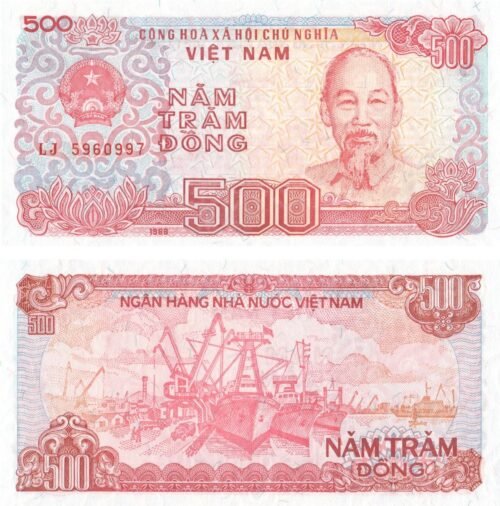
Vietnam 500 Dong 1988, P-101a(2), UNC
0,99 € -

Vietnam 100 Dong 1991, P-105a, UNC
1,49 € -

Vietnam 1000 Dong 1988, P-106a(1), UNC
0,99 € -

Vietnam 1000 Dong 1988, P-106a(2), UNC
1,49 € -

Vietnam 2000 Dong 1988, P-107a(1), UNC
0,99 € -

Vietnam 2000 Dong 1988, P-107a(2), UNC
1,49 € -

Vietnam 5000 Dong 1991, P-108, UNC
1,49 € -

Vietnam 10000 Dong 2014, P-119h, UNC
2,49 € -

Vietnam 10000 Dong 2019, P-119, UNC
2,49 € -

Vietnam 10000 Dong 2020, P-119, UNC
2,49 € -

Vietnam 10000 Dong 2023, P-119, UNC
2,49 € -

Vietnam 10000 Dong 2024, P-119, UNC
2,49 € -
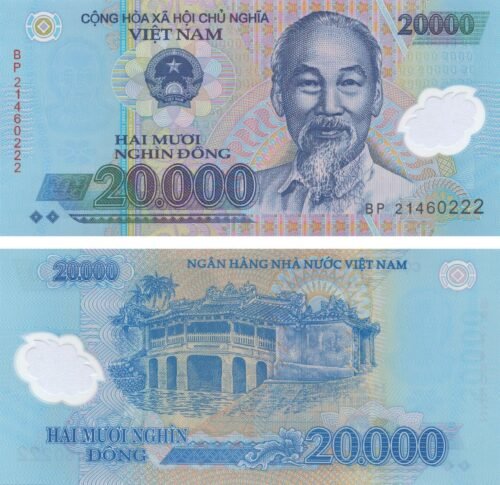
Vietnam 20000 Dong 2021, P-120, UNC
2,99 € -

Vietnam 20000 Dong 2022, P-120, UNC
2,99 € -

Vietnam 50000 Dong 2022, P-121, UNC
5,99 € -

Vietnam 100000 Dong 2021, P-122, UNC
11,99 €