
National Printing Bureau of Japan

Japan’s National Printing Bureau combines a public-service mandate with an unusually integrated banknote system, controlling papermaking, original engraving, printing, inspection and finishing for Bank of Japan notes.
Quick Facts
Official name: National Printing Bureau, Incorporated Administrative Agency
Alternative names: NPB, National Printing Bureau of Japan, Kokuritsu Insatsukyoku, Printing Bureau of the Ministry of Finance
Country: Japan
Headquarters: Toranomon Alcea Tower, 2-2-3 Toranomon, Minato City, Tokyo, Japan
Established: Institutional origins on 27 July 1871 as the Paper Money Office; first domestically produced modern paper money in 1877; current incorporated administrative agency from 1 April 2003
Status: Active
Institution type: Public incorporated administrative agency manufacturing Bank of Japan notes and other national security products
Ownership or parent: Supervised by Japan’s Minister of Finance under the Act on the National Printing Bureau
Official website: npb.go.jp
Institutional Identity
The National Printing Bureau is Japan’s public banknote manufacturer. Its current legal form is an incorporated administrative agency supervised by the Minister of Finance. The Bureau manufactures Bank of Japan notes, but it does not issue them: the Bank of Japan is the issuer, while the Ministry of Finance determines key design matters after consultation with the Bank and the NPB.
NPB operates as a distributed public production network rather than a single plant. Its official organisation includes a head office, research institute and six plants. Banknote work is integrated from papermaking through printing and finishing, while other facilities produce passports, postage stamps, revenue stamps and the Official Gazette.
The institutional model gives NPB a direct research role. It develops printing machinery, authentication features and production-control methods within the same organisation that manufactures the notes. This integration is central to Japan’s banknote system, but the page still separates the roles of designer, issuer, manufacturer and policy authority.
Historical Development
The Bureau traces its origin to the Paper Money Office established under the Ministry of Finance on 27 July 1871. Early modern Japanese notes were initially printed abroad because domestic security-printing technology was not yet mature. The state then built its own papermaking and printing capacity, and in 1877 the Bureau produced Japan’s first domestically manufactured modern paper money.
The organisation passed through several names and administrative forms. Papermaking capacity developed at Oji, new plants were added across the country, and a dedicated research institute was established in 1909. War, earthquake damage and post-war reconstruction changed the production geography, but the state printing lineage remained continuous.
On 1 April 2003 the institution became the National Printing Bureau, Incorporated Administrative Agency. The 2024 redesign of the 10,000-, 5,000- and 1,000-yen notes demonstrates that this legal transition did not reduce its core monetary role. The present Bureau remains responsible for manufacturing the country’s banknotes under public supervision.
Role in Banknote Production
NPB’s documented production sequence begins with design and original-plate work, continues through platemaking, printing, application of specialised features, inspection, cutting and finishing, and is supported by in-house papermaking. The Bureau also develops banknote-printing machinery and applies strict control to each stage.
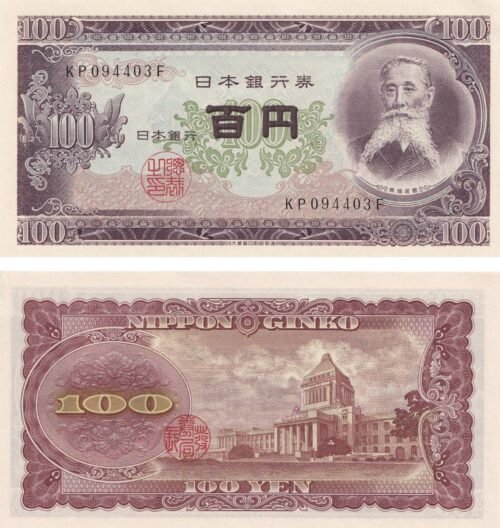
WorldBanknotes.eu currently links the National Printing Bureau to the Series-B 100 yen note first issued on 1 December 1953. NPB’s own banknote database confirms the issue date, Taisuke Itagaki portrait, National Diet Building reverse, dimensions and withdrawal date. The printer attribution is supported by the Bureau’s continuous role in manufacturing Japanese notes since the nineteenth century.
The note should still be catalogued under the Bank of Japan as issuer. “National Printing Bureau” identifies the manufacturing institution, not the legal source of the monetary obligation. For current notes, the Ministry of Finance also participates in the design-authorisation process, further demonstrating why institutional roles must remain distinct.
Security and Technology
NPB describes Japanese banknotes as products created from first to last within its system. Traditional paper manufacture, watermarking, detailed line engraving and intaglio printing are combined with newer optical and machine-readable features. The Bureau’s research institute develops authentication technologies for both public recognition and machine processing.
In the production process, original plates are translated into hardened printing plates capable of withstanding extreme pressure. Printing is carried out on specialised equipment developed by the Bureau, followed on current series by processes such as hologram application and automated inspection. These capabilities describe the system, but feature attribution must remain tied to the correct series.
The 1953 100-yen note belongs to an earlier technical generation. Its value lies in comparing post-war engraving, paper and serial presentation with later Series-C, Series-D, Series-E and 2024 notes. Such comparison reveals technological development without projecting modern holographic or accessibility features backwards onto an older issue.
For Collectors
The National Printing Bureau provides one of the strongest documentary environments available to collectors. Its official database records issue dates, dimensions, portraits, reverse subjects and withdrawal dates, while its history explains the institutional and technological background of domestic production.
The Series-B 100-yen note can be examined as part of Japan’s post-war monetary reconstruction. Collectors should study portrait engraving, the National Diet Building reverse, paper texture, watermark, serial typography and circulation wear. Different printings or serial changes should be documented against recognised series references rather than inferred solely from colour.
The most reliable catalogue entry combines Bank of Japan as issuer, NPB as manufacturer and the official first-issue date. For authentication, use transmitted light, magnification and tactile examination as described in the WorldBanknotes.eu guide to banknote authentication.
Banknotes Printed by National Printing Bureau of Japan



Selected References
- National Printing Bureau — Bureau Overview
- National Printing Bureau — History
- National Printing Bureau — Characteristics of Banknotes
- National Printing Bureau — Banknote Production Process
- National Printing Bureau — Basic Information on Banknotes
- National Printing Bureau — Introduction to NPB Technology
- National Printing Bureau — New Bank of Japan Notes
- National Printing Bureau — 2025 Business Guide