
Nigerian Security Printing & Minting Plc

Nigerian Security Printing & Minting Plc is Nigeria’s principal domestic producer of banknotes, coins and high-security documents. Founded in 1963 and commonly known as The Mint, it has printed naira issues for the Central Bank of Nigeria while developing local secure-production capacity.
Quick Facts
Official name: Nigerian Security Printing & Minting Plc
Alternative names: The Nigerian Security Printing and Minting Company; NSPM Plc; The Mint
Country: Nigeria
Headquarters: Abuja, Nigeria, with production operations documented in Abuja and Lagos
Established: 1963
Status: Active
Institution type: State-controlled security printer and mint
Ownership or parent: Central Bank of Nigeria is the majority shareholder; official company and CBN sources describe federal public ownership
Official website: mintnigeria.com
Institutional Identity
NSPM is a state-controlled security-printing and minting company rather than a department of the central bank. The Central Bank of Nigeria is its majority shareholder and maintains direct quality oversight through its Mint Inspectorate.
The company’s remit extends beyond currency to passports, certificates, stamps and other protected documents. Banknote production nevertheless remains its most visible national function and the core reason its imprint matters to collectors.
Nigeria’s domestic currency-production policy gives NSPM a strategic role that is broader than an ordinary supplier relationship. The company maintains secure industrial capacity inside the country, while the Central Bank sets note specifications, places production requirements and releases finished currency into circulation. Official annual reporting identifies the Central Bank as the dominant shareholder, with the balance held within the federal public sector. This ownership structure supports close institutional oversight but does not remove the need to distinguish printer from issuer in a catalogue record.
The public-facing name The Mint can also cause ambiguity because the same organisation produces both notes and coins. On a banknote page, the printer field refers specifically to its security-printing work; it does not imply that the note was manufactured by a coin-minting process or at a particular site unless the source says so.
Historical Development
The company was established in 1963 as Nigeria built the institutions required for monetary independence. Domestic production reduced reliance on foreign printers and created a permanent national base for both paper money and coinage.
Facilities and machinery have been renewed across later decades. Central Bank reporting describes production in Abuja and Lagos and records installed banknote capacity measured in billions of notes per year, confirming an industrial operation rather than a ceremonial mint function.
The 1963 foundation followed independence and the creation of a national central bank, when locally controlled production was an important part of institutional consolidation. Nigeria nevertheless continued to use foreign printers for selected series and periods. Domestic capability and external contracting therefore coexisted, particularly when demand, redesign schedules or technical requirements exceeded available local capacity.
Central Bank reports describe an operating network in Abuja and Lagos and continued investment in production systems. Published figures for installed capacity demonstrate the scale required by Africa’s most populous country. They should be read as corporate production capability, not as proof that every note ordered in a given year was printed domestically.
Role in Banknote Production
The Banknote Book attributes numerous Nigerian issues to the Nigerian Security Printing & Minting Company or its standard abbreviations. These attributions cover multiple naira series and denominations, although foreign contractors also printed selected Nigerian notes.
WBN therefore treats NSPM as an issue-level printer term, not as an automatic attribution for every note issued by the Central Bank of Nigeria. A catalogue entry or other production record should support each assignment.
Across the naira series, a printer attribution can mark a genuine variety even when the portrait, denomination and date remain unchanged. Contract redistribution may produce different imprint conventions, paper behaviour or serial ranges. Catalogues sometimes abbreviate the company name in several forms; WBN normalises these forms to one approved term only after confirming that they refer to NSPM.
The company also prints protected state documents, but those contracts are not used as indirect evidence for currency. A banknote is linked to this profile only when an issue-specific catalogue, central-bank source or reliable production record names the company.
Security and Technology
Currency manufacture combines controlled artwork, plate and cylinder preparation, specialist inks, numbered production, inspection and secure finishing. Public CBN material also documents a Mint Inspectorate responsible for quality control and compliance at production sites.
Specific features vary by series and may include watermarks, embedded threads, optically variable elements and machine-readable properties. Their presence identifies the note technology, but does not by itself prove which plant produced an individual printing.
Industrial banknote output requires more than the visible application of ink. Sheet accountability, access control, secure storage, numbering integrity, spoilage destruction and final reconciliation form part of the production environment. The Central Bank’s own Mint Inspectorate is evidence of formal client supervision, while sensitive operating details appropriately remain outside public documentation.
Collectors may see the results in consistent registration, intaglio relief, sharp serials and correctly positioned threads or watermarks. These observations help assess authenticity and condition, but they cannot replace documented printer credit because more than one producer can work to the same central-bank specification.
For Collectors
For collectors, NSPM attribution helps separate domestic Nigerian printings from otherwise similar contracts placed abroad. Printer credit, date, signatures and security-feature configuration should be checked together.
Company naming changed in presentation over time, so catalogue abbreviations such as NSPM or NSPMC should be normalised cautiously. An issuing-bank name alone is not sufficient evidence of production by The Mint.
A useful attribution workflow begins with the precise issue reference, then compares signatures, date, prefix and security features with a recognised catalogue. The printer name should be recorded in its historical form but mapped to the approved WBN term. If two sources disagree, the product should remain unassigned rather than converting a likely domestic origin into a stated fact.
NSPM printings also illustrate why “local printer” is not a grade or rarity claim. A domestically printed note may be common, scarce or exist beside foreign-printed varieties; availability depends on the individual issue and not on the institutional prestige of The Mint.
Banknotes Printed by Nigerian Security Printing & Minting Plc
-
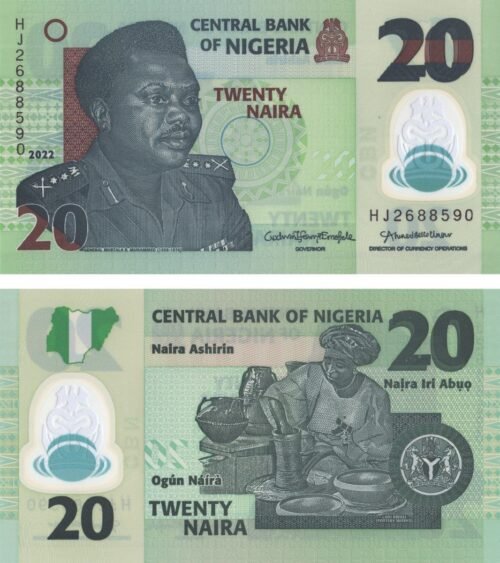
Nigeria 20 Naira 2022, P-34, UNC
1,49 € -

Nigeria 20 Naira 2024, P-34(2), UNC
0,99 € -

Nigeria 20 Naira 2025, P-34, UNC
0,99 € -

Nigeria 5 Naira 2016, P-38g, UNC
0,99 € -

Nigeria 5 Naira 2017, P-38h, UNC
0,99 € -

Nigeria 5 Naira 2018, P-38, UNC
0,99 € -

Nigeria 5 Naira 2020, P-38, UNC
0,99 € -

Nigeria 5 Naira 2024, P-38, UNC
0,99 € -
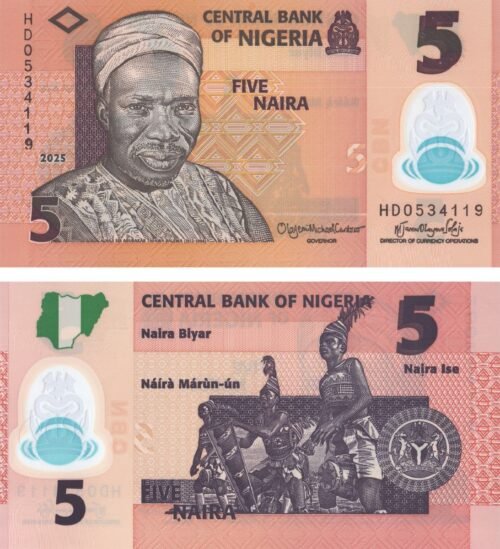
Nigeria 5 Naira 2025, P-38(1), UNC
0,99 € -

Nigeria 10 Naira 2019, P-39, UNC
0,99 € -

Nigeria 10 Naira 2022, P-39, UNC
0,99 € -
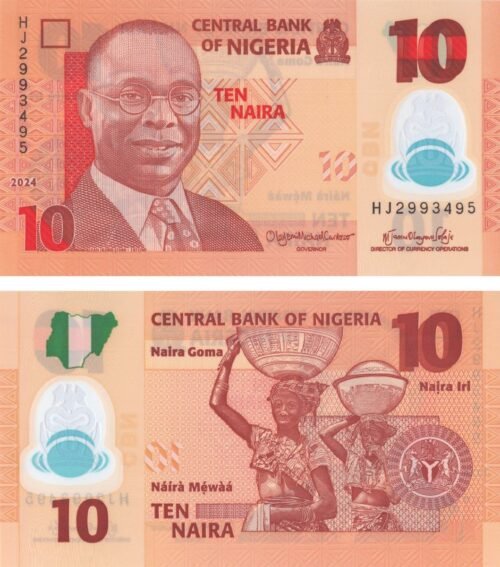
Nigeria 10 Naira 2024, P-39, UNC
0,99 € -
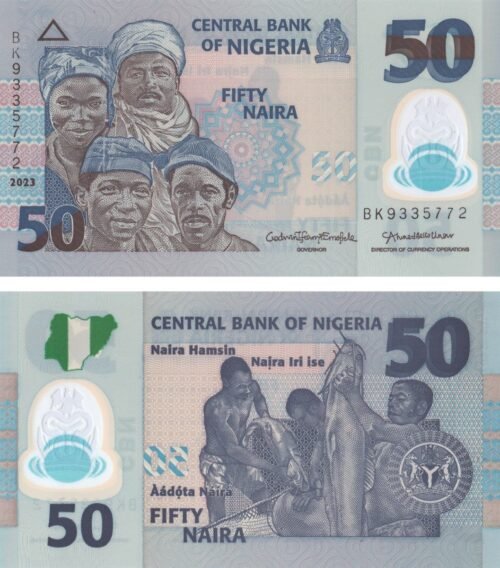
Nigeria 50 Naira 2023, P-40, UNC
1,49 € -

Nigeria 50 Naira 2024, P-40, UNC
0,99 € -

Nigeria 50 Naira 2025, P-40(2), UNC
1,49 € -

Nigeria 200 Naira 2023, P-47(2), UNC
3,99 € -

Nigeria 200 Naira 2026, P-47, UNC
2,49 € -
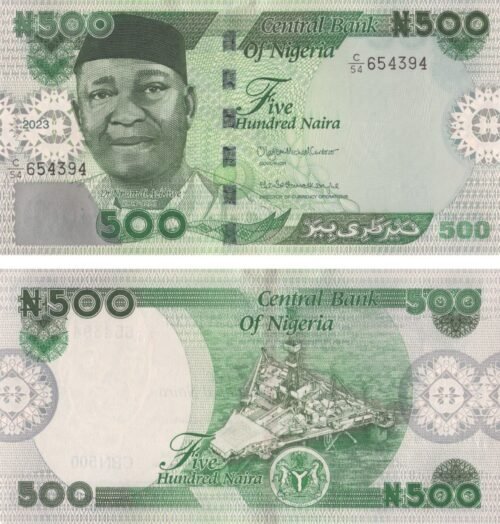
Nigeria 500 Naira 2023, P-48(2), UNC
3,99 € -

Nigeria 500 Naira 2025, P-48(2), UNC
2,49 € -
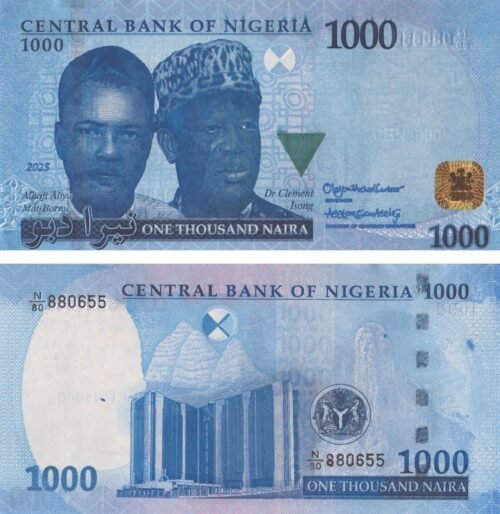
Nigeria 1000 Naira 2025, P-49(2), UNC
2,99 €