
Note Printing Australia

Note Printing Australia stands at the centre of the polymer-banknote revolution, transforming the Reserve Bank’s printing branch into a specialised producer for Australia and international customers.
Quick Facts
Official name: Note Printing Australia Limited
Alternative names: NPA, Note Printing Branch (predecessor)
Country: Australia
Headquarters: Craigieburn, Victoria, Australia
Established: 1990; separately incorporated in 1998
Status: Active
Institution type: Central bank-owned security printer
Ownership or parent: Wholly owned subsidiary of the Reserve Bank of Australia
Official website: noteprinting.com
Institutional Identity
Note Printing Australia Limited, usually abbreviated NPA, is the specialist banknote printer wholly owned by the Reserve Bank of Australia. It is based at Craigieburn, Victoria, where Australian banknotes are produced within a high-security industrial site. NPA is a printer rather than the issuing authority: the Reserve Bank of Australia determines and issues the nation’s banknotes, while NPA manufactures them.
The company’s identity is inseparable from polymer. Australia’s shift from paper to polymer required the printer to adapt design origination, inks, plate preparation, clear-window integration, inspection and finishing to a substrate with different behaviour from cotton-based security paper. NPA became the industrial arm that converted research and policy into circulating notes.
NPA has also produced banknotes and other security documents for export. These projects demonstrate that its expertise is not limited to Australian iconography or denominations, although polymer manufacturing remains the defining theme of its institutional history.
Historical Development
NPA developed from the Reserve Bank’s Note Printing Branch at Craigieburn. The branch’s technical and research capacity was expanded as Australia prepared its new polymer series. It was renamed Note Printing Australia in 1990 and became a separately incorporated, wholly owned subsidiary of the Reserve Bank in July 1998.
The decisive milestone preceded incorporation. Australia issued a commemorative polymer $10 note in 1988, testing technology developed jointly by the Reserve Bank and the Commonwealth Scientific and Industrial Research Organisation. The first complete polymer series followed between 1992 and 1996, making Australia the first country to convert its full circulating banknote family from paper to polymer.
NPA’s historical role therefore combines continuity and transformation. It inherited the responsibilities of a central-bank printing branch, but its modern identity was shaped by a new substrate and by export work. Reserve Bank annual reports from the late 1990s and 2000s describe NPA printing for Australia and other countries, while remaining under the Bank’s ownership and broad policy direction.
The company’s development should not be confused with substrate manufacture. Guardian® polymer substrate was historically supplied by Securency, while NPA printed the banknotes. The distinction between substrate maker and printer is fundamental to accurate attribution.
Role in Banknote Production
At Craigieburn, NPA converts polymer substrate sheets into finished banknotes through a sequence of highly controlled operations. The Reserve Bank describes the use of different printing plates, processes, machines and inks, with offset and intaglio contributing colour, detail and tactile structure. Clear windows are created in areas of the film left transparent before printing and feature integration.
Design and production are closely connected. For Australia’s current series, artistic concepts are translated into line structures and intaglio-ready elements suitable for high-pressure printing. Numbering, inspection, cutting and finishing follow, with security controls applied throughout the site and supply chain.
For export work, the same production capability is adapted to the customer’s approved design and specification. NPA should therefore be recorded as the printer only where documentation confirms that role. The use of polymer alone does not prove NPA production, because polymer technology and substrates have been adopted by many other printers.
Security and Technology
NPA’s defining technical contribution is the industrialisation of polymer banknotes. Polymer allows transparent windows, durable printed layers and the integration of security features that cannot be reproduced through ordinary paper-printing methods. It also changes wear patterns: folds, surface abrasion, ink adhesion and window condition become central to grading and authentication.
The Reserve Bank’s production description shows that polymer notes still depend on established security-printing disciplines. Offset provides background and colour structures, while intaglio creates raised, tactile elements. Special inks, plates, inspection systems and controlled finishing turn the polymer sheet into a monetary document.
Polymer should not be treated as a single uniform technology. Different generations can vary in opacifying layers, windows, applied devices, coatings and tactile features. NPA’s long experience makes the company an important reference point for studying how polymer moved from experimental issue to mature circulating substrate.
For Collectors
For collectors, Note Printing Australia offers a clear thematic route through the history of polymer money. Australian issues show the transition from the 1988 commemorative experiment to the first full polymer series and later generations with more complex windows and security devices. Export issues extend that story across different national designs.
Printer attribution should be separated from substrate attribution. A note printed on Guardian® or another polymer substrate was not necessarily printed by NPA. Conversely, NPA’s name may be documented even when no prominent printer imprint appears on the note. Central-bank publications and reliable catalogues are therefore often stronger evidence than visual inspection alone.
Condition assessment also differs from paper. Collectors should examine clear windows, surface scuffing, ink loss, creasing, edge deformation and coating wear rather than applying paper-only assumptions. NPA-linked notes are especially useful for comparing how polymer technology changes across countries, denominations and production generations.
Banknotes Printed by Note Printing Australia
-

Australia 1 Dollar 1983, P-42d, UNC
9,99 € -

Australia 2 Dollars 1985, P-43e, UNC
9,99 € -

Australia 5 Dollars 2021, P-62, UNC
8,99 € -

Australia 10 Dollars 2017, P-63, UNC
14,99 € -

Bangladesh 10 Taka 2000, P-35, UNC
3,99 € -
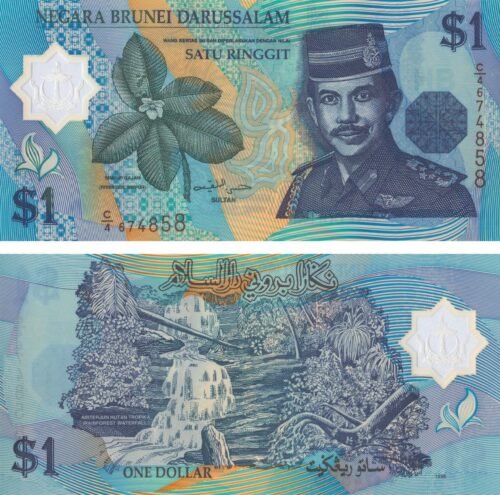
Brunei 1 Ringgit 1996, P-22a, UNC
4,99 € -
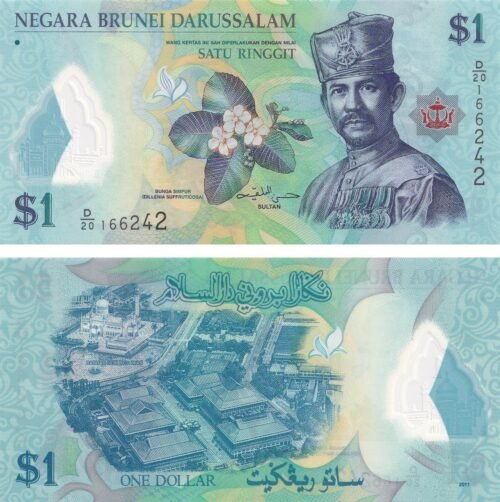
Brunei 1 Dollar 2011, P-35a, UNC
2,49 € -

Brunei 1 Ringgit 2013, P-35b, UNC
3,99 € -

Chile 1000 Pesos 2020, P-161j, UNC
3,99 € -

Chile 1000 Pesos 2021, P-161k, UNC
3,99 € -

Chile 1000 Pesos 2025, P-161l, UNC
3,99 € -

Chile 2000 Pesos 2015, P-162e, UNC
5,99 € -

Chile 5000 Pesos 2014, P-163e, UNC
12,99 € -
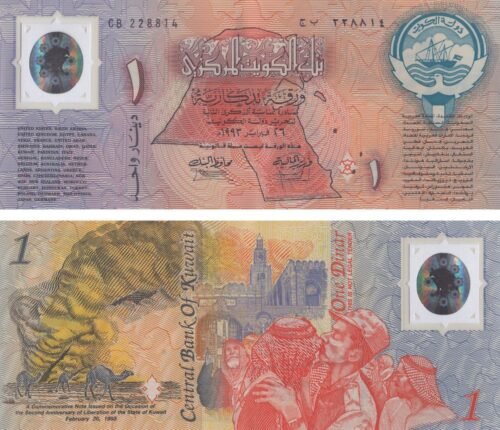
Kuwait 1 Dinar 1993, P-CS1, UNC
8,99 € -
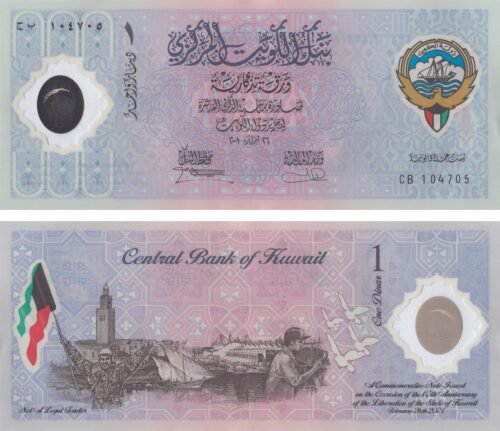
Kuwait 1 Dinar 2001, P-CS2, UNC
8,99 € -

Nepal 10 Rupees 2002, P-45, UNC
2,49 € -

Nepal 10 Rupees 2005, P-54, UNC
2,99 €