
Oumolat Security Printing

Oumolat is a young central-bank-owned printer built in Abu Dhabi to bring sovereign banknote manufacturing into the Gulf and to compete for high-security contracts across international markets.
Quick Facts
Official name: Oumolat Security Printing L.L.C.
Alternative names: Oumolat; Oumolat Security Printing LLC; عملات للطباعة الأمنية
Country: United Arab Emirates
Headquarters: KIZAD A4, Al Taweelah, Abu Dhabi, United Arab Emirates
Established: Founded in 2016; production facility officially opened in March 2017
Status: Active
Institution type: Central-bank-owned high-security banknote printer
Ownership or parent: Wholly owned subsidiary of the Central Bank of the United Arab Emirates
Official website: oumolat.com
Institutional Identity
Oumolat Security Printing L.L.C. is a high-security banknote manufacturer based in Abu Dhabi and wholly owned by the Central Bank of the United Arab Emirates. Founded in 2016, it was established as a domestic production centre for currency and as an export-oriented supplier to other central banks.
The company is not the issuing authority. The Central Bank of the UAE designs monetary policy, authorises denominations and issues UAE currency; Oumolat manufactures notes under the relevant production specification. The same distinction applies to foreign work: a central bank remains the issuer even when Oumolat performs all or part of the physical production.
Its emergence altered the geography of commercial banknote manufacture. Rather than sending every contract to the older European and North American centres, the UAE created an integrated regional facility in Khalifa Industrial Zone, positioned near major air and sea routes and designed for secure international logistics.
Historical Development
Oumolat was founded in 2016 and officially opened in March 2017. The opening announcement described it as the first banknote-printing plant of its kind in the Arabian Gulf and recorded the presentation of the first 1,000-dirham note printed by the company. From the beginning, the stated ambition extended beyond domestic production to services for central banks in the wider region.
The printer subsequently developed a visible international portfolio, including UAE polymer banknotes and export work. Its institutional status is unusually clear: official company material and industry records identify it as fully owned by the Central Bank of the UAE. That clarity makes it a useful contrast with printers whose legal ownership is obscured by holding companies or incomplete public disclosure.
Intergraf records Oumolat at ISO 14298 Central Bank level, with a current certification scope covering banknote manufacture. Certification is not a list of contracts or features, but it confirms that the plant’s security-management system is assessed against a specialist standard designed for the secure-printing industry.
Role in Banknote Production
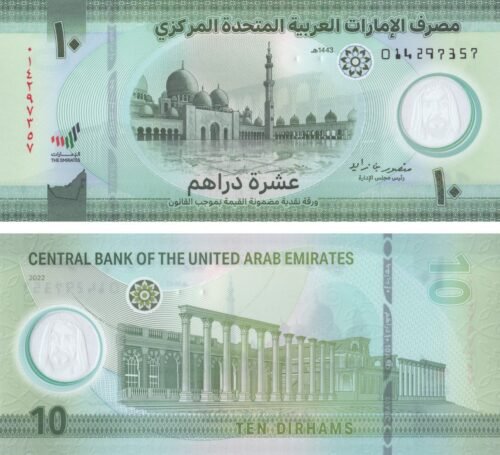
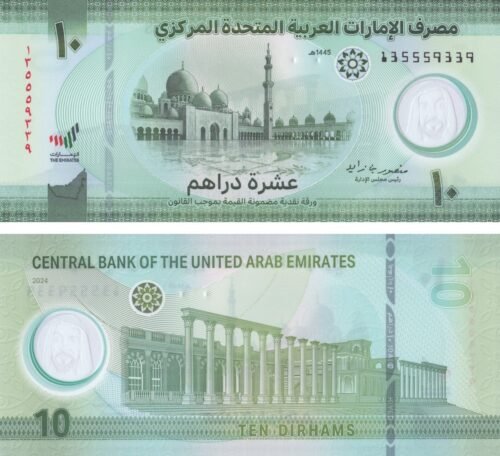
Oumolat has manufactured notes for the UAE and foreign issuers, sometimes within production chains involving external substrate, feature or design partners. A printer entry should therefore identify the actual manufacturing role without assigning every technology on the note to the printer itself.
WorldBanknotes.eu links Oumolat to Namibia’s 60-dollar polymer commemorative note honouring Hage G. Geingob. Bank of Namibia documentation establishes the official commemorative issue, while specialist production reporting states that two million notes were printed by Oumolat in Abu Dhabi under subcontract from De La Rue. This creates a layered attribution: Namibia is the issuer, Oumolat the physical printer, and De La Rue a contracting and technology partner.
That chain should remain visible in catalogue prose. ‘Printed by Oumolat’ is correct; ‘designed entirely by Oumolat’ or ‘an exclusively Oumolat technology platform’ would require separate evidence. Modern banknotes are often collaborative industrial objects in which design, substrate, security features, origination and print execution are distributed across several organisations.
Security and Technology
Oumolat’s plant is presented as a modern integrated high-security facility with controlled systems for banknote manufacture. Its ISO 14298 Central Bank-level certification covers the management of banknote-production processes, including the physical and organisational controls expected around sensitive materials, data, machinery, personnel and finished currency.
The Namibia 60-dollar note demonstrates a contemporary polymer specification. Official Bank of Namibia material identifies a commemorative note with advanced public-recognition features, while specialist production evidence connects the manufacturing run to Oumolat and the wider contract to De La Rue. The individual features should be attributed to the documented note specification rather than treated as universal Oumolat trademarks.
For collectors, polymer examination differs from paper. Clear windows, printed opacity, tactile intaglio, metallic or optically variable effects, microtext and ultraviolet response need appropriate lighting and angles. There is no traditional fibre-formed watermark in a polymer substrate; transparent and shadow-image features must be described by their actual construction.
For Collectors
Oumolat is significant because collectors can observe the formation of a major printer almost from its beginning. Its notes belong to a period when polymer, complex windows, outsourced technology partnerships and regional sovereign manufacturing are reshaping the industry’s older map.
The Namibian 60-dollar note is particularly instructive. It combines a singular commemorative denomination, a polymer substrate, a documented two-million-note production run and a multinational contract chain. Correct cataloguing should record all of those layers without allowing the printer field to absorb the roles of issuer, designer, substrate supplier or prime contractor.
When comparing Oumolat products, study the production signature rather than searching for a single house style. Registration, tactile relief, window integration, serial application and finishing quality may reveal consistency across contracts, while colour, imagery and feature selection remain primarily properties of each issuer’s specification.
Banknotes Printed by Oumolat Security Printing



Selected References
- Oumolat — Official Company Website
- Oumolat — Official Company Profile
- Government of Dubai Media Office — Opening of Oumolat
- Intergraf — Oumolat ISO 14298 Certification
- Bank of Namibia — N$60 Commemorative Banknote
- Namibia Government Gazette — Characteristics of the N$60 Note
- BanknoteNews — Namibia N$60 Printer and Contract Chain