
Pakistan Security Printing Corporation

Pakistan Security Printing Corporation is the country’s principal banknote printer and a wholly owned subsidiary of the State Bank of Pakistan. Established in Karachi in 1949 as a joint venture between the Government of Pakistan and Thomas De La Rue, it grew alongside the new state’s need for monetary and documentary sovereignty. Its production system extends from banknote printing and packing to prize bonds and related secure products, supported by domestic security-paper and ink partnerships. Recent plans for a new integrated paper and banknote facility show that PSPC remains an evolving industrial institution rather than a static post-independence relic.
Quick Facts
Official name: Pakistan Security Printing Corporation (Private) Limited
Alternative names: PSPC; Pakistan Security Printing Corporation Pvt. Ltd.
Country: Pakistan
Headquarters: Karachi, Pakistan
Established: 1949
Status: Active
Institution type: Central-bank-owned banknote and security printer
Ownership or parent: State Bank of Pakistan
Official website: pspc.gov.pk
Institutional Identity
PSPC is a specialised security-printing company whose principal monetary customer is the State Bank of Pakistan. Current official procurement documents identify it as a wholly owned subsidiary of the SBP and state that it is primarily responsible for producing banknotes to meet the central bank’s demand.
The corporation began on 10 March 1949 as a joint venture between the Government of Pakistan and Thomas De La Rue International. The partnership brought established security-printing knowledge into a country that had only recently become independent and needed reliable domestic production of its own currency and state documents.
Over time, the institutional structure changed. The State Bank acquired the banknote and prize-bond printing facility, while other security-printing functions were separated into a new company. The present PSPC therefore has a more focused relationship with currency production than the broader original enterprise.
The company also holds a major stake in Security Papers Limited, established in 1965 to reduce dependence on imported banknote paper. A separate ink-manufacturing joint venture was created in 1995 with SICPA. These relationships place PSPC within a wider national security-printing ecosystem rather than an isolated factory.
Historical Development
Pakistan initially depended on arrangements inherited from British India and on external printing. Establishing a domestic security printer was therefore both practical and symbolic. The 1949 joint venture gave the new state a controlled production base while drawing on De La Rue’s technical experience.
Successive expansion programmes increased capacity and broadened the product portfolio. The foundation of Security Papers Limited in 1965 was especially important because the substrate is one of the most sensitive and strategically significant components of a banknote.
In 1995, PSPC participated in the creation of a domestic banknote-ink manufacturer with SICPA. This reduced dependence on imported inks and added another layer of control over the security supply chain.
Corporate restructuring later separated the banknote and prize-bond production function from other secure-document activities. PSPC’s official description now emphasises its support for the State Bank’s currency-management policy, from printing and packing to scheduled delivery.
The corporation is planning a new facility near Faisalabad that combines security-paper manufacture with banknote production. Official tender documents describe an initial paper capacity of 3,000 tonnes per year, expandable to 6,000 tonnes, and two banknote production lines expandable to four. These are project specifications rather than completed operating capacities and should be described as planned.
The project signals a move towards deeper vertical integration, modern environmental standards and potential international work. Until it is commissioned, however, the historic Karachi operation remains the principal reference point for current PSPC production.
Role in Banknote Production
PSPC prints banknotes to the denominations, quantities and specifications ordered by the State Bank of Pakistan. It does not decide monetary policy or issue notes independently. Its responsibility is industrial: converting approved designs and technical requirements into secure, correctly counted and packaged currency.
The official corporate description states that production runs from printing to packing and must follow the indent and delivery schedule supplied through the SBP system. The printer therefore sits within a broader cash-management chain that includes forecasting, issue, distribution, fitness sorting and destruction.
Banknote production involves secure paper, background printing, intaglio or other relief processes, serial numbering, inspection, cutting and packing. The exact process and feature package vary by denomination and series. Public sources support the corporation’s broad capabilities but do not justify assigning every visible feature to a particular machine or supplier.
The relationships with Security Papers Limited and the domestic ink venture provide strategic support. They reduce dependence on imported critical inputs, although not every substrate or ink used in every series can be assumed to originate from those companies without specific evidence.
The WorldBanknotes.eu term currently has no linked products. The profile establishes the correct canonical printer for future Pakistani notes and separates PSPC from the State Bank as issuer and from National Security Printing Company’s other document work.
Security and Technology
PSPC’s security system combines protected materials, multi-stage printing, serial control and strict custody. The effectiveness of a banknote depends on the interaction of substrate features, printed design, optical responses and machine-readable properties.
Pakistan’s modern notes may include watermarks, embedded security threads, intaglio relief, microtext, see-through elements, optically variable ink and ultraviolet features. These should be verified note by note; the printer’s general capability does not prove that every denomination contains the same elements.
Domestic paper and ink partnerships are important because they bring sensitive production knowledge and supply closer to the issuing system. Security Papers Limited reduced dependence on imported substrate, while the ink venture addressed another specialised input.
Current project documents emphasise a new, environmentally responsible and sustainable facility with modern paper manufacturing and banknote lines. Because this project was still in procurement and design stages in the reviewed sources, the profile treats it as planned capacity rather than an existing accomplishment.
Security also includes packing and delivery. Finished banknotes must be counted accurately, reconciled with production records and transferred according to the State Bank’s schedule. A secure note that is poorly controlled after printing would still represent a failure of the monetary system.
For Collectors
For collectors, PSPC is the industrial counterpart to the State Bank of Pakistan. Separating printer from issuer clarifies how national note design, signatures and denominations were physically produced after independence.
The company’s history also helps interpret changes in paper, ink and security. Domestic supply-chain development did not occur at once; it was built through separate institutions and joint ventures over several decades.
Printer attribution can be combined with prefix, signature, date and design revision. Notes may remain visually similar while substrate or security details change, and a general PSPC attribution should not replace careful variety identification.
The planned new facility will eventually create another production chapter. Future collectors may be able to distinguish notes made under different plant and supply arrangements, but such attribution should wait for documented commissioning and note-level evidence.
Banknotes Printed by Pakistan Security Printing Corporation
-

Pakistan 1 Rupee 1977, P-24A(2), UNC
2,99 € -

Pakistan 1 Rupee 1994, P-27l, UNC
1,49 € -

Pakistan 1 Rupee 1996, P-27m, UNC
1,49 € -

Pakistan 5 Rupees 1976, P-28(1), UNC
2,49 € -
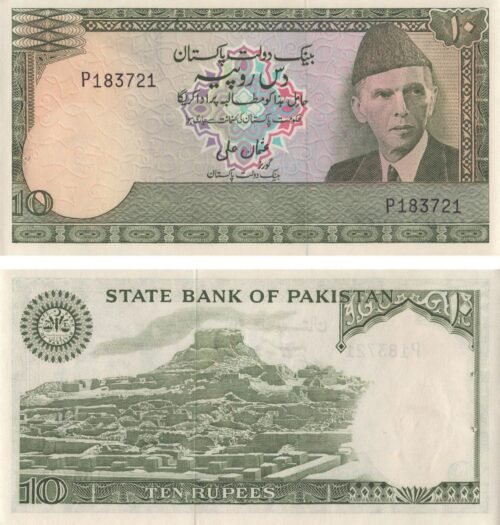
Pakistan 10 Rupees 1976, P-29(1), UNC
4,99 € -

Pakistan 2 Rupees 1985, P-37(1), UNC
1,49 € -

Pakistan 5 Rupees 1999, P-38(6-2), UNC
1,49 € -

Pakistan 10 Rupees 1999, P-39(6), UNC
2,49 € -

Pakistan 50 Rupees 2006, P-40(8), UNC
3,99 € -
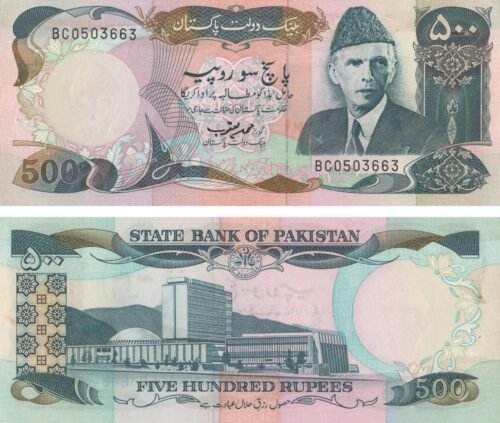
Pakistan 500 Rupees 1993, P-42(5), UNC
23,99 € -

Pakistan 5 Rupees 1997, P-44, UNC
3,99 € -

Pakistan 10 Rupees 2015, P-45j, UNC
1,49 € -

Pakistan 10 Rupees 2022, P-45(2), UNC
0,99 € -
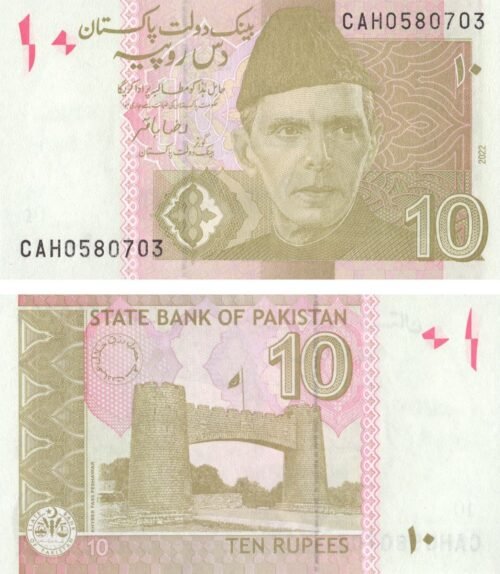
Pakistan 10 Rupees 2022, P-45(1), UNC
0,99 € -
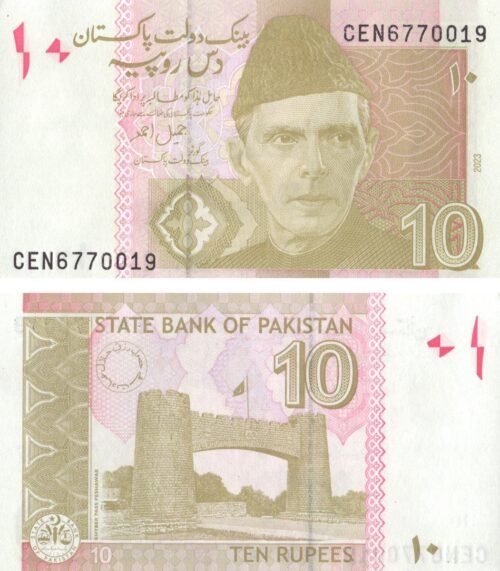
Pakistan 10 Rupees 2023, P-45, UNC
0,99 € -
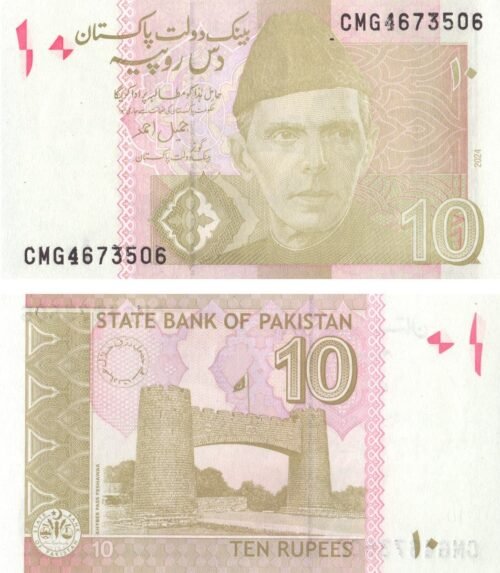
Pakistan 10 Rupees 2024, P-45, UNC
0,99 € -
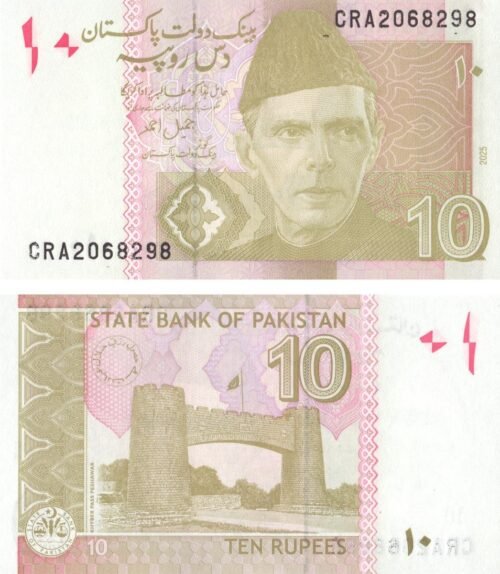
Pakistan 10 Rupees 2025, P-45, UNC
0,99 € -

Pakistan 20 Rupees 2005, P-46a, UNC
2,49 € -

Pakistan 50 Rupees 2021, P-47, UNC
2,49 € -

Pakistan 100 Rupees 2021, P-48, UNC
3,99 € -

Pakistan 5 Rupees 2009, P-53b, UNC
1,49 € -

Pakistan 20 Rupees 2022, P-55(1), UNC
1,49 € -
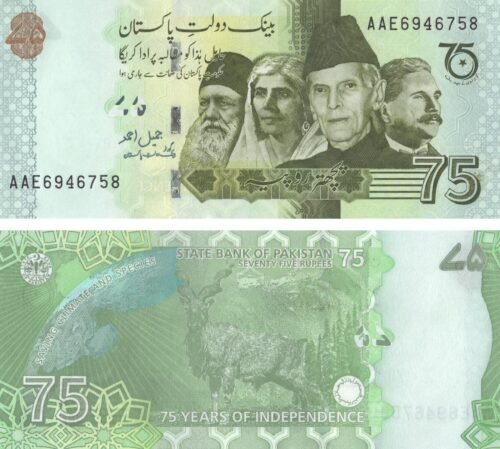
Pakistan 75 Rupees 2022, P-56(2), UNC
2,49 € -

Pakistan 75 Rupees 2023, P-57, UNC
2,49 €