Pénzjegynyomda

Pénzjegynyomda is Hungary’s central-bank-owned banknote printer, producing the forint through an integrated system that links secure design and intaglio printing with banknote paper from its DIPA subsidiary.
Quick Facts
Official name: Pénzjegynyomda Zrt. (Hungarian Banknote Printing Plc.)
Alternative names: Hungarian Banknote Printing Company; Hungarian Banknote Printing Plc.; HBPC
Country: Hungary
Headquarters: 1055 Budapest, Markó utca 13–17, Hungary
Established: 1925
Status: Active
Institution type: Central-bank-owned banknote and high-security printing company
Ownership or parent: Wholly owned by Magyar Nemzeti Bank; DIPA Diósgyőri Papírgyár Zrt. is its wholly owned security-paper subsidiary
Official website: penzjegynyomda.hu
Institutional Identity
Pénzjegynyomda Zrt., presented in English as the Hungarian Banknote Printing Company or Hungarian Banknote Printing Plc., is wholly owned by Magyar Nemzeti Bank. The MNB decides the denomination structure, authorises and issues the forint; Pénzjegynyomda manufactures the banknotes to the central bank’s orders. This issuer–printer distinction is explicit in MNB public information and is central to correct cataloguing.
The company is more than a banknote press. It produces secure paper and plastic documents, securities, banderoles and personalised products for domestic and international clients. Yet its defining monetary responsibility remains the reliable supply of forint banknotes in the quantity and quality required by the MNB.
A second attribution boundary runs through the group itself. DIPA Diósgyőri Papírgyár, the company’s wholly owned subsidiary, manufactures the specialist paper used for forint banknotes. Pénzjegynyomda prints the finished notes. A banknote can therefore be both printed by Pénzjegynyomda and made on paper produced by DIPA without those organisations being interchangeable.
Historical Development
The company was established in 1925 as the Hungarian central bank’s banknote-printing enterprise. Its milestone history records design and production of the pengő series from 1926, placing the printer at the beginning of Hungary’s interwar national currency production. The first forint banknotes after the Second World War were also produced within this institutional line.
The early 1990s brought major reconstruction and technological renewal to both the printer and Diósgyőr Paper Mill. According to the MNB, that investment enabled the later forint series to be produced with modern materials, technology and processes. This renewal should be treated as an industrial transformation, not a new foundation date.
The company reached its centenary in 2025. Contemporary MNB reports continue to describe banknote production as a priority activity, alongside secure documents and personalisation. The present Pénzjegynyomda is therefore both a historic national institution and an active industrial subsidiary within the central-bank group.
Role in Banknote Production
Pénzjegynyomda performs the physical manufacture of forint banknotes ordered by Magyar Nemzeti Bank. The process can include security-design translation, prepress, background printing, intaglio printing, numbering, inspection, finishing and secure packing. The company states that intaglio banknote printing is practised exclusively by it within Hungary.
The MNB remains responsible for the currency programme, protective-feature development, issue and withdrawal. This means a governor’s decree or issue date belongs to the central bank, while the printer’s role is the industrial execution of the approved specification. DIPA’s paper supply is another separate layer.
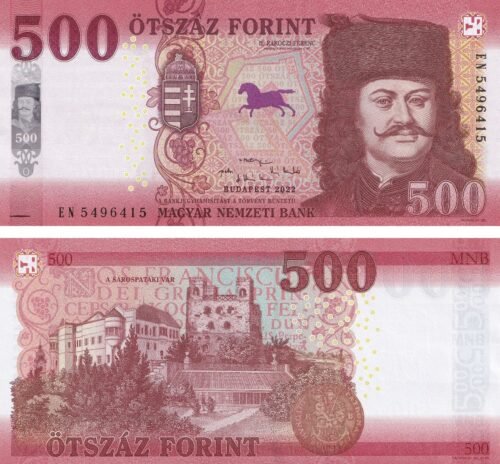
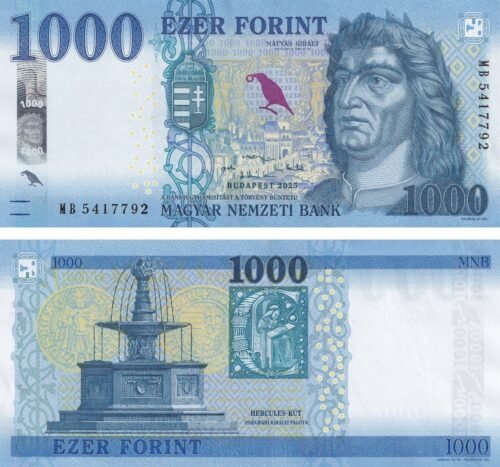
WorldBanknotes.eu currently links Pénzjegynyomda to the 500-forint note dated 2022 and the 1,000-forint note dated 2025. These are date varieties within the redesigned forint family rather than newly invented design systems. Their printer attribution is supported by the MNB’s statement that forint banknotes are produced by Pénzjegynyomda.
Security and Technology
Forint banknotes combine traditional engraved relief with modern optical and machine-readable elements. The current 500- and 1,000-forint designs include watermarks, embedded threads with microtext, holographic foils, colour-changing motifs, UV-responsive fibres and inks, microprinting, front-to-back register and tactile intaglio. These features are defined at note level by the MNB.
The production system is vertically coordinated but not organisationally collapsed. DIPA supplies security paper; Pénzjegynyomda integrates that substrate with printing and finishing; the MNB owns the currency programme and determines the security strategy. This separation prevents the common mistake of crediting the printer with every component or treating the paper mill as the finished-note manufacturer.
Collectors should also distinguish a banknote’s design generation from the year printed in the signature/date field. A 2025-dated 1,000-forint note can belong to the same redesigned type introduced earlier. Printer attribution remains stable unless evidence shows a change in production source.
For Collectors
Pénzjegynyomda offers a clear route through modern Hungarian currency history: pengő, early forint, the post-1990s reconstruction and the current redesigned series. The printer page can unite those stages while the catalogue keeps denomination, issue, year and signature varieties separate.
The 500- and 1,000-forint examples in WorldBanknotes.eu are useful for studying how a mature design is maintained across later printings. Compare serial structure, print sharpness, optical elements and date/signature combinations, but do not invent a new series simply because the year changes.
The strongest collector record names four elements independently: Magyar Nemzeti Bank as issuer, Pénzjegynyomda as finished-note printer, DIPA as banknote-paper manufacturer, and the exact dated variety. That structure preserves both institutional accuracy and practical catalogue value.