
Pertjetakan Kebajoran

Pertjetakan Kebajoran was one of the institutions through which independent Indonesia brought banknote production onto domestic soil. Bank Indonesia records N.V. Pertjetakan Kebajoran in Jakarta among the printers of its first banknotes, dated 1952 and issued from 1953; the Indonesian-language museum record specifies that the company printed part of the 10- and 25-rupiah denominations. Nationalisation and state reorganisation then transformed the printer into P.N. Percetakan Kebayoran, whose statutory purpose included printing banknotes and other securities for the government and the central bank. In 1971 it was merged with PN Arta Yasa to form Perum Peruri. For collectors, its imprint marks a formative stage in Indonesia’s transition from reliance on foreign security printers toward a national printing infrastructure.
Quick Facts
Official name: Pertjetakan Kebajoran
Alternative names: N.V. Pertjetakan Kebajoran; Percetakan Kebayoran P.T.; P.N. Percetakan Kebayoran; PN Pertjetakan Kebajoran; Perkeba
Country: Indonesia
Headquarters: Jakarta, Indonesia; historic Kebayoran operations
Established: Operational by 1953; nationalisation formalised in 1959 (effective 1 January 1958); reorganised as P.N. Percetakan Kebayoran in 1963; merged into Peruri in 1971
Status: Historic; merged with PN Arta Yasa into Perum Peruri on 15 September 1971
Institution type: Banknote and security printer; state enterprise from 1963
Ownership or parent: Nationalised by the Republic of Indonesia; P.N. Percetakan Kebayoran from 1963; direct predecessor of Perum Peruri
Institutional Identity
Pertjetakan Kebajoran was a specialist printing institution rather than an issuing authority. Its role was physical production: converting approved monetary designs into banknotes and other protected printed matter. Bank Indonesia’s museum identifies N.V. Pertjetakan Kebajoran in Jakarta as one of the printers used for the first Bank Indonesia banknotes, while later Indonesian legislation uses the modernised spelling Percetakan Kebayoran. For catalogue purposes these forms belong to the same institutional lineage, but the exact imprint and legal name visible on a note should be preserved when describing a specific issue.
The company’s legal position changed substantially during its lifetime. Government Regulation No. 51 of 1959 nationalised Percetakan Kebayoran P.T., with effect from 1 January 1958. Government Regulation No. 34 of 1963 then established P.N. Percetakan Kebayoran as a state enterprise, transferred to it the assets, rights and obligations of the nationalised company, and fixed its seat in Jakarta. The same regulation defined banknote and security-document printing for the Government and the Central Bank as a core field of business.
The 1963 charter also placed the duties of the company’s board with Bank Indonesia. This created a close institutional relationship between printer and central bank without making the printer itself an issuer. That distinction remains important in WorldBanknotes.eu: Bank Indonesia or the Government of Indonesia authorised and issued the notes; Pertjetakan Kebajoran manufactured documented issues.
Historical Development
The printer appears at a decisive moment in Indonesia’s post-independence monetary history. Bank Indonesia records that its first notes entered circulation in 1953 carrying the year 1952. Production was divided among several printers: Thomas De La Rue in the United Kingdom, Joh. Enschedé in the Netherlands and N.V. Pertjetakan Kebajoran in Jakarta. The Indonesian museum text is more specific, stating that Pertjetakan Kebajoran printed part of the Rp10 and Rp25 denominations. This mixed-printer arrangement is evidence of a transitional phase in which Indonesia was developing domestic capacity while still using established foreign security printers.
The private-company phase ended through nationalisation. Government Regulation No. 51 of 1959 formally subjected Percetakan Kebayoran P.T. to nationalisation, effective from 1 January 1958. The legal restructuring was completed by Government Regulation No. 34 of 1963, which created P.N. Percetakan Kebayoran, transferred the predecessor company’s assets and obligations to the new state enterprise, and confirmed Jakarta as its seat.
Under the 1963 framework, the company’s statutory field included printing banknotes and other securities for the Government and the Central Bank. Surviving Indonesian notes carrying Pertjetakan Kebajoran or P.N. Pertjetakan Kebajoran imprints document the printer’s continuing role through the 1960s, a period in which domestic note production became increasingly central to Indonesia’s monetary system.
The separate corporate identity ended in 1971. Government Regulation No. 60 of 1971 created Perum Percetakan Uang Republik Indonesia, or Peruri, by merging P.N. Pertjetakan Kebajoran with P.N. Arta Yasa. PERURI’s own corporate history identifies both enterprises as its direct predecessors. Pertjetakan Kebajoran should therefore be treated as a historical printer in its own right for pre-merger issues, not retrospectively relabelled as Peruri.
Role in Banknote Production
Pertjetakan Kebajoran’s documented function was the production of banknotes and other security printing for public monetary institutions. The 1963 state-enterprise charter explicitly lists the printing of banknotes and other securities for the Government and the Central Bank among its fields of business. This makes its role fundamentally different from that of an issuing bank: denomination policy, legal issue and circulation authority belonged to the state and Bank Indonesia, while the printer was responsible for manufacturing documented orders.
Printer attribution must remain note-specific. The first Bank Indonesia series is a clear example because production was split among three printing houses, and Bank Indonesia specifically attributes only part of the Rp10 and Rp25 production to N.V. Pertjetakan Kebajoran. A series name, design family or date alone is therefore not enough to assign the printer; the catalogue variety, printer imprint and specialist reference should be checked together.
Through the 1950s and 1960s the company became a key domestic link between Indonesian monetary design and physical production. Its importance lies not merely in the number of notes printed but in the development of a national security-printing capability that could serve both government low-denomination issues and Bank Indonesia banknotes. That industrial lineage passed into Peruri in 1971.
Security and Technology
Pertjetakan Kebajoran was established for security-sensitive work, and its 1963 statutory purpose explicitly covered banknotes and other valuable documents. Surviving notes attributed to the printer show the visual disciplines expected of banknote production: controlled multicolour registration, fine-line ornamental structures, serial numbering, complex denomination layouts and, on documented later issues, raised intaglio elements.
Care is required when turning visible banknote features into claims about the printer itself. Watermarks, security threads and specialised papers may involve external suppliers or specifications set by the issuing authority, so they should not automatically be described as technologies manufactured by Pertjetakan Kebajoran. Likewise, public primary sources located for this profile do not provide a complete press inventory, paper-supplier register or proprietary security-feature catalogue for the company’s operating years.
PERURI’s later corporate material preserves the continuity of this industrial heritage and notes that historical money-printing machinery forms part of its museum presentation. For Pertjetakan Kebajoran, however, the strongest technical evidence remains the surviving printed object and note-level attribution. This profile therefore distinguishes observable production characteristics from undocumented claims about equipment or proprietary processes.
For Collectors
For collectors, Pertjetakan Kebajoran is one of the most meaningful printer names in the early history of the modern Indonesian rupiah. Its imprint identifies the growth of domestic security printing during a period when Indonesia still relied partly on foreign firms such as De La Rue and Joh. Enschedé.
The 1952-dated first Bank Indonesia series is especially instructive because printer attribution can separate notes within the same design family. Bank Indonesia records that the series was shared among several printers and specifically identifies Pertjetakan Kebajoran with part of the Rp10 and Rp25 production. Such varieties allow a collection to be organised not only by Pick number, year or signature, but also by the industrial history behind the note.
Names and spellings matter. N.V. Pertjetakan Kebajoran, Percetakan Kebayoran P.T. and P.N. Percetakan Kebayoran reflect different legal phases and orthographic conventions. Collectors should follow the imprint and date rather than treating every form as interchangeable descriptive text.
The 1971 merger provides a firm chronological boundary. Notes produced before the merger should remain attributed to Pertjetakan Kebajoran when supported by the issue, while Peruri belongs to the successor period. Keeping that distinction intact preserves the transition from a formative domestic printer to Indonesia’s integrated national security-printing and minting corporation.
Banknotes Printed by Pertjetakan Kebajoran
-
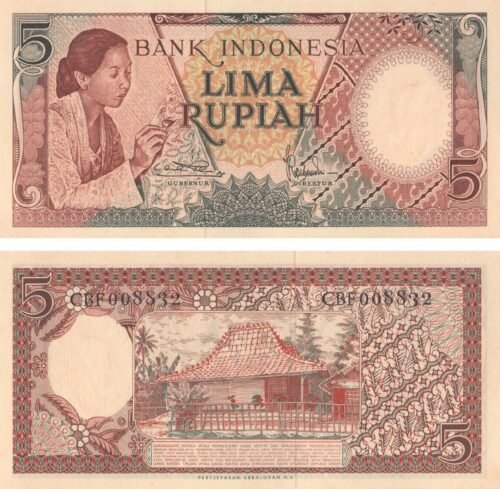
Indonesia 5 Rupiah 1958, P-55, UNC
5,99 € -
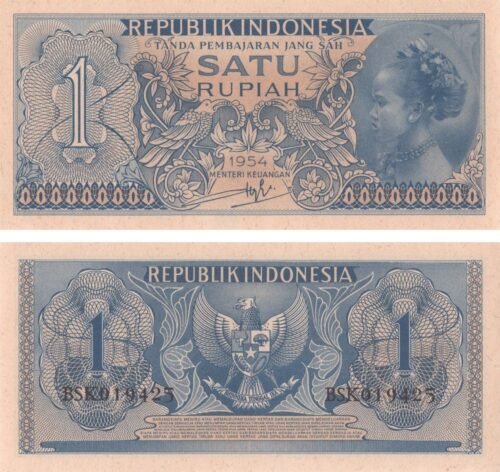
Indonesia 1 Rupiah 1954, P-72, UNC
5,99 € -

Indonesia 1 Rupiah 1956, P-74, UNC
3,99 € -

Indonesia 2½ Rupiah 1956, P-75, UNC
3,99 € -
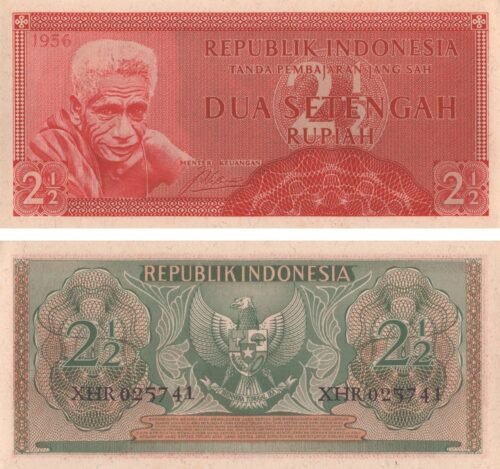
Indonesia 2½ Rupiah 1956, P-75r, UNC
5,49 € -
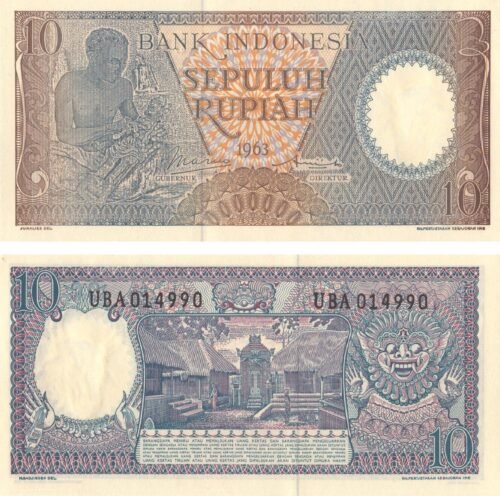
Indonesia 10 Rupiah 1963, P-89, UNC
5,99 € -

Indonesia 1 Sen 1964, P-90, UNC
0,99 € -

Indonesia 5 Sen 1964, P-91, UNC
0,99 € -
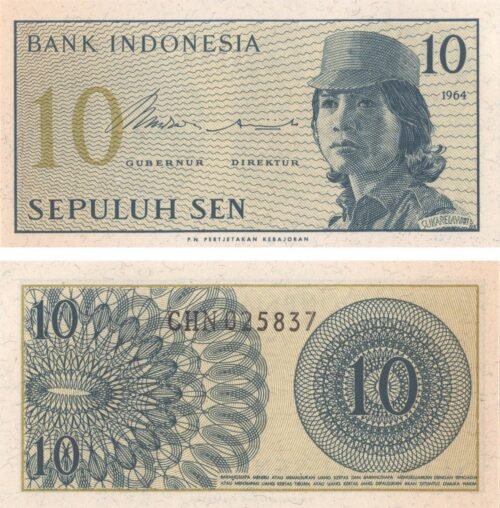
Indonesia 10 Sen 1964, P-92, UNC
0,99 € -

Indonesia 25 Sen 1964, P-93, UNC
0,99 € -
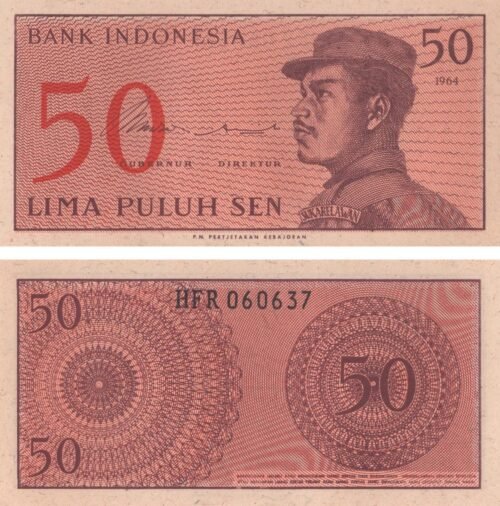
Indonesia 50 Sen 1964, P-94, UNC
2,49 € -

Indonesia 2½ Rupiah 1968, P-103, UNC
2,99 €
Selected References
- Bank Indonesia Museum — First Bank Indonesia Notes and Printers
- Bank Indonesia Museum — Indonesian-language Collection Record
- BPK Legal Database — Government Regulation No. 51 of 1959, Nationalisation of Percetakan Kebayoran P.T.
- BPK Legal Database — Government Regulation No. 34 of 1963, Establishment of P.N. Percetakan Kebayoran
- BPK Legal Database — Government Regulation No. 60 of 1971, Establishment of Perum Peruri
- PERURI — Company Profile and Corporate History
- PERURI — 2020 Sustainability Report and Establishment History