Reichsdruckerei

Reichsdruckerei was Germany’s imperial state printing office, created in Berlin in 1879 by merging two Prussian government printers. It produced banknotes, treasury paper and other secure state documents, forming the principal historical predecessor of today’s Bundesdruckerei.
Quick Facts
Official name: Reichsdruckerei
Alternative names: Imperial Printing Office; German Imperial Printing Office; Reich Printing Office
Country: Germany
Headquarters: Berlin, Germany
Established: 1879
Status: Historical; facilities were largely destroyed in 1945 and the institutional line continued after the war through successor state printers
Institution type: State security-printing office
Ownership or parent: German state
Official website: bundesdruckerei.de
Institutional Identity
The office combined the Geheime Ober-Hofbuchdruckerei with the Königlich-Preußische Staatsdruckerei. As a state producer, it printed for official issuers but did not itself define the monetary obligation shown on each note.
Its remit included currency, bonds, stamps, identity material and high-quality official publications. The breadth of this work made it a central technical institution of the German Empire and later state.
Reichsdruckerei’s creation consolidated two Prussian state-printing traditions into one imperial institution. Its clients included treasury and financial administrations, postal authorities and other public bodies. The office’s name on a printer record therefore describes manufacturer status inside government, not an issuing bank.
This structure helps explain why German paper money can combine a Reichsschuldenverwaltung issuer with Reichsdruckerei production. Both were state bodies, but one created the obligation and the other manufactured the document.
Historical Development
Founded in 1879, Reichsdruckerei inherited Prussian engraving and security-printing traditions. It supplied the expanding imperial administration and played an important role during wartime and inflationary demand.
The Berlin facilities suffered extensive destruction in 1945. Post-war organisations rebuilt the federal security-printing function, and Bundesdruckerei identifies the imperial office as a direct part of its historical lineage.
The 1879 merger gave the empire an integrated source for protected documents and high-quality official printing. Reichsdruckerei carried this function through imperial Germany, the First World War and the Weimar period, when extraordinary monetary demand tested production systems.
Destruction at the end of the Second World War broke the physical continuity of the Berlin works. Post-war federal security printing was rebuilt under successor structures, eventually becoming Bundesdruckerei. The lineage is real, but historical notes should retain the printer name current when they were made.
Role in Banknote Production
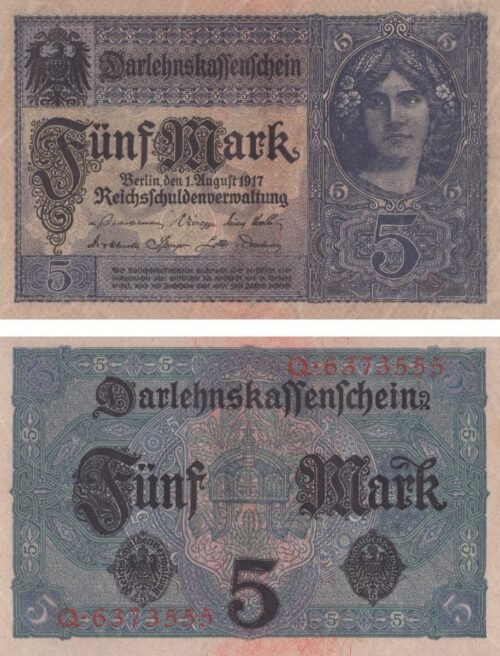
The Banknote Book attributes Germany’s 1917 5-mark note and other state issues to Reichsdruckerei. The printer served several legal categories of money, including notes issued by the Reichsschuldenverwaltung and other public authorities.
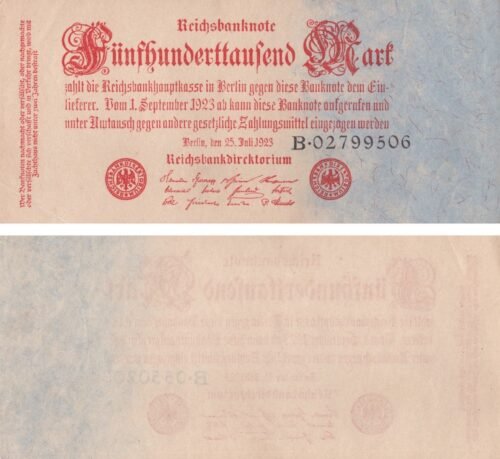
WBN records printer and issuer separately. A Reichsdruckerei product can be a treasury note rather than a Reichsbanknote, so the presence of the printer does not determine the issuing authority.
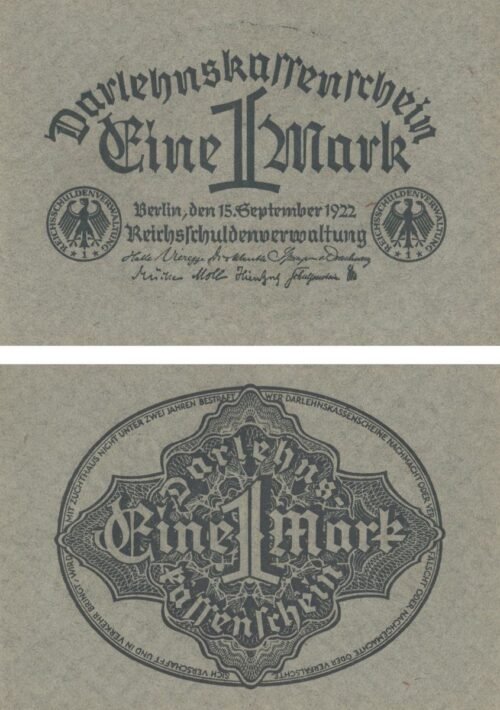
The office printed material for more than one German monetary authority and legal category. Reichskassenscheine, Darlehenskassenscheine and other state paper can share production techniques while differing in backing and issue law. Catalogue attribution must preserve both dimensions.
The 1917 5-mark issue sits within wartime currency expansion and is a direct WBN use case for the printer term. Similar denominations from the Reichsbank or regional emergency issuers require independent attribution.
Security and Technology
The office used engraving, complex guilloche, specialist paper, serial numbering and controlled plate production. These techniques supported both anti-counterfeiting requirements and the formal visual authority expected of imperial documents.
Production methods varied across decades and emergency conditions. Individual note features remain the correct basis for technical description.
Guilloche networks, engraved lettering, seals, watermarked paper and structured serials gave official notes layered protection. Large state facilities could coordinate these elements across bonds, stamps and money, building expertise through repeated secure commissions.
Wartime urgency sometimes reduced materials or simplified design, and later inflation demanded extraordinary output. Production context can explain variation, but the printer name cannot establish a specific watermark or process without note-level evidence.
For Collectors
For collectors, Reichsdruckerei attribution adds production context to German imperial and wartime notes. It should be paired with the exact issuer heading, date, legal text, watermark and serial format.
The historical link to Bundesdruckerei is institutional, not a reason to relabel old notes with the modern company name. Preserving Reichsdruckerei keeps the catalogue record faithful to the period.
A strong catalogue record separates the state printer from the legal issuer and records the exact document title. This prevents a treasury note printed by Reichsdruckerei from being listed as a Reichsbank obligation simply because both use marks and imperial symbolism.
Watermark orientation, serial prefix, signatures and law date can distinguish printings. The modern Bundesdruckerei connection is valuable institutional history, but it should remain in the profile rather than replacing the historical product attribute.