Rīgas Paraugtipogrāfija

Rīgas Paraugtipogrāfija was the Riga printing house that helped produce Latvia’s temporary rublis banknotes in 1992. Its work, carried out with the design and production enterprise LITTA, supported the country’s urgent exit from the Soviet rouble area.
Quick Facts
Official name: Rīgas Paraugtipogrāfija
Alternative names: Riga Model Printing House; Riga Sample Printing House; Rīgas Paraugtipogrāfija, Latvia
Country: Latvia
Headquarters: Riga, Latvia
Established: Founding date not confirmed in the reviewed official sources
Status: Historical printer attribution; current operating status under this exact name not confirmed
Institution type: Commercial or state-transition printing house documented in Latvia’s 1992 currency production
Ownership or parent: Not confirmed in the reviewed public sources
Institutional Identity
The Bank of Latvia identifies Rīgas Paraugtipogrāfija as a production partner for the Latvian rublis. The printing house was not the issuer: monetary responsibility remained with the restored central bank.
Public official sources document the currency project more clearly than the company’s wider history. WBN therefore keeps the profile centred on the verified 1992 role.
The Bank of Latvia’s historical account names both the printing house and LITTA, preserving a collaborative production model. LITTA is associated with the practical creation of the temporary notes, while Rīgas Paraugtipogrāfija supplied printing capacity. Neither replaces the central bank as issuer.
A separate company biography cannot be reconstructed confidently from the reviewed official record. The WBN page therefore gives priority to the documented currency project and explicitly marks unknown corporate details instead of turning a single contract into a speculative institutional history.
Historical Development
Latvia introduced the rublis on 7 May 1992 under severe time pressure. Simple, locally producible notes were needed first for parallel circulation and then as the country’s sole payment instrument from July.
Rīgas Paraugtipogrāfija worked with LITTA to turn the functional designs into currency. The temporary series was replaced by the lats in 1993, ending this particular banknote-production programme.
The monetary reform proceeded in stages. Latvian rubli first circulated at parity with Soviet and Russian roubles from 7 May 1992, became the only acceptable tender on 20 July and began giving way to the lats on 5 March 1993. Production had to serve each stage without delay.
The notes’ local manufacture was politically and practically significant. It gave Latvia a controllable supply while final lats designs were being prepared and foreign exchange conditions remained unstable.
Role in Banknote Production
Bank of Latvia historical material and The Banknote Book both connect the printing house with the 1992 rublis denominations. This convergence provides a strong attribution even though a detailed corporate archive is not publicly available.
The printer term should remain limited to the documented rublis notes. Later Latvian lats and euro production involved different arrangements and printers.
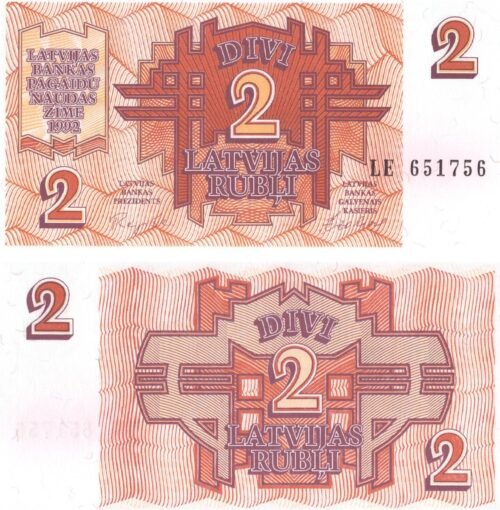
The printer is associated with the six standard rublis denominations released in 1992. Their common visual system and local production make them a coherent printer group, although individual serial or minor print distinctions can still require separate catalogue entries.
Later lats notes were printed through different arrangements, including major international security firms. Extending the Rīga printer attribution beyond the temporary rublis would erase that change in production strategy.
Security and Technology
The rublis notes were intentionally economical: large values, restrained colour and repeated graphic structures allowed rapid local manufacture. Serial numbering and controlled issue procedures supplied practical safeguards within a short-lived currency.
Their simplicity should be read as a design response to emergency transition, not as evidence that the notes lacked institutional control.
The rublis design emphasised fast recognition and reproducibility: large denomination figures, short text and restrained patterns. Limited complexity was appropriate for a currency planned as an interim measure and produced under tight deadlines.
Serial control and secure distribution remained essential even when elaborate portrait engraving or advanced threads were absent. The distinction between simple design and uncontrolled printing is important when evaluating the series.
For Collectors
For collectors, the printer attribution completes the story of the rublis as a locally produced bridge currency. Denomination, serial form and any minor print differences should be recorded alongside the printer.
Because the series lasted little more than a year, it forms a compact type set. Well-centred notes with clean surfaces show the sparse design and production quality most clearly.
A full rublis set documents the complete scale of Latvia’s temporary currency from low to high values. Printer context makes the set more than a group of similar notes: it records a domestic emergency-production achievement during restored independence.
Subtle shade or alignment differences should be described only when repeatable and catalogued. The known local printer does not justify inventing unofficial varieties from normal production tolerance.