
The Security Printing Corporation (Bangladesh) Ltd.

SPCBL turned Bangladesh’s dependence on imported currency production into a domestic security-printing system serving both the monetary authorities and a wide range of protected state documents.
Quick Facts
Official name: The Security Printing Corporation (Bangladesh) Ltd.
Alternative names: SPCBL; Security Printing Corporation; Bangladesh Security Printing Press
Country: Bangladesh
Headquarters: Shimultali, Gazipur-1703, Bangladesh
Established: Security press established in Gazipur in 1988; formally inaugurated in 1989; incorporated as a limited company on 22 April 1992
Status: Active
Institution type: Central-bank-owned banknote and high-security printer
Ownership or parent: Wholly owned subsidiary of Bangladesh Bank
Official website: spcbl.org.bd
Institutional Identity
The Security Printing Corporation (Bangladesh) Ltd., usually abbreviated SPCBL, is the wholly owned security-printing subsidiary of Bangladesh Bank. Its factory is located at Shimultali in Gazipur. Bangladesh Bank’s audited accounts identify the company as a fully owned subsidiary formed on 22 April 1992 for printing and supplying currency notes, while the physical security press itself had been established several years earlier.
This corporate relationship does not collapse the distinction between issuer and printer. Bangladesh Bank issues banknotes under the central-bank framework, while Bangladesh also distinguishes government currency notes at the lower end of the denomination structure. SPCBL is the physical manufacturer. The issuing legend and legal authority on each note must therefore be read independently from the printer’s identity, especially when comparing 2- and 5-taka notes with higher denominations.
SPCBL’s production remit is broader than circulating money. Official Bangladesh Bank material lists judicial and non-judicial stamps, postal and revenue stamps, tax labels, educational certificates, transcripts, cheque books, savings instruments and other security products. That breadth explains the institution’s industrial character: it is a protected state-printing complex whose equipment, access controls and quality systems serve several document classes, not a general commercial printer producing ordinary stationery.
Historical Development
The Government of Bangladesh authorised Bangladesh Bank to establish a domestic security press in 1988. The project was financed by the central bank and built in Gazipur to replace imported banknotes, currency notes and other protected materials with local production. Printing of 1- and 10-taka notes began before the formal inauguration in 1989, demonstrating that factory operation and ceremonial opening were separate milestones.
The present corporate form followed on 22 April 1992, when SPCBL was established as a limited company owned by Bangladesh Bank. This date is the legal incorporation point, not the origin of the factory. Official financial statements continue to consolidate SPCBL as a fully owned subsidiary and record note-printing costs paid by Bangladesh Bank to the company. The relationship is therefore operational and financial as well as institutional.
Production diversified alongside Bangladesh’s administrative and fiscal systems. By the early 2010s, Bangladesh Bank described large and growing volumes of banknotes and other security products, as well as commemorative-note work. Modernisation introduced new printing and finishing capacity, while current public tenders continue to refer to banknote equipment such as sheet-fed rotary numbering machines and machinery used in intaglio-roller preparation. These records support an active industrial status without requiring speculation about confidential press configurations or individual production runs.
Role in Banknote Production
SPCBL manufactures notes to the specifications and quantities authorised by the relevant issuing authority. The production chain can involve security paper and ink procurement, plate and cylinder preparation, offset backgrounds, intaglio, numbering, inspection, cutting and secure delivery. Public supplier-enlistment notices confirm that the company purchases specialist paper and inks; they do not prove that SPCBL manufactures those materials itself.
The WorldBanknotes.eu catalogue currently links SPCBL to 18 published Bangladeshi notes dated from 1996 to 2023. The group includes regular denominations and commemorative issues, offering useful evidence of the printer’s sustained role across changing designs. It should still be interpreted note by note. The presence of a familiar portrait, shared substrate or Bangladesh Bank legend cannot replace a documented printer attribution.
For lower denominations, terminology matters. Official sources use both ‘bank note’ and ‘currency note’, reflecting a legal distinction between central-bank and government issues. From a production perspective, both may pass through the same Gazipur works. From a catalogue perspective, however, issuer, signatures and legal wording must remain attached to the correct authority. WorldBanknotes.eu therefore treats SPCBL as printer metadata rather than as a substitute for the issuing-authority field.
Security and Technology
Bangladesh Bank’s institutional history records the use of Super Orlof intaglio and five-colour offset equipment in the development of the press. These technologies support complex multi-colour backgrounds, tactile relief and controlled register, but the exact sequence varies by note and generation. Current SPCBL notices concerning numbering and intaglio-related machinery show that specialised banknote processes remain part of the factory’s operating environment.
The security product is a system rather than a single feature. Paper composition, security threads, watermarks, coatings, serial-number controls, background line work and tactile printing can involve different suppliers and departments. An SPCBL attribution identifies the finished-note printer; it should not be expanded into unsupported claims that the company designed every feature or manufactured the substrate.
Collectors examining SPCBL output should compare registration, intaglio sharpness, numbering style and the interaction between paper and print. Security changes described by Bangladesh Bank, including modifications to watermark and thread systems, belong to specific note programmes. They should not be copied mechanically across all notes bearing the same printer attribution.
For Collectors
SPCBL provides a clear industrial framework for studying modern Bangladeshi money. The linked catalogue range covers nearly three decades, allowing comparison of recurring denominations, commemorative designs and changes in signature, date and security structure. This is more informative than treating the printer as a one-line production credit.
The strongest identification method combines official issuer material, reliable catalogue evidence and close examination of the note. A printer name may not be prominently displayed, and the factory’s ownership by Bangladesh Bank does not mean that every note is legally issued by the central bank. Collectors should record issuer, printer and date as separate facts, following the WorldBanknotes.eu guide to who issues banknotes.
SPCBL’s broader security-printing activity also gives context to quality and control. The same institution prints fiscal, judicial and educational documents, yet those products do not establish banknote attribution by analogy. A catalogue record should identify SPCBL only where the specific issue is supported, while feature descriptions remain tied to the physical note and its documented series.
Banknotes Printed by The Security Printing Corporation (Bangladesh) Ltd.
-

Bangladesh 10 Taka 1996, P-26c(3), UNC
2,49 € -

Bangladesh 10 Taka 2000, P-33(2), UNC
2,49 € -

Bangladesh 500 Taka 1998, P-34, UNC
32,99 € -

Bangladesh 5 Taka 2007, P-46Aa, UNC
1,49 € -

Bangladesh 5 Taka 2009, P-46Ab(2), UNC
2,49 € -

Bangladesh 10 Taka 2010, P-47c, UNC
1,49 € -

Bangladesh 2 Taka 2011, P-52a, UNC
0,99 € -

Bangladesh 2 Taka 2012, P-52b, UNC
0,99 € -

Bangladesh 2 Taka 2013, P-52c, UNC
0,99 € -

Bangladesh 2 Taka 2015, P-52d, UNC
0,99 € -

Bangladesh 2 Taka 2016, P-52e, UNC
0,99 € -

Bangladesh 2 Taka 2022, P-52, UNC
0,99 € -

Bangladesh 5 Taka 2012, P-53c, UNC
0,99 € -

Bangladesh 5 Taka 2014, P-53Aa, UNC
1,49 € -

Bangladesh 10 Taka 2014, P-54c, UNC
0,99 € -

Bangladesh 10 Taka 2023, P-54, UNC
0,99 € -
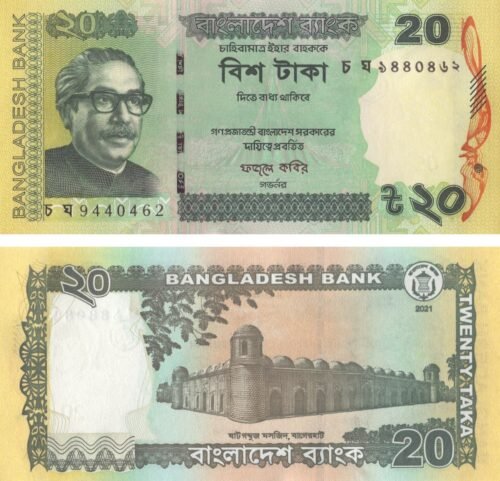
Bangladesh 20 Taka 2021, P-55A, UNC
1,49 € -
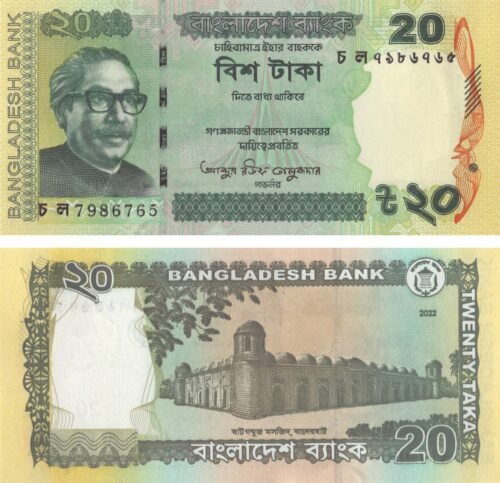
Bangladesh 20 Taka 2022, P-55A(2), UNC
1,49 € -
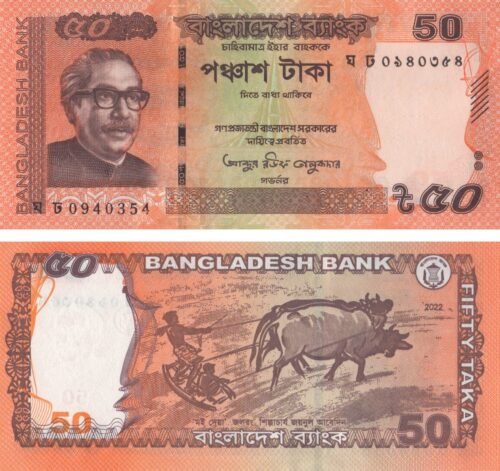
Bangladesh 50 Taka 2022, P-56A, UNC
2,49 € -
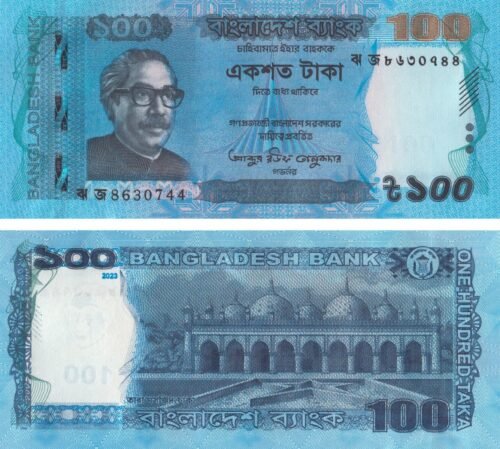
Bangladesh 100 Taka 2023, P-57, UNC
3,99 € -

Bangladesh 60 Taka 2012, P-61, UNC
2,99 € -

Bangladesh 100 Taka 2013, P-63, UNC
3,99 € -
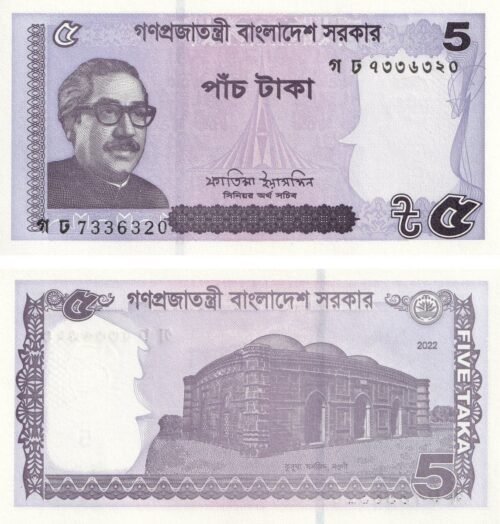
Bangladesh 5 Taka 2022, P-64A, UNC
1,49 € -

Bangladesh 100 Taka 2020, P-66, UNC
4,99 €