
South African Bank Note Company

The South African Bank Note Company created domestic rand-production capacity in 1961 and remains the Reserve Bank subsidiary responsible for manufacturing South Africa’s banknotes.
Quick Facts
Official name: South African Bank Note Company (RF) Proprietary Limited
Alternative names: South African Bank Note Company; SABN
Country: South Africa
Headquarters: Pretoria, Gauteng, South Africa
Established: 1958; domestic banknote production began in 1961
Status: Active
Institution type: Central bank-owned banknote printer
Ownership or parent: Wholly owned subsidiary of the South African Reserve Bank
Official website: resbank.co.za
Institutional Identity
The South African Bank Note Company (RF) Proprietary Limited, usually abbreviated SABN, is the banknote-manufacturing subsidiary of the South African Reserve Bank. It is a printer, not the issuer. The Reserve Bank holds the statutory authority to make, issue and withdraw South African currency, determines the note programme and security requirements, and places annual production orders; SABN manufactures the approved banknotes.
SABN is now wholly owned by the Reserve Bank. Its ring-fenced corporate form and restricted purpose reflect the sensitivity of banknote production, but the company remains legally and operationally distinct from the Reserve Bank’s Currency Management Department. It should also be kept separate from the South African Mint, another Reserve Bank subsidiary responsible for coins.
The company’s principal public role is the production of all South African banknote denominations. The Reserve Bank also states that SABN has printed for neighbouring countries. Those external contracts must be recorded issue by issue: regional origin or similarity to South African notes is not sufficient evidence of SABN manufacture.
Historical Development
Until the late 1950s, South African banknotes were generally printed abroad. In 1958 the Reserve Bank and the British security printer Bradbury Wilkinson established the South African Bank Note Company as a joint venture, with the specific objective of creating domestic banknote-production capacity. Factory premises were erected in Pretoria, and local manufacture began in 1961 as South Africa introduced the decimal rand.
The timing made the new printer part of a wider monetary transformation. The Reserve Bank had issued its first notes in 1922, but the 1961 conversion replaced the South African pound with the rand and required new denominations, designs and production arrangements. SABN supplied the industrial capability for that change while the Reserve Bank remained responsible for issue and monetary policy.
Bradbury Wilkinson’s shareholding was later acquired by the Reserve Bank, making SABN a wholly owned subsidiary. The printer then supported successive South African families—from early rand notes through the Big Five and Mandela series to the upgraded notes introduced in 2023. The institutional continuity should not conceal the scale of technical change between those issues: paper specifications, security threads, tactile systems, optical inks and public-authentication methods have all evolved.
Role in Banknote Production
The Reserve Bank manages the cash supply chain through its Currency Management Department. It forecasts demand, decides annual volumes and works with technical teams to determine the quality and security specification. SABN then produces banknotes against the annual order. Distribution, bulk issue, circulation quality and destruction remain Reserve Bank functions rather than printer responsibilities.
Manufacture covers the controlled sequence required to turn banknote paper into numbered, inspected and finished notes. Depending on the series, this includes background printing, raised intaglio, security-thread and watermark integration through supplied paper, specialised optical inks, microlettering, numbering, sheet inspection, cutting and secure delivery. A feature supplier or paper maker may contribute to the note without being the finished-note printer.
The WorldBanknotes.eu catalogue currently links SABN to South African ten- and twenty-rand notes dated 2015 and 2023. These examples span the Mandela series and its upgraded form. They can be studied against the general production sequence in How Banknotes Are Printed, while printer attribution remains separate from the Reserve Bank’s role as issuer.
Security and Technology
South African notes are built for public checking through the “Look, Feel and Tilt” method. Official descriptions identify cotton-based banknote substrate, raised intaglio, denomination watermarks, see-through registration, windowed threads, microlettering, tactile denomination marks and colour-changing optical effects. The 2023 upgrade added stronger visual differentiation and enhanced accessibility while retaining the established denomination structure.
SABN’s task is the reliable integration of that system at production scale. A thread must sit in the correct position and display the authorised text or holographic effect; the watermark and see-through register must align; raised print and tactile marks must remain legible after circulation; numbering and machine-readable characteristics must meet the approved specification.
No single device should be used as proof by itself. The WorldBanknotes.eu security-feature guide explains why authentication depends on agreement between material, print, transmitted-light and tilt features rather than one prominent patch or thread.
For Collectors
SABN provides a focused collecting field because its institutional history follows the development of the modern rand. The 1961 domestic-production milestone, successive portrait and wildlife themes, changes in governor signatures and the 2012 and 2023 Mandela designs allow collectors to trace monetary and technical change without leaving one national printing tradition.
The printer attribution must still be used carefully. A South African note is issued by the Reserve Bank and manufactured by SABN, but the paper, thread, optical pigment or design component may come from another specialist. Conversely, SABN’s documented work for neighbouring countries means that a foreign note may belong in the printer’s output even when no South African symbol appears on it.
Condition assessment should concentrate on the areas that carry both security and evidence of handling: raised print, tactile marks, windowed threads, watermark panels, see-through elements and corners. On the upgraded 2023 notes, collectors should also compare the denomination-specific animal registration shapes, microlettering and optical movement. The issue year, signature and exact security configuration are more reliable classifiers than a general resemblance to another SABN-produced note.
Banknotes Printed by South African Bank Note Company
-

South Africa 10 Rand 1975, P-113c, UNC
25,99 € -

South Africa 10 Rand 1975, P-114c, UNC
25,99 € -
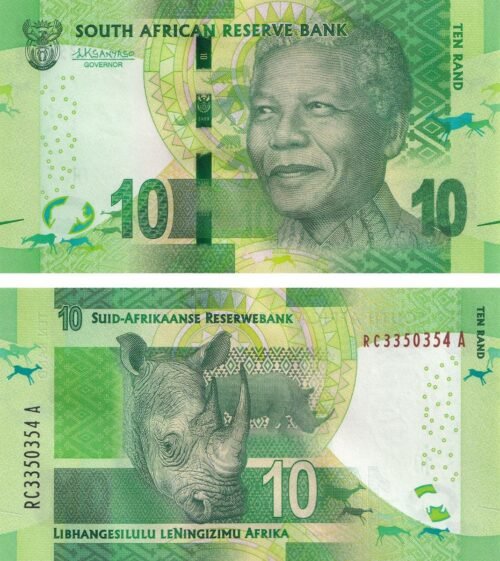
South Africa 10 Rand 2015, P-138b, UNC
3,99 € -

South Africa 50 Rand 2015, P-140b, UNC
10,99 € -
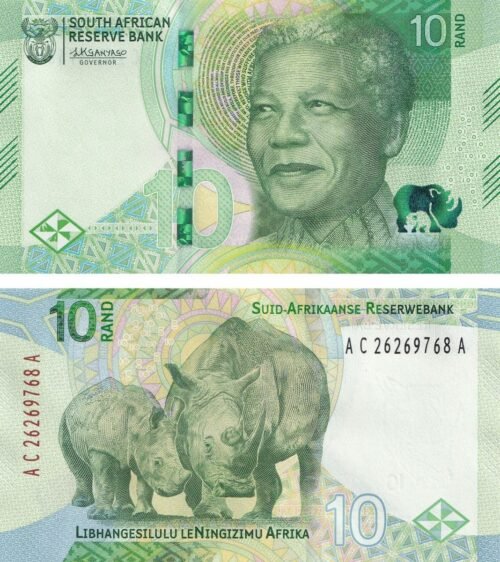
South Africa 10 Rand 2023, P-148, UNC
2,99 € -
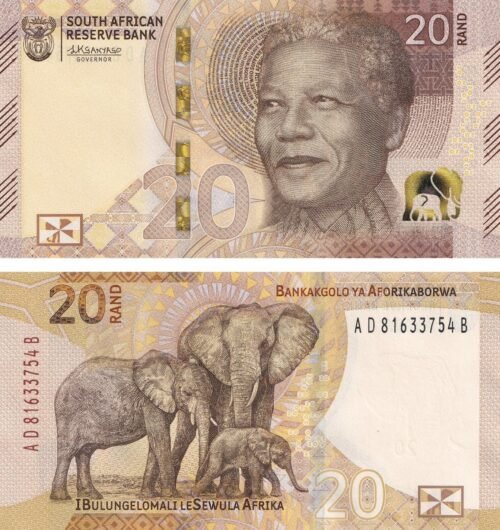
South Africa 20 Rand 2023, P-149, UNC
4,99 € -

South Africa 50 Rand 2023, P-150, UNC
8,99 € -
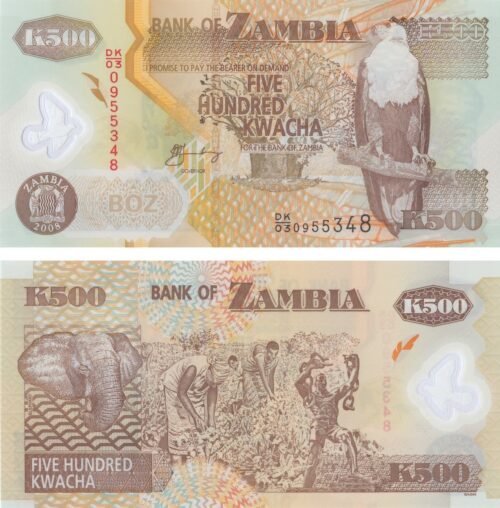
Zambia 500 Kwacha 2008, P-43f, UNC
2,99 €