
Security Printing and Minting Corporation of India

Security Printing and Minting Corporation of India Limited is the government-owned group that unites nine historic Indian security-printing, paper-making and minting units. Formed in 2006 through the corporatisation of production establishments previously managed directly by the Ministry of Finance, it includes the Currency Note Press at Nashik and Bank Note Press at Dewas. These plants form a distinct branch of India’s banknote system alongside the Reserve Bank-owned BRBNMPL presses at Mysuru and Salboni. SPMCIL’s identity is therefore both modern and inherited: a twenty-first-century corporation carrying production traditions that began with domestic note printing in 1928.
Quick Facts
Official name: Security Printing and Minting Corporation of India Limited
Alternative names: SPMCIL; Security Printing & Minting Corporation of India Limited
Country: India
Headquarters: New Delhi, India
Established: 2006; banknote-unit lineage from 1928
Status: Active
Institution type: Government-owned security printing and minting corporation
Ownership or parent: Government of India, Ministry of Finance, Department of Economic Affairs
Official website: spmcil.com
Institutional Identity
SPMCIL is a wholly government-owned company under the administrative control of the Department of Economic Affairs, Ministry of Finance. Management and operation of nine former government production units were transferred to the corporation with effect from 10 February 2006.
The group comprises four government mints, two currency-note presses, two security-printing presses and one security-paper mill. Its products include banknotes, security paper, stamps, passports, certificates, cheques, bonds, security inks, coins and precious-metal services.
For banknote cataloguing, the two relevant production units are Currency Note Press, Nashik, and Bank Note Press, Dewas. They are sister plants within SPMCIL but have different histories, equipment and production roles. The corporate term identifies the parent institution; a plant-level attribution is more precise when reliable evidence exists.
SPMCIL must also be distinguished from Bharatiya Reserve Bank Note Mudran Private Limited. BRBNMPL is owned by the Reserve Bank of India and operates Mysuru and Salboni. SPMCIL belongs to the Government of India and operates Nashik and Dewas. Both serve India’s currency needs, but they are not one printer.
Historical Development
India’s first major domestic currency-note press was established at Nashik in 1928. Official history records that the Government decided to end routine dependence on the Bank of England and constructed a secure printing complex near the railway at Nashik Road.
The first Nashik-produced 5-rupee notes entered circulation in October 1928. Additional denominations followed, and by the early 1930s the press had assumed production of notes that had previously been made in England. The facility later expanded and moved parts of its currency operation into a newer dedicated location.
Bank Note Press at Dewas was conceived in 1969 and established in 1974. Its first consignment of the new family of notes was delivered to the Reserve Bank in March 1975. The plant introduced modern intaglio and dry-offset capability and developed its own security-ink factory.
For decades, Nashik and Dewas operated as government units under the Ministry of Finance. In January 2006, SPMCIL was registered, and management of the nine units was transferred the following month. Corporatisation created a common board, investment framework and commercial structure while preserving state ownership.
Modernisation has continued. New banknote printing lines were inaugurated at Nashik and Dewas in 2022. These investments sit within a broader programme of updated security printing, paper, quality control and automation.
The corporate structure allows India to maintain multiple domestic sources of banknote production. This distributed capacity supports continuity and scale but makes careful printer attribution more complex for collectors.
Role in Banknote Production
SPMCIL prints Indian currency through CNP Nashik and BNP Dewas according to requirements placed by the Reserve Bank of India. The corporation is not the issuer. The RBI determines the monetary programme and demand; SPMCIL’s plants manufacture and deliver the required notes.
Nashik’s official profile describes complete pre-printing and offset facilities, intaglio machines, numbering, finishing and post-printing processes. Dewas lists design, engraving, plate making, offset, intaglio, numbering, finishing and an in-house ink factory.
The two plants should not be treated as visually interchangeable. They may print the same denominations or design families, but plant attribution depends on documented markers, catalogue evidence or production records. The corporate name alone cannot identify whether Nashik or Dewas made a particular note.
SPMCIL also operates the Security Paper Mill at Narmadapuram and security-ink capability at Dewas, giving the group a degree of vertical integration. Nevertheless, individual notes may involve materials from other domestic or external sources, and no blanket assumption should replace note-level evidence.
The WorldBanknotes.eu term currently has no linked products. The profile is needed to preserve the corporate parent while allowing future plant-level precision where the data supports it.
Security and Technology
SPMCIL’s banknote plants use layered security-printing processes. Offset establishes complex colour backgrounds and interlocking structures; intaglio creates raised portraits, inscriptions and tactile features; numbering provides individual control; inspection and finishing ensure that only conforming notes are delivered.
Dewas describes features including microtints, interlocking and see-through designs, latent images, fluorescent inks and optically variable inks. These capabilities are general plant technologies and should not be assigned to every denomination without checking the specific note.
The Dewas ink factory produces security inks for its own plant and other SPMCIL units. This internal capability supports colour control, confidentiality and supply resilience. Nashik’s scale and long experience provide a complementary production base.
Physical security is supported by the Central Industrial Security Force and by controlled transport arrangements. Nashik’s official material describes secure accounting and protected movement of currency consignments. Such systems are part of banknote security even though they leave no visible mark on the note.
Recent production-line investments show that the corporation is not relying solely on inherited machinery. Modernisation must maintain compatibility with new substrates, machine-readable features, inspection systems and the Reserve Bank’s changing requirements.
For Collectors
For collectors, SPMCIL is essential to understanding modern Indian printer attribution. A note may be issued by the Reserve Bank yet produced by one of four principal domestic plants belonging to two different state organisations.
The corporate distinction should come before plant-level speculation. SPMCIL means the Government-owned Nashik–Dewas branch; BRBNMPL means the RBI-owned Mysuru–Salboni branch. Only stronger evidence should narrow the attribution further.
Historic Nashik notes form a direct line from the end of routine Bank of England production to independent domestic manufacture. Dewas represents a later expansion into modern high-security printing and ink production. Together they allow collectors to trace industrial development across almost a century.
Inset letters, prefixes, signatures, dates and catalogue studies may help identify production varieties, but these indicators must be interpreted carefully. A printer profile should organise evidence, not turn uncertain conventions into facts.
Banknotes Printed by Security Printing and Minting Corporation of India
-

India 2 Rupees A 1985, P-53Ac(2), UNC
2,49 € -

India 2 Rupees B 1985-1990, P-79i, UNC
2,49 € -
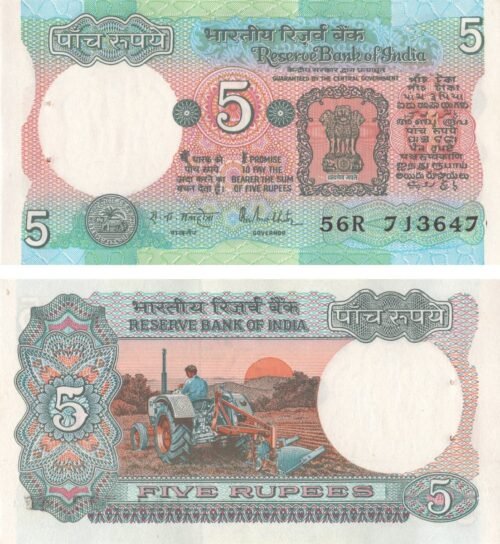
India 5 Rupees 1987-1990, P-80o, UNC
1,49 € -

India 5 Rupees R 2002-2003, P-88Ac, UNC
0,99 € -

India 5 Rupees E 2009, P-94Aa, UNC
1,49 € -

India 5 Rupees R 2011, P-94Af, UNC
1,49 € -

India 10 Rupees R 2009, P-95r, UNC
1,49 € -

India 20 Rupees E 2007, P-96c, UNC
3,99 € -

India 20 Rupees 2017, P-103x, UNC
2,49 € -

India 50 Rupees L 2015, P-104m, UNC
3,99 € -

India 10 Rupees 2017, P-109a, UNC
1,49 € -

India 10 Rupees 2024, P-109, UNC
1,49 € -

India 10 Rupees R 2025, P-109, UNC
1,49 € -
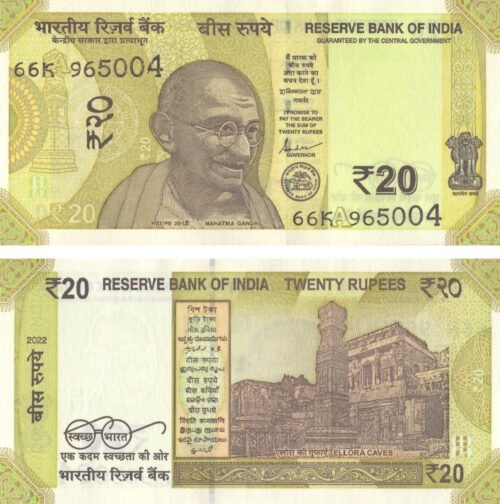
India 20 Rupees A 2022, P-110, UNC
1,49 € -

India 20 Rupees S 2022, P-110, UNC
0,99 € -

India 20 Rupees A 2023, P-110, UNC
1,49 € -
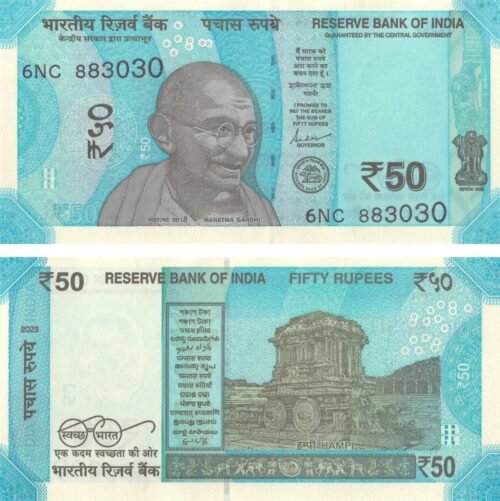
India 50 Rupees 2023, P-111, UNC
2,99 € -

India 100 Rupees F 2023, P-112, UNC
3,99 € -

India 200 Rupees R 2018, P-113, UNC
5,99 € -

India 500 Rupees C 2022, P-114, UNC
12,99 € -

India 1 Rupee L 2015, P-117a, UNC
0,99 € -
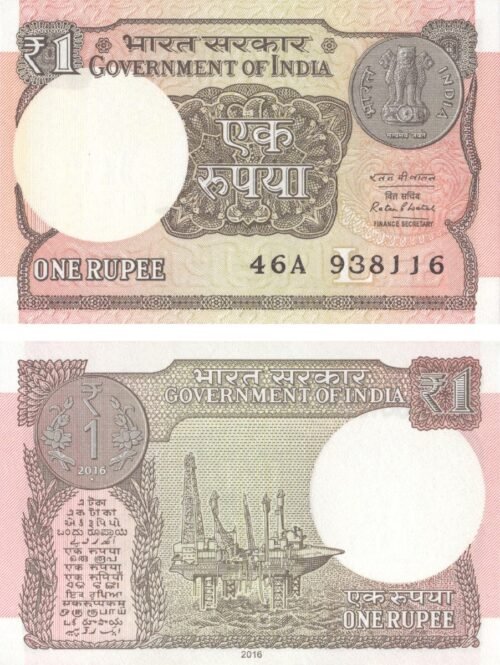
India 1 Rupee L 2016, P-117b, UNC
0,99 € -

India 1 Rupee L 2017, P-117c, UNC
0,99 €