

TAKAB is the printer attribution used in modern Iranian notaphily for a large group of twenty-first-century rial notes and Iran cheques, but official Central Bank of Iran material shows that the name belongs to the Security Paper Mill. That distinction is important: TAKAB is part of Iran’s domestic security-production system, while the Central Bank separately identifies the Security Printing and Minting Organization as the body executing all phases of banknote design and printing.
Quick Facts
Official name: Security Paper Mill (TAKAB)
Alternative names: TAKAB; Security Paper Mill
Country: Iran
Headquarters: Iran
Established: Active in contemporary Central Bank of Iran materials; documented as a current security-paper operation in the twenty-first century
Status: Active Central Bank of Iran security-paper operation
Institution type: Security-paper mill and collector-attributed banknote printer term
Ownership or parent: Central Bank of the Islamic Republic of Iran
Official website: cbi.ir
Institutional Identity
In official Central Bank of Iran material, TAKAB appears as the Security Paper Mill. The bank’s English-language banknotes-and-coins section states that paper banknotes, cheques and passport pages are produced by the Security Paper Mill, establishing TAKAB as an active element in Iran’s secure-document infrastructure rather than as a casual collector shorthand.
At the same time, the same official CBI source distinguishes TAKAB from the Security Printing and Minting Organization (SPMO), which it describes as executing all phases of designing and printing banknotes, cheques, Iran cheques and other security papers. That institutional separation is one of the most important facts about TAKAB and must be reflected clearly in any high-quality printer profile.
In catalogues and dealer descriptions, however, TAKAB frequently appears in the printer slot for Iranian notes. WBN preserves that usage because it is well established in notaphily and in the user’s own product data. But the page also explains the deeper structure: TAKAB is not simply a generic commercial printer name; it belongs to the Central Bank of Iran’s security-paper production ecosystem.
This dual identity makes TAKAB especially interesting. It is both a practical catalogue term for collectors and an institutional clue to how Iran localised sensitive stages of its banknote-production chain under central-bank control.
Historical Development
The reviewed official CBI material confirms TAKAB as a current security-paper operation but does not, in the accessible English pages located for this audit, publish a full stand-alone corporate history. That is why this profile is careful with chronology. It does not attempt to invent a detailed origin story beyond what current official material supports.
What can be said confidently is that TAKAB belongs to the modern era of domestic Iranian banknote production. It is associated in collector usage with later rial issues and Iran cheques, and it sits within a broader institutional framework in which the Central Bank of Iran controls issuance, secure paper and printing through linked specialised units.
This structure matters historically because it marks a shift away from understanding a banknote printer as a single monolithic factory. In Iran’s case, the publicly visible central-bank description divides responsibility: TAKAB is linked to security paper, while SPMO is linked to design and printing execution. The production story is therefore distributed across more than one official entity.
For notaphily, that distinction helps explain why the printer field can look deceptively simple. A catalogue may say “TAKAB,” but the underlying industrial reality is richer and more layered. The WBN page embraces that complexity rather than flattening it.
As additional verified official material becomes available, this profile can be expanded further. For now, its strength lies in precision: it records what the CBI openly states, aligns that with the collector term in current WBN use and avoids creating unsupported biographical detail for the mill.
Role in Banknote Production
TAKAB’s role in banknote production is best described as foundational but not solitary. According to the CBI, the Security Paper Mill produces paper banknotes, cheques and passport pages, while SPMO carries out all phases of design and printing for banknotes and related security documents. This means TAKAB belongs to the material-production side of the chain even when collectors encounter it as a printer attribution.
In practical numismatic cataloguing, that makes TAKAB a valid and useful term. It identifies a specific domestic Iranian production context and helps distinguish later rial notes from earlier periods printed by different arrangements. The term is therefore retained in WBN as a printer profile, but with an explicit explanation that the official institutional picture is more nuanced than a one-word printer label suggests.
The user’s current WBN import data already links TAKAB to a substantial group of Iranian notes, especially modern regular issues and higher denominations. Those notes belong to the era in which Iranian production became strongly associated with central-bank-controlled internal facilities rather than with foreign houses.
Because of this, TAKAB is an excellent example of why printer pages should do more than repeat a label. A good profile explains where the label sits inside the real production system, what it means and what it does not mean. TAKAB identifies a core production entity, but it should not erase the separate role of SPMO in designing and printing the finished banknotes.
Security and Technology
The official CBI description of TAKAB is concise but revealing. By stating that the Security Paper Mill produces paper banknotes, cheques and passport pages, it positions the facility within the high-security substrate and document-manufacturing chain. That alone signals a technically sensitive role, because secure paper is one of the essential anti-counterfeiting foundations of modern banknote production.
The parallel CBI description of SPMO then adds the second layer: all phases of designing and printing banknotes and related security papers are executed by that organisation. Read together, the two statements imply a production model in which secure paper and the finished printing process are institutionally connected but not identical. This is precisely the nuance collectors need.
For the notes themselves, the technical consequences are visible in watermark-bearing paper, embedded security features and the broad range of modern anti-counterfeiting devices used on Iranian notes and Iran cheques. This profile does not assign specific machine lines, fibres or thread-production systems to TAKAB unless they are explicitly documented by official sources; instead, it grounds the page in the verified institutional role and in observable banknote outcomes.
That controlled approach is especially important for Iran, where the temptation is strong to compress a multi-entity central-bank production system into a single printer name. WBN keeps the terminology usable for collectors without sacrificing institutional accuracy.
For Collectors
For collectors, TAKAB matters for two reasons. First, it is the name most often encountered as a printer attribution on modern Iranian issues. Second, it opens the door to a more sophisticated reading of how those issues were produced. A TAKAB attribution is not just a label; it points to a domestically controlled security-paper environment within the Central Bank of Iran system.
The biggest practical caution is not to overread the term. If a catalogue or dealer listing says “printed by TAKAB,” that should not automatically be understood as proof that the Security Paper Mill alone handled every stage from artwork to final sheet printing. The CBI’s own wording indicates a more distributed production structure involving SPMO as well.
This distinction does not reduce TAKAB’s importance. On the contrary, it makes the attribution more interesting. It helps collectors place modern Iranian notes in a production context shaped by domestic substrate capability, secure-document manufacture and central-bank coordination across multiple specialised units.
For WBN cataloguing, the best practice is to preserve the product printer term exactly as used — TAKAB, Iran — while using the printer page to explain the institutional context behind that term. That approach gives the collector both a stable taxonomy and a more truthful historical record.
Banknotes Printed by TAKAB
-

Iran 2000 Rials 2005, P-144a, UNC
0,99 € -

Iran 2000 Rials 2005-2013, P-144d, UNC
1,49 € -

Iran 10000 Rials 2007, P-146h, UNC
1,49 € -

Iran 10000 Rials 2015, P-146i, UNC
1,49 € -

Iran 5000 Rials 2009, P-150, UNC
2,49 € -

Iran 100000 Rials 2013, P-151b, UNC
2,49 € -

Iran 100000 Rials 2019, P-151e, UNC
2,49 € -

Iran 5000 Rials 2015, P-152b, UNC
0,99 € -
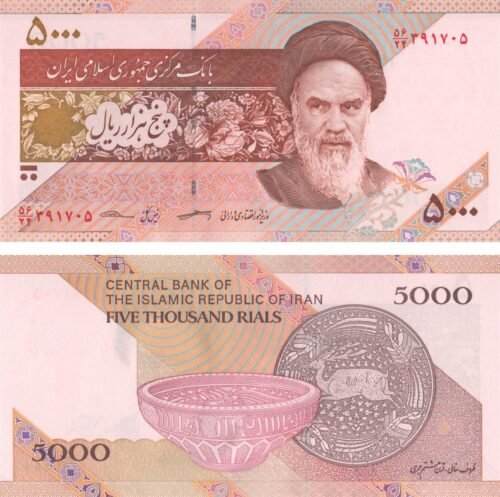
Iran 5000 Rials 2018, P-152c, UNC
0,99 € -

Iran 20000 Rials 2017, P-153b(1), UNC
0,99 € -

Iran 20000 Rials 2018, P-153c(2), UNC
0,99 € -

Iran 20000 Rials 2019, P-153d(2), UNC
0,99 € -
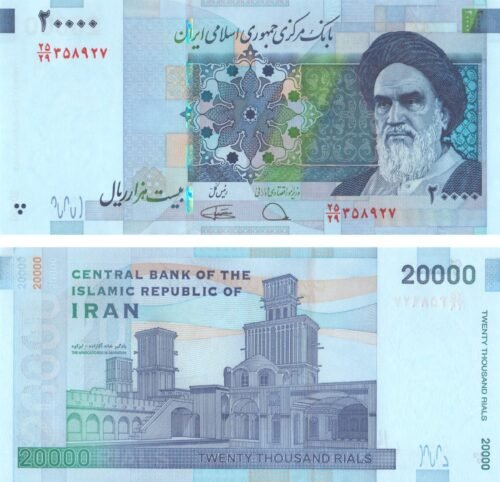
Iran 20000 Rials 2021, P-153e(1), UNC
0,99 € -

Iran 50000 Rials 2019, P-155(2), UNC
1,49 € -

Iran 10000 Rials 2018, P-159b, UNC
0,99 € -

Iran 10000 Rials 2019, P-159c, UNC
0,99 € -

Iran 10000 Rials 2022, P-160, UNC
1,49 € -

Iran 20000 Rials 2022, P-161, UNC
1,49 € -
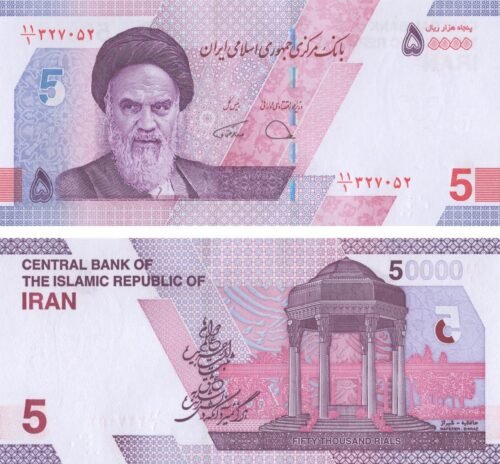
Iran 50000 Rials 2021, P-162(1), UNC
1,49 € -

Iran 50000 Rials 2023, P-162(3), UNC
0,99 € -

Iran 50000 Rials 2023, P-162(2), UNC
1,49 € -
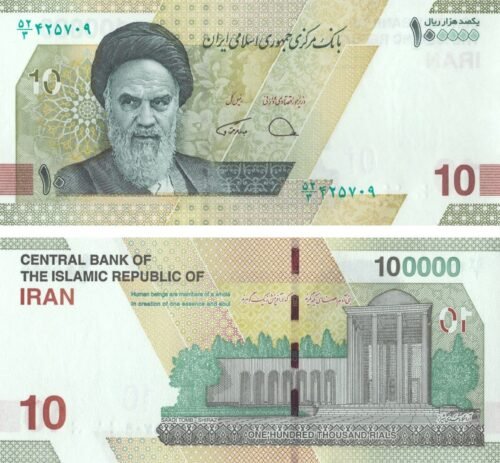
Iran 100000 Rials 2020, P-163(1), UNC
1,49 € -

Iran 100000 Rials 2021-2022, P-163(3), UNC
2,49 € -
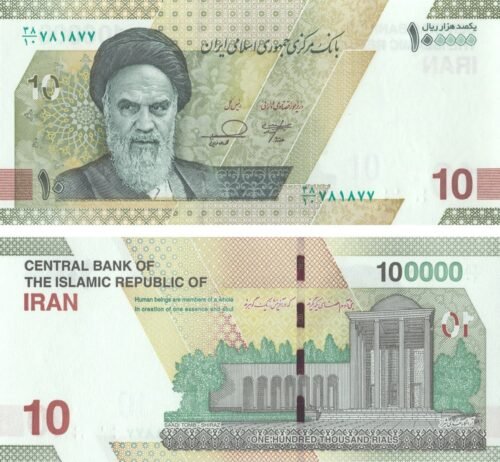
Iran 100000 Rials 2023, P-163(4), UNC
2,49 €