Toppan Insatsu

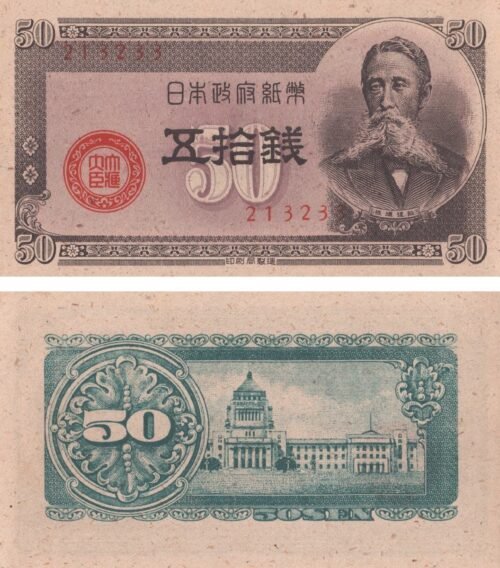
Toppan Insatsu was one of Japan’s major commercial printers and a documented producer of selected wartime banknotes. Catalogue attributions can identify individual Toppan plants through serial-number suffixes, turning a small code into valuable production evidence.
Quick Facts
Official name: Toppan Insatsu
Alternative names: Toppan Printing; Toppan Printing Co., Ltd.; 凸版印刷
Country: Japan
Headquarters: Tokyo, Japan
Established: 1900
Status: Historical printer name; the corporate group now operates under TOPPAN Holdings
Institution type: Commercial printing and security-printing company
Ownership or parent: Historical Toppan Printing company; current corporate lineage within TOPPAN Holdings
Official website: holdings.toppan.com
Institutional Identity
Founded in 1900, the company developed from modern relief and security printing into a broad industrial printing group. Toppan Insatsu is the Japanese corporate name commonly rendered in English as Toppan Printing.
Its banknote role was contractual. The Bank of Japan or Japanese government remained the issuer, while Toppan plants supplied physical production for specified notes.
Toppan began as a private printing enterprise built around advanced relief-printing methods and grew into one of Japan’s largest information and materials groups. Its wartime banknote work represents a specialised government contract inside a much broader commercial history.
Because the company operated several plants, the corporate printer name and the physical facility are not always the same level of attribution. WBN links the note to Toppan Insatsu while collector text can preserve the plant identified by an issue-specific serial code.
Historical Development
Toppan expanded alongside Japan’s modern printing industry and acquired skills in fine commercial and protected work. Wartime demand brought private plants into currency production when the state needed additional capacity.
The company continued far beyond the banknote contracts and evolved into today’s TOPPAN corporate group. The historical printer term is retained because it matches the period in which the notes were manufactured.
The company’s 1900 foundation placed it within Japan’s rapid industrial modernisation. Technical expansion in colour, plate and high-volume printing prepared it to support state demand when regular government capacity was under wartime pressure.
Post-war Toppan continued into packaging, electronics, communications and security products, and the group later reorganised under TOPPAN Holdings. Modern corporate branding should not replace the Toppan Insatsu name used for historical note production.
Role in Banknote Production
The Banknote Book identifies Toppan Insatsu on selected Japanese sen notes and distinguishes plants through the final serial-number digits. On the 1948 50-sen issue, recorded endings include codes associated with Itabashi, Fuji and Osaka production.
These suffixes are issue-specific and should not be generalised to every Toppan-printed note. WBN applies the printer term only when the catalogue or serial evidence supports it.
Private-plant participation can be visible only through the serial system. For the relevant 50-sen issue, catalogue entries associate different final two-digit endings with Itabashi, Fuji and Osaka. A complete serial photograph is therefore production evidence, not merely inventory documentation.
The same ending cannot be assumed to identify the same plant on every Japanese issue. Serial structures were designed for particular production programmes, and code interpretation must stay attached to its catalogue context.
Security and Technology
Toppan’s commercial expertise included precision plate work, controlled registration and mass printing. Wartime and immediate post-war small-change notes were relatively simple, but consistency across large runs remained essential.
Plant-code interpretation can be more informative than a visible printer imprint. Paper, serial style and suffix must be examined together before identifying a facility.
Toppan’s industrial strength lay in repeatable plate work, accurate registration and large-run control. Small wartime notes used limited colours and compact designs, but even these required consistent numerals, serial application and inspection across more than one facility.
Plant variation may appear in alignment, shade or paper behaviour, yet such observations are supporting evidence only. The catalogue-defined serial suffix remains safer than assigning a plant through visual impression.
For Collectors
For collectors, the last two serial digits may separate plant varieties that otherwise look identical. A note ending in 33, for example, can carry a different Toppan plant attribution from endings 13 or 23 within the relevant issue.
The exact catalogue entry must still be consulted because code meanings are not universal. Recording the complete serial, rather than only the main number, preserves the evidence needed for attribution.
A note whose serial ends in 33 should be catalogued with the exact issue’s code table before its plant is named. Keeping the final digits visible in product photography allows later verification and prevents distinct plant varieties from being combined in one restock pool.
Printer attribution and condition should also remain separate. A plant code can make a variety more specialised, but rarity and value depend on survival and demand, not on the code alone.