
Türkiye Cumhuriyet Merkez Bankası Banknot Matbaası

The Banknote Printing Plant of the Central Bank of the Republic of Türkiye is the country’s in-house producer of lira banknotes. Established in the 1950s, it ended reliance on continuous foreign production and has printed Turkish issues since 1958.
Quick Facts
Official name: Türkiye Cumhuriyet Merkez Bankası Banknot Matbaası
Alternative names: Central Bank of the Republic of Türkiye Banknote Printing Plant; TCMB Banknote Printing Plant; Banknot Matbaası
Country: Turkey
Headquarters: Ankara, Türkiye
Established: Established by decision in 1955; the first banknote was printed at the plant in 1958
Status: Active
Institution type: In-house central-bank banknote printing plant
Ownership or parent: Türkiye Cumhuriyet Merkez Bankası
Official website: tcmb.gov.tr
Institutional Identity
Banknot Matbaası is a central-bank production unit based in Ankara. The TCMB determines the currency and issues the notes; the plant transforms approved designs into secure circulating banknotes.
Its full Turkish title is retained in the WBN taxonomy because it is the official institutional form. English translations and catalogue abbreviations refer to the same plant.
The Turkish constitutional and central-bank framework separates the privilege to authorise banknote printing from the plant that performs it. Official TCMB material explains that the Grand National Assembly transferred the exclusive authority to print and issue banknotes to the central bank. Banknot Matbaası is the operational expression of that mandate.
The facility also contains creative and technical expertise: banknote design, prepress preparation, security printing and quality control are not outsourced concepts even when specialist materials may come through a wider supply chain. This makes the plant both an industrial and artistic part of the institution.
Historical Development
Türkiye decided to establish a domestic banknote works in 1955. The plant’s first note entered production in 1958, beginning a gradual transfer from overseas contracts to national manufacture.
Later facilities and equipment supported the high-denomination inflation-era lira and, from 2005 onward, the revalued Turkish lira. The operation remains active within the TCMB organisation.
Before 1958, Republic of Türkiye banknotes were produced by foreign firms. The 1955 decision and the first domestic output three years later created a long-term change in monetary infrastructure. Production expanded gradually rather than replacing every external arrangement instantly.
The inflationary decades required increasingly high denominations and frequent issue revisions. After six zeros were removed in 2005 and the “new” designation was later dropped, the plant supported another complete design cycle. Its history therefore covers radically different nominal systems within one lira tradition.
Role in Banknote Production
The Banknote Book explicitly credits the TCMB Banknote Printing Plant on many modern Turkish issues. Earlier republic notes and selected contracts name foreign printers, so the in-house term should be applied at issue level rather than inferred from country alone.
Printer attribution is especially useful where a long-running design continued through several signatures, prefixes and security changes.
Modern Turkish series frequently distinguish signature combinations and prefix ranges while retaining the same principal portraits and reverse subjects. The plant remains constant across many of these entries, but the catalogue variety changes. This is why printer data should not absorb signature or issue information.
Official production also does not eliminate the relevance of older foreign printer terms. A historical archive benefits from showing when domestic manufacture began and where imported contracts still apply.
Security and Technology
The plant produces multicolour offset and intaglio work, serial numbering and denomination-specific security features. Modern lira notes include watermarks, embedded or windowed threads, holographic elements, tactile marks and ultraviolet features.
Technology evolved substantially after 1958. An early domestic printing should not be described with features documented only for current series.
Current notes layer offset backgrounds, intaglio relief, holographic or foil elements, watermarks, security threads, microtext and ultraviolet response. Denomination size and tactile features also support accessibility. These elements are designed as a system rather than as isolated decorations.
Prefix and signature changes can occur without a complete security redesign, while a security revision may retain the same printed year. Collectors need the exact issue description; plant identity alone cannot date the technology.
For Collectors
For collectors, the plant attribution confirms domestic production but does not by itself identify the precise issue. Signature pair, prefix range, printed date and security-thread form can divide visually similar notes.
The full Turkish name, English translation and catalogue abbreviation should be treated as naming variants of one printer. Separate foreign contractors remain distinct terms.
Turkish product titles often use the statutory date printed on the note rather than the actual production year. The printer profile should not be used to “correct” that convention. Prefix, signatures and catalogue subtype provide the operational chronology.
Recording the official Turkish plant name improves precision, especially where abbreviated catalogue forms vary. All aliases should resolve to one printer archive, but individual products must retain their own Pick and TBB distinctions.
Banknotes Printed by Türkiye Cumhuriyet Merkez Bankası Banknot Matbaası
-

Turkey 20 Lira 1970, P-187a(1), UNC
3,99 € -
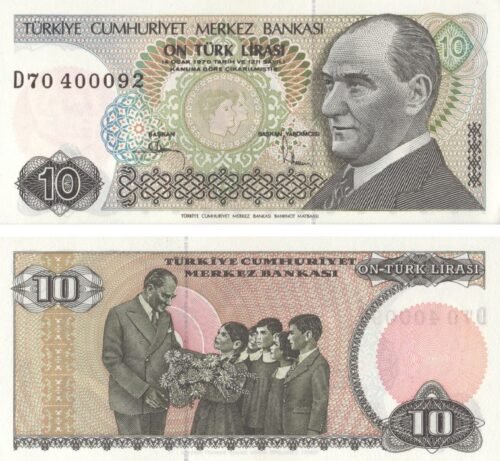
Turkey 10 Lira 1970, P-192(2), UNC
2,99 € -

Turkey 10 Lira 1970, P-193(2), UNC
2,49 € -

Turkey 500 Lira 1970, P-195(3), UNC
3,99 € -

Turkey 1000 Lira 1970, P-196(2), UNC
2,99 € -

Turkey 10000 Lira 1970, P-199c, UNC
3,99 € -

Turkey 20000 Lira 1970, P-202, UNC
3,99 € -

Turkey 100000 Lira 1970, P-206(1), UNC
3,99 € -

Turkey 250000 Lira 1970, P-211, UNC
3,99 € -

Turkey 1 New Lira 2005, P-216, UNC
2,99 € -

Turkey 5 Lira 2022, P-222f, UNC
0,99 € -
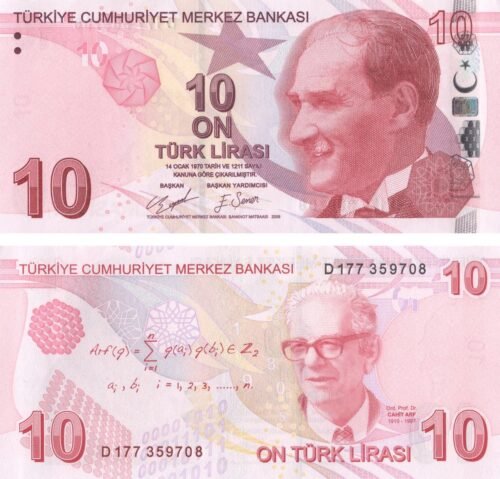
Turkey 10 Lira 2020, P-223d, UNC
1,49 € -

Turkey 10 Lira 2022, P-223f, UNC
1,49 € -

Turkey 20 Lira 2022, P-224f, UNC
3,99 € -

Turkey 50 Lira 2022, P-225e, UNC
6,99 €