United States Bank Note Company

United States Bank Note Company printed Estonia’s first restored-kroon low denominations, placing an American commercial security printer inside one of Europe’s defining monetary transitions.
Quick Facts
Official name: United States Bank Note Company
Alternative names: USBN; United States Banknote Company; United States Banknote Corporation; USBC
Country: United States
Headquarters: United States; corporate and production operations were associated with the New York–New Jersey–Pennsylvania security-printing corridor
Established: Active as a major security-printing company by the late twentieth century; the related holding company was renamed American Banknote Corporation in 1995
Status: Former corporate identity; later reorganised within American Banknote Corporation
Institution type: Former commercial security printer and security-document manufacturer
Ownership or parent: Operated within United States Banknote Corporation; the corporation was renamed American Banknote Corporation effective 1 July 1995
Institutional Identity
United States Bank Note Company was a commercial American security printer active in high-security documents and foreign currency work. It must not be confused with the older American Bank Note Company merely because later corporate restructuring brought the names into the same organisational history.
A United States appellate decision described United States Bank Note Company as a competitor of American Bank Note Company in 1989, both operating in the specialised security-document field. Securities filings later record that United States Banknote Corporation changed its name to American Banknote Corporation effective 1 July 1995. These records show succession and consolidation, not timeless identity between every similarly named company.
For WorldBanknotes.eu, the canonical title follows the wording used by Eesti Pank for the printer of the 1992 1- and 2-kroon notes. Alternative corporate forms are included for discovery, while the profile explains the limits of equivalence.
Historical Development
By the late twentieth century, United States Bank Note Company was one of the major American firms engaged in security documents such as certificates, bonds, visas and travellers’ cheques. Its position in the market became visible during the 1989 contest involving American Bank Note Company and the subsequent corporate realignment.
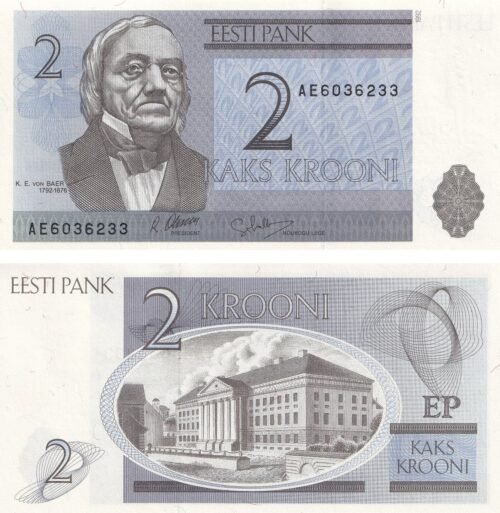
The most important banknote evidence for this catalogue comes from Estonia. After the restoration of independence, Eesti Pank introduced the kroon in 1992. Official Bank of Estonia security-feature sheets state that the 1- and 2-kroon notes were printed at the United States Bank Note Company plant. Later 2-kroon printings were assigned to Giesecke & Devrient, making printer attribution essential at the variety level.
The related United States Banknote Corporation adopted the American Banknote Corporation name in 1995 and later underwent reorganisation. Because company, corporation and plant names can shift within a holding structure, the profile avoids giving a single founding date that primary sources reviewed do not establish with confidence for the exact contract entity named by Eesti Pank.
Role in Banknote Production
WorldBanknotes.eu links the printer to Estonia’s 2-kroon note dated 1992. Eesti Pank’s own document provides the decisive attribution, naming the United States Bank Note Company printing plant. This is stronger evidence than a dealer description or an inferred imprint and allows the catalogue to state the printer without qualification for that issue.
The note belongs to the first restored-kroon family and depicts the scientist Karl Ernst von Baer on the face and the University of Tartu on the reverse. Its production formed part of a wider international programme: different denominations and later printings were assigned to several foreign printers while Estonia rebuilt its independent monetary system.
Variety control is therefore essential. The company printed the early 1- and 2-kroon notes, but a printer field should not be copied automatically to every later note of the same denomination or design. Official Eesti Pank material explicitly notes that later 2-kroon series were printed by Giesecke & Devrient.
Security and Technology
United States Bank Note Company operated within the American engraved security-printing tradition, where steel-plate origination, intaglio printing, fine-line backgrounds and controlled numbering were established methods for protected documents. The exact process sequence for the Estonian 2-kroon note should nevertheless be derived from the note and issuer documentation, not from a generic description of American practice.
Eesti Pank’s security sheet documents the note’s public features and provides a reliable baseline for examination. Collectors should compare portrait relief, line sharpness, serial typography, paper, security thread and watermark against the correct printing, because later printer changes can produce legitimate technical differences within an otherwise familiar design.
The corporate succession adds another layer of control. A stock certificate carrying a later American Banknote corporate imprint is not evidence for the production identity of an Estonian note made under the United States Bank Note Company name. Technical and legal attributions must be tied to the date and object under study.
For Collectors
United States Bank Note Company matters because its Estonian contract captures the international infrastructure behind a newly restored national currency. The note is Estonian in authority and symbolism, yet its manufacture reflects the specialised foreign capacity required to launch a secure banknote family quickly.
The 2-kroon denomination is also ideal for printer comparison. Early notes attributed by Eesti Pank to United States Bank Note Company can be set beside later Giesecke & Devrient printings. Differences in colour balance, line execution, paper or feature presentation must be assessed carefully, but the documented printer change provides a meaningful framework for that study.
Catalogue records should retain the exact contract-era printer name and list United States Banknote Corporation and American Banknote Corporation only as corporate context. This prevents one of the most common printer-research errors: merging similarly named American firms until historical attribution becomes impossible to audit.