
Topčider Institute for Manufacturing Banknotes and Coins

Topčider is the National Bank of Serbia’s secure production complex, combining a banknote works opened in 1929 with later minting, document and payment-card capabilities.
Quick Facts
Official name: Zavod za izradu novčanica i kovanog novca – Topčider
Alternative names: Institute for Manufacturing Banknotes and Coins – Topčider; ZIN; Topčider Institute
Country: Serbia
Headquarters: Topčider, Belgrade, Serbia
Established: December 1929; mint operations added in 1938
Status: Active
Institution type: Central bank security-printing and minting institute
Ownership or parent: Specialised organisational unit of the National Bank of Serbia
Official website: nbs.rs
Institutional Identity
The Institute for Manufacturing Banknotes and Coins – Topčider is a specialised organisational unit of the National Bank of Serbia rather than a separate commercial issuer. The distinction matters. The National Bank of Serbia holds the exclusive right to issue Serbian banknotes and coins, determines their denominations and principal characteristics, and decides when they enter or leave circulation. The Institute carries out the secure industrial manufacture required to produce those monetary instruments.
Its remit is broader than banknote printing. The Topčider complex manufactures circulating and numismatic coin, public documents, value and secured papers, payment and identification cards, and other controlled products. It also undertakes work for foreign customers. That breadth makes Topčider part of Serbia’s national security infrastructure, but it does not erase the attribution boundaries within an individual project: the issuer, designer, paper or feature supplier and finished-note printer may still be different organisations.
For catalogue purposes, the institution is best recorded under its full Serbian name, with “Topčider Institute” used as a practical English reference. Topčider identifies the Belgrade district in which the production complex stands; it is not a separate corporate brand detached from the National Bank of Serbia.
Historical Development
Serbia’s issuing bank originally depended on foreign production. Its first banknote was prepared with Belgian assistance, and the National Bank subsequently worked closely with Banque de France. The push for a domestic printing works emerged after the creation of the Kingdom of Serbs, Croats and Slovenes, when local manufacture was increasingly viewed as an expression of monetary and state independence.
The Governor’s Council decided in 1925 to construct an institute for banknote manufacture. Land in Topčider was assigned in March 1927 and building work began that September. On the recommendation of Banque de France, architect Josif Najman was engaged to design the complex. The main building was completed by the end of October 1929, and the Institute for Manufacturing Banknotes of the Kingdom of Yugoslavia began operating in December 1929. A detailed decree adopted in 1930 formalised its organisation and working procedures.
Coin production was added later: the mint was built in 1937 and began operating in 1938. The institution then passed through successive Yugoslav and Serbian monetary regimes while remaining a production arm of the central bank. The National Bank of Serbia records that manufacturing at Topčider did not cease even during the Second World War or the 1999 NATO bombing. This continuity is historically significant, but it should not be mistaken for technological uniformity: plant, processes, issuer names and security specifications changed repeatedly across those decades.
Role in Banknote Production
Topčider’s principal monetary role is the manufacture of banknotes and coins ordered by the National Bank of Serbia. Issue policy and the approved specification remain central-bank responsibilities; the Institute converts that specification into controlled production through prepress, plate preparation, printing, numbering, inspection, finishing and secure handling. The wider workflow is explained in the WorldBanknotes.eu guide to how banknotes are printed.
Official descriptions of Serbian issues show that production may combine multicolour offset, intaglio and letterpress numbering. A documented 200-dinar issue, for example, used intaglio and multicolour offset on the front, multicolour offset and letterpress numbering on the reverse, together with security paper, a watermark and a windowed thread. That example demonstrates the Institute’s range; it should not be treated as a template for every denomination or period.
The Institute also produces banknotes and coins for foreign countries. Such work must be attributed at issue level. A foreign banknote should not be assigned to Topčider merely because Serbia supplied technical assistance, because its design resembles a Serbian note, or because a catalogue lists the institution for another denomination from the same issuer.
Security and Technology
Modern Serbian banknotes use layered public and machine-readable protection. The National Bank of Serbia identifies features including intaglio printing, watermarks, security threads, see-through registers, kinegrams, colour-shifting inks, microlettering, fluorescent fibres and denomination-specific tactile marks. Topčider’s production task is to register these elements accurately and consistently within the finished note.
The technical value of a feature depends on the complete production system. Raised printing must match the correct design; a watermark must be formed within the specified paper; a thread must have the right width, placement and optical behaviour; numbering must follow the authorised format. The Institute’s security capability therefore lies not in any single device but in the controlled integration, inspection and accountability of the whole object.
Collectors examining a Serbian note should use several mutually supporting checks rather than rely on one conspicuous feature. The practical sequence is set out in the WorldBanknotes.eu guides to banknote security features and banknote authentication.
For Collectors
The WorldBanknotes.eu catalogue currently links Topčider to seven Serbian dinar notes dated from 2006 to 2014, including the 10-, 20-, 50- and 100-dinar denominations. Together they offer a compact study of how a single printing institution can serve successive signatures, issue years and minor design revisions without creating a new printer identity.
Attribution is especially useful when comparing notes carrying the name or symbols of the National Bank of Yugoslavia with later issues of the National Bank of Serbia. Changes to the issuer inscription, coat of arms, signature, date and security specification can be more important for classification than the continued use of the Topčider works. A shared printer does not make two issues the same series, and a changed issuer does not necessarily imply a changed production site.
For condition assessment, pay close attention to tactile intaglio, thread surfaces, watermark clarity, corners and the alignment of see-through elements. These areas often reveal handling and wear more clearly than the broad colour fields. Printer attribution should finally be confirmed through issuer documentation, a reliable catalogue or another issue-specific source, not inferred from national origin alone.
Banknotes Printed by Topčider Institute for Manufacturing Banknotes and Coins
-
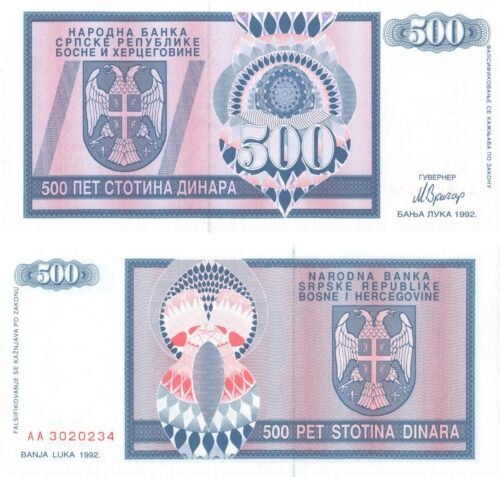
Bosnia and Herzegovina 500 Dinara 1992, P-136, UNC
4,99 € -

Bosnia and Herzegovina 1000 Dinara 1992, P-137, UNC
4,99 € -

Bosnia and Herzegovina 100000 Dinara 1993, P-141, UNC
3,99 € -

Bosnia and Herzegovina 50000 Dinara 1993, P-153, UNC
1,49 € -

Bosnia and Herzegovina 10000000000 Dinara 1993, P-159r, UNC
55,99 € -

Bosnia and Herzegovina 10000000000 Dinara 1993, P-159, UNC
43,99 € -

Bosnia and Herzegovina 50000000000 Dinara 1993, P-160r, UNC
55,99 € -

Bosnia and Herzegovina 50000000000 Dinara 1993, P-160, UNC
43,99 € -

Croatia 5000 Dinara 1993, P-R20, UNC
4,99 € -

Croatia 50000 Dinara 1993, P-R21, UNC
4,99 € -

Croatia 500000 Dinara 1993, P-R23, UNC
2,99 € -

Croatia 500000000 Dinara 1993, P-R26, UNC
4,99 € -

Croatia 10000000000 Dinara 1993, P-R28, UNC
5,99 € -

Croatia 1000 Dinara 1994, P-R30, UNC
5,99 €