
Bangladesh
Bangladesh banknotes originate in independence, where Liberation War overprints and the 1972 map series transformed provisional notes into a sovereign taka system.
1972–2010 | Government Issue Series


1982–2006 | Standard Series

1997–2000 | Mujibur Rahman Series

2006–2011 | Security Upgrade Series

2011–2024 | Mujibur Rahman Series
-

Bangladesh 10 Taka 2014, P-54c, UNC
0,99 € -

Bangladesh 10 Taka 2023, P-54, UNC
0,99 € -

Bangladesh 2 Taka 2013, P-52c, UNC
0,99 € -

Bangladesh 2 Taka 2015, P-52d, UNC
0,99 € -

Bangladesh 2 Taka 2016, P-52e, UNC
0,99 € -

Bangladesh 2 Taka 2022, P-52, UNC
0,99 € -

Bangladesh 5 Taka 2012, P-53c, UNC
0,99 € -

Bangladesh 5 Taka 2014, P-53Aa, UNC
1,49 €
2012 | Language Movement Anniversary Commemorative Issue

2016–2024 | Low Denomination Series
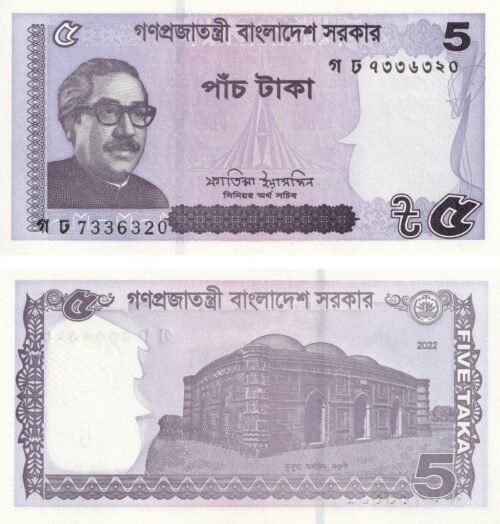
2020–2024 | Mujibur Rahman Birth Centenary Commemorative Series

2021 | Golden Jubilee of Independence Commemorative Issue

2022 | Constitution and Supreme Court Jubilee Commemorative Issue

2022 | Dhaka Metro Rail Commemorative Issue

2023 | Bangabandhu Tunnel Commemorative Issue

Design & Visual Identity
Bangladeshi banknotes are structured around portraiture, national symbols, and identifiable landmarks. Sheikh Mujibur Rahman appears as the central figure across modern issues, while the Royal Bengal Tiger provides a strong national emblem. Key architectural motifs include the National Martyrs’ Memorial, the Shaheed Minar, and the Sixty Dome Mosque, anchoring the designs in political, cultural, and religious history.
Compositions incorporate guilloche patterns, watermarks, security threads, and microtext, with production involving both domestic printing by The Security Printing Corporation (Bangladesh) Ltd. and international firms such as De La Rue. Colour coding across denominations ensures clear differentiation while maintaining a consistent visual framework.
Historical & Cultural Context
The Bangladeshi taka emerged during the 1971 Liberation War, when overprinted Pakistani rupees circulated as emergency currency. This was followed by the 1972 Map series, the first official banknotes of the independent state, featuring the national outline as a central design element.
Subsequent issues introduced structured national themes and consistent portrait use, while technical production evolved through both domestic and international printing. A short-lived polymer 10 taka note represents a notable experimental phase before the system returned to paper-based issues with enhanced security features.
For Collectors
For collectors, Bangladesh offers a clearly defined collecting field centered on Liberation War overprints, the 1972 Map series, and modern portrait issues featuring Sheikh Mujibur Rahman. The withdrawn polymer 10 taka note provides a distinct modern rarity, while variations in domestically and internationally printed series add further depth. These elements make Bangladeshi banknotes particularly relevant for collectors focused on independence-era currency, transitional issues, and evolving security production.
Quick Facts
Currency: Bangladeshi Taka
Issuer: Bangladesh Bank