
Ecuador
Ecuador banknotes present a complete historical cycle, where the sucre integrates Andean peaks, Amazonian biodiversity, and independence figures into a closed currency narrative.
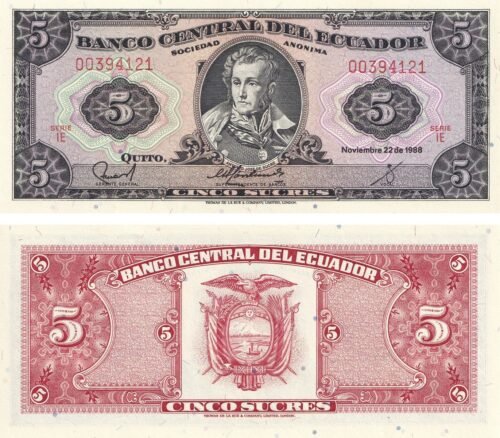
1957–1988 | Sociedad Series
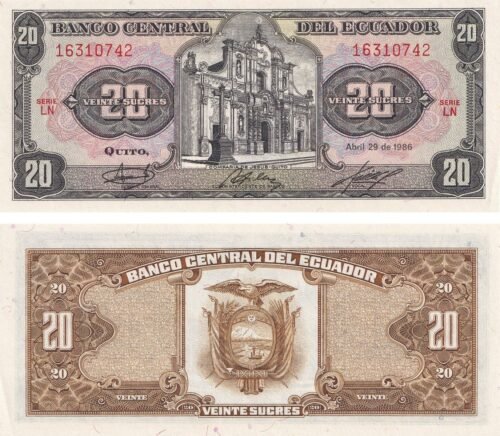
1984–1997 | Modern Sucre Series
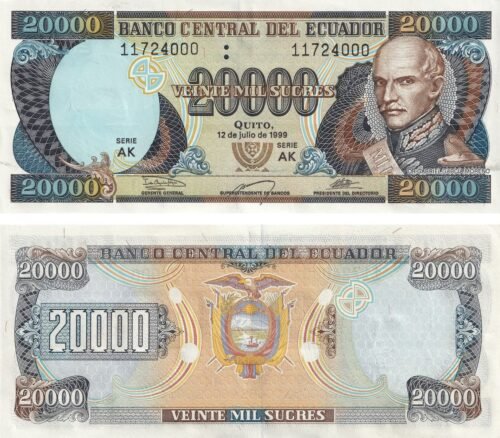
1991–1999 | High Denomination Series
Design & Visual Identity
The final Sucre series anchors Ecuador’s identity in endemic wildlife and dramatic geography. The 10,000 sucres note features the Galapagos giant tortoise, one of the most recognizable species in global natural history, while the 5,000 sucres note presents the Andean condor, symbolizing altitude, endurance, and the Andean spine of the country. These motifs move beyond decoration, establishing Ecuador as one of the few currencies where globally unique ecosystems are directly embedded into circulating design.
Urban and coastal identity appears through Quito Old Town, the first UNESCO World Heritage city, and through the port of Guayaquil, where maritime history is represented by the sailing ship Guayas. Together, these elements connect highland culture with Pacific trade, forming a balanced geographic structure across denominations. Traditional engraving, watermark portraits, embedded security threads, and fine guilloché patterns support the series without overshadowing its ecological and historical focus.
Historical & Cultural Context
The historical framework of the Sucre is defined by independence and political transformation. The currency takes its name from Antonio José de Sucre, the Marshal of Ayacucho, whose role in South American independence establishes the ideological foundation of the series. Later issues expand this narrative through figures such as Eloy Alfaro, the central figure of Ecuador’s liberal revolution, linking the currency to internal political change as well as external independence.
This trajectory concludes abruptly in 2000, when the Sucre was replaced by the U.S. dollar, closing the series as a complete monetary chapter. The end of circulation fixed all denominations within a finite historical boundary, giving the currency a clearly defined beginning and endpoint.
For Collectors
For collectors, Ecuador offers a compact and highly identifiable collecting field built on strong visual anchors and a closed currency system. The Galapagos tortoise 10,000 sucres, the Andean condor 5,000 sucres, and the portrait series of Antonio José de Sucre create a clear thematic core, while the inclusion of Quito UNESCO architecture and Guayaquil maritime elements adds geographic depth. This combination of endemic biodiversity, independence symbolism, and a definitive endpoint positions Ecuadorian banknotes as one of the most cohesive and collectible series in Latin American numismatics.
Quick Facts
Currency: Ecuadorian Sucre
Issuer: Central Bank of Ecuador