
Nepal
Nepal banknotes trace a visible political transformation, where royal authority recedes while mountains, temples, and wildlife remain constant.
1974 | King Birendra Dark Military Cap Issue

1981–2001 | King Birendra Plumed Crown Issue


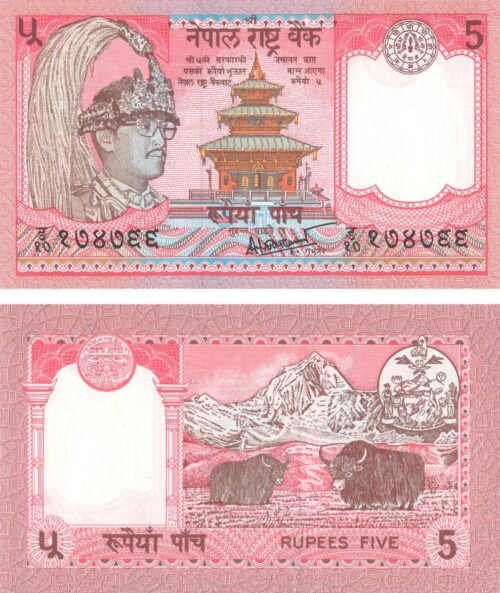

1988–2001 | King Birendra Plumed Crown Issue


2002 | King Gyanendra Accession Commemorative Issue

2002–2005 | King Gyanendra Issue

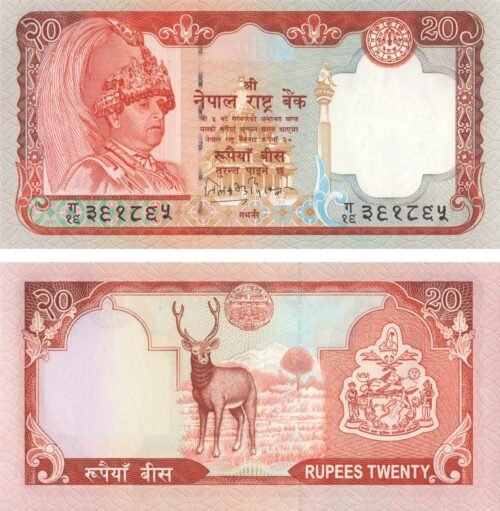
2007–2010 | Mount Everest Issue


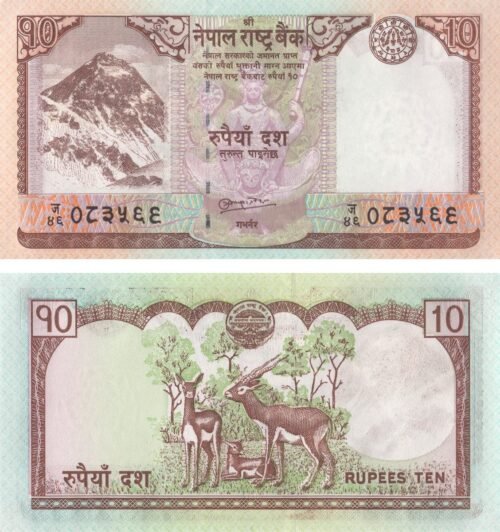

2012–2016 | Dated Mount Everest Issue

2015–2024 | Dated Mount Everest Issue
-

Nepal 5 Rupees 2017, P-76, UNC
0,99 € -

Nepal 5 Rupees 2020, P-76, UNC
0,99 € -
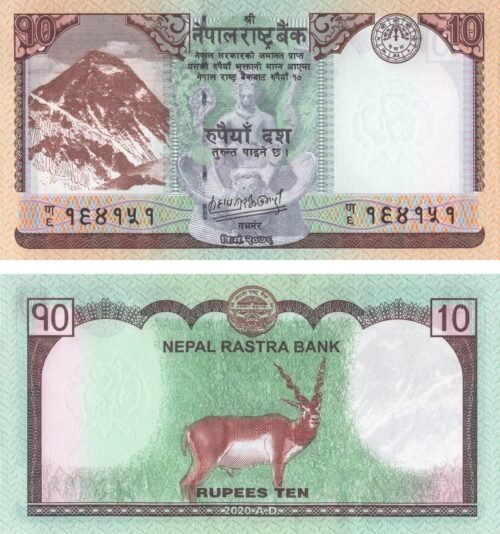
Nepal 10 Rupees 2020, P-77, UNC
0,99 € -

Nepal 20 Rupees 2016, P-78, UNC
1,49 € -

Nepal 20 Rupees 2020, P-78, UNC
1,49 € -

Nepal 100 Rupees 2019, P-80, UNC
3,99 € -

Nepal 500 Rupees 2020, P-81, UNC
9,99 €
Design & Visual Identity
Earlier issues are centered on monarchy. Kings Birendra and Gyanendra appear in formal portrait wearing the Shripech crown, framed with controlled symmetry and royal insignia. In later issues, this central position is replaced by Mount Everest (Sagarmatha), engraved with sharp ridgelines and open sky, marking the transition to a republic through a clear visual substitution. Around this central field, the obverse integrates sacred architecture: Swayambhunath Stupa with its all-seeing eyes, the carved structure of Changu Narayan, and the wooden Kasthamandap pavilion, each rendered with precise structural detail. Micro-elements include the rhododendron watermark and engraved representations of ancient Nepalese coins embedded within the layout.
The reverse forms a fixed wildlife register. The one-horned rhinoceros is shown with layered skin plates and forward mass, the Bengal tiger appears in low stance with defined striping, the snow leopard is positioned in climbing motion across rock, and the yak is rendered with dense coat and lowered head adapted to altitude. The highest denomination introduces the paired Asian elephants Ram and Lakshman, aligned symmetrically with mirrored posture and trunk placement, creating a balanced and easily identifiable composition.
Historical & Cultural Context
Nepal’s banknotes are structured through separation of themes. The obverse carries political and sacred identity, shifting from royal portraiture to mountain symbolism, while the reverse maintains a consistent zoological system. Each subject is isolated and rendered with controlled linework.
This produces a coherent sequence where political change, religious architecture, and wildlife classification are clearly legible across denominations without reliance on abstract symbolism.
For Collectors
For collectors, Nepal offers a well-defined field built around the transition from Birendra and Gyanendra portrait issues with Shripech crown to Everest-centered republic notes, combined with Swayambhunath, Changu Narayan, and Kasthamandap architecture, the rhododendron watermark, ancient coin engravings, and the full fauna set including rhinoceros, tiger, snow leopard, yak, and the paired elephants Ram and Lakshman. The Nepalese Rupee stands out as a clear record of political transformation combined with precise Himalayan wildlife representation.
Quick Facts
Currency: Nepalese Rupee
Issuer: Nepal Rastra Bank