
Romania
Romania banknotes function as Europe’s polymer laboratory, where transparent windows, scientific themes, and exact denomination scaling create a highly engineered currency.
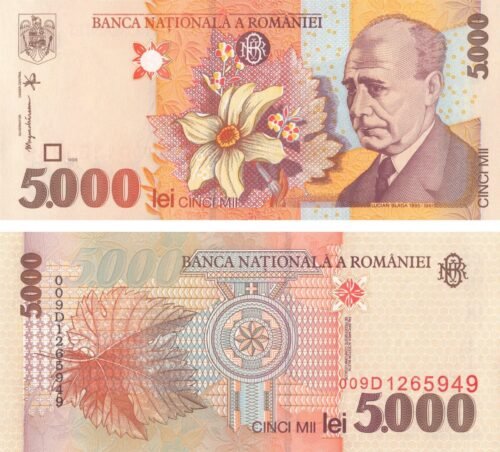
1996–2001 | Paper Lei Issue

1999 | Solar Eclipse Commemorative Issue

2000–2004 | Polymer Lei Issue

2005–2026 | Revaluation Lei Issue
-
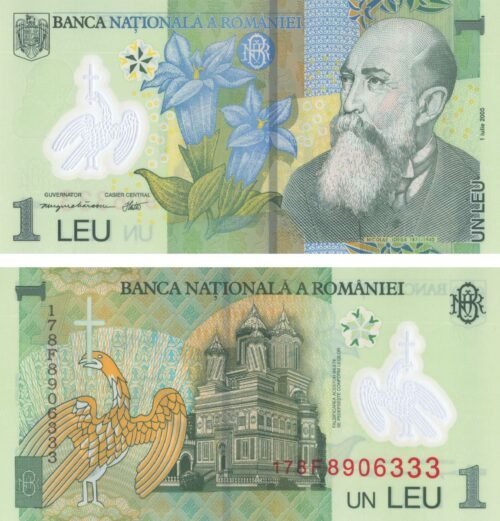
Romania 1 Leu 2017, P-117k, UNC
1,49 € -

Romania 1 Leu 2022, P-117, UNC
1,49 € -
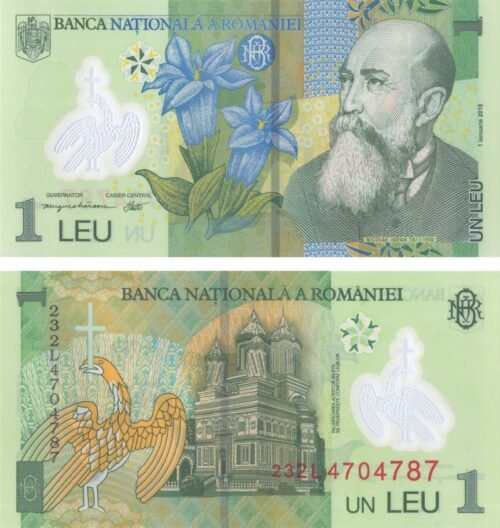
Romania 1 Leu 2023, P-117, UNC
1,49 € -

Romania 1 Leu 2024, P-117, UNC
1,49 € -

Romania 5 Lei 2019, P-118, UNC
3,99 € -
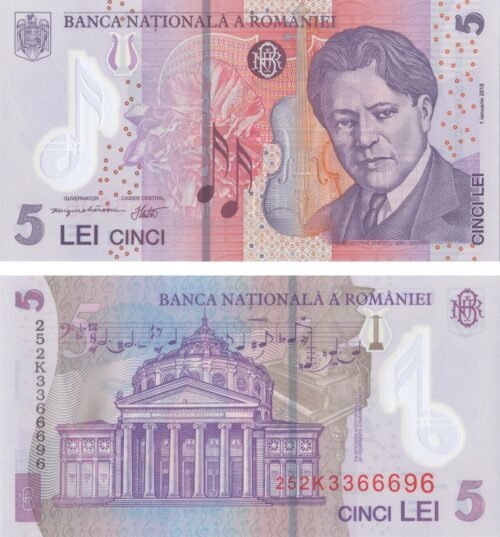
Romania 5 Lei 2025, P-118, UNC
3,99 € -

Romania 10 Lei 2020, P-119, UNC
5,99 € -
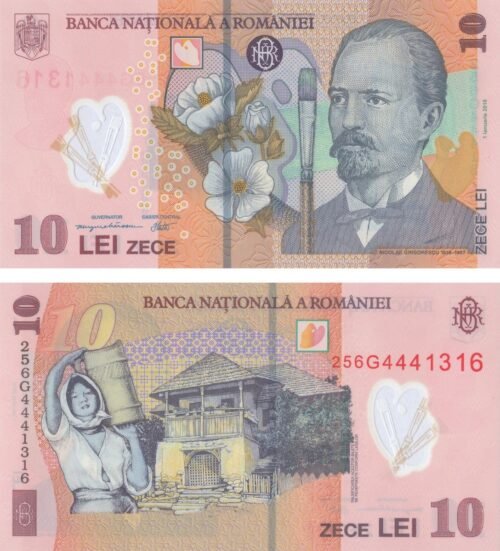
Romania 10 Lei 2025, P-119, UNC
5,99 € -
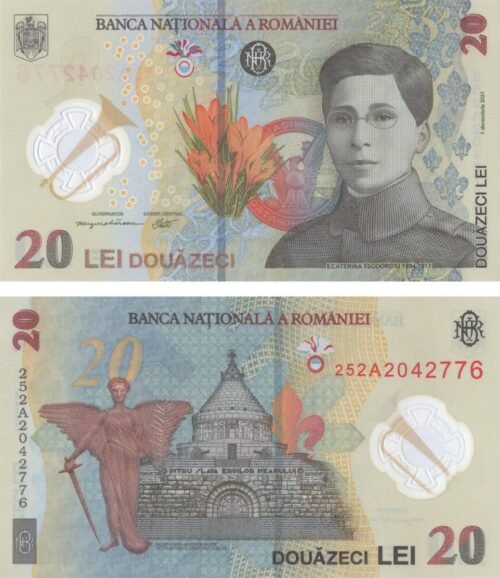
Romania 20 Lei 2025, P-119A, UNC
10,99 € -

Romania 50 Lei 2024, P-120, UNC
24,99 €
Design & Visual Identity
The defining anchor is the 1999 2,000 Lei Solar Eclipse polymer note. Its transparent magenta window acts as a metameric filter for checking the printed sun motif elsewhere on the banknote; it is not a filter for viewing the real Sun. This issue established Romania as a pioneer in modern substrate technology.
Contemporary layouts maintain a structured portrait system. Figures such as Nicolae Iorga and George Enescu appear on the right, integrated with architectural and cultural references, while the 2021 20 Lei introduces Ecaterina Teodoroiu as the first female figure on a modern circulating Romanian banknote.
Reverse compositions combine cultural landmarks and intellectual themes. The Romanian Athenaeum is rendered with architectural precision, while scientific and artistic elements are arranged within layered engraving and transparent design zones that define spatial hierarchy.
The polymer substrate shapes the entire surface. Large transparent windows with embedded motifs, micro-perforations forming latent imagery, and saturated color gradients create a fluid visual field where elements merge without rigid boundaries.
Historical & Cultural Context
The 2005 redenomination introduced a strict technical standard, aligning each banknote with the exact dimensions of Euro denominations, establishing physical compatibility within the European monetary environment. Earlier high-denomination issues such as the 1,000,000 Lei reflect the peak of monetary transition and remain key historical artifacts.
For Collectors
For collectors, Romania offers a technically advanced field built around the 1999 Solar Eclipse polymer note, Euro-aligned sizing, the introduction of Ecaterina Teodoroiu, and high-denomination pre-reform issues like the 1,000,000 Lei. The Romanian Leu stands as one of the most innovative and structurally distinctive currencies in European numismatics.
Quick Facts
Currency: Romanian Leu
Issuer: National Bank of Romania