
Scotland
Scotland banknotes are defined by a rare multi-bank issuing tradition, where parallel designs from separate institutions coexist within a single sterling framework.
1988–2017 | Royal Bank of Scotland Lord Ilay Reduced Size Issue
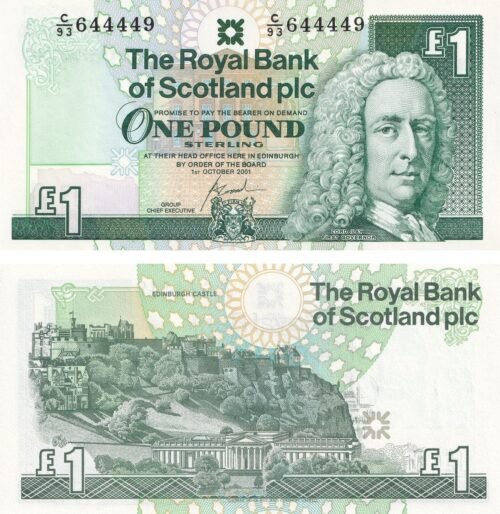
Design & Visual Identity
Three authorized issuers — Bank of Scotland, Royal Bank of Scotland, and Clydesdale Bank — each produce distinct banknote series, creating a layered visual identity rather than a single national design standard.
The Royal Bank of Scotland is known for its vertical “Fabric of Nature” polymer series, where figures such as Nan Shepherd are paired with detailed natural studies, including fish and wildlife, structured with precise engraving and Gaelic text elements.
Clydesdale Bank polymer notes incorporate transparent windows shaped as the map of Scotland, functioning as both a security device and a clear geographic identifier within the composition.
Bank of Scotland maintains a more architectural approach, with landmarks such as the Forth Bridge rendered in dense intaglio, emphasizing structural engineering and industrial heritage.
Historical & Cultural Context
Among notable issues, the Royal Bank of Scotland 5 Pound note featuring golfer Jack Nicklaus stands out as a rare example of a living non-royal individual depicted on a British banknote.
This combination of institutional independence, design diversity, and modern polymer innovation creates a continuously evolving system of parallel banknote series.
For Collectors
For collectors, Scotland stands out for its three-bank issuing structure, contrasting design philosophies, vertical polymer formats, map-shaped security windows, and distinctive commemorative issues, forming one of the most structurally unique banknote systems in Europe.
Quick Facts
Currency: Scottish Pound
Issuer: Royal Bank of Scotland