
Estonia
Estonia banknotes form a precise national series, where the kroon pairs writers, scientists, and reformers with clearly identifiable landmarks and landscapes.
1991–1992 | Restored Kroon Series
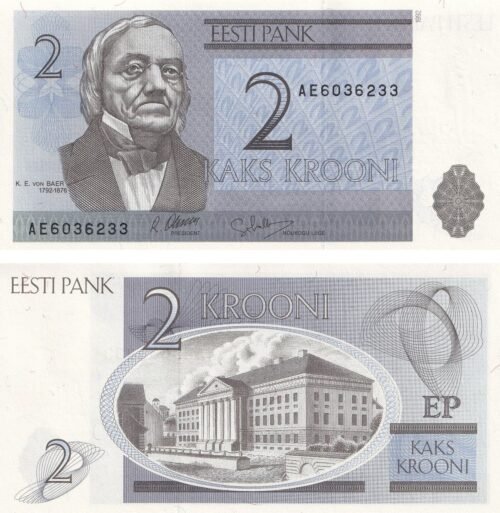
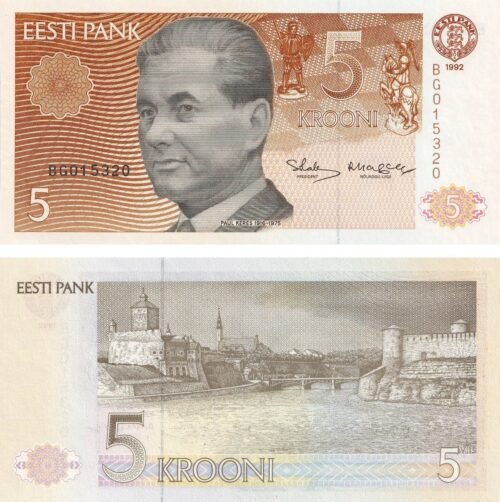
1994–2002 | Modern Kroon Series
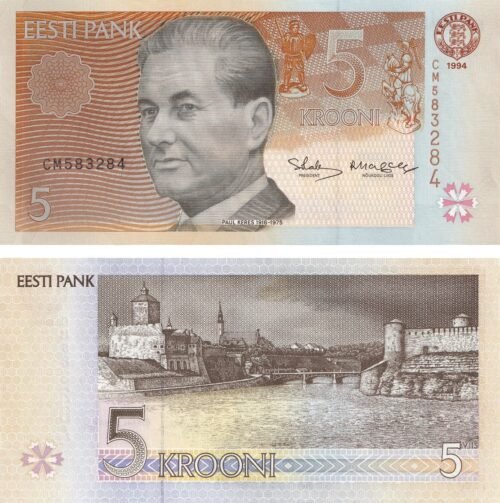
2006–2007 | Final Kroon Series
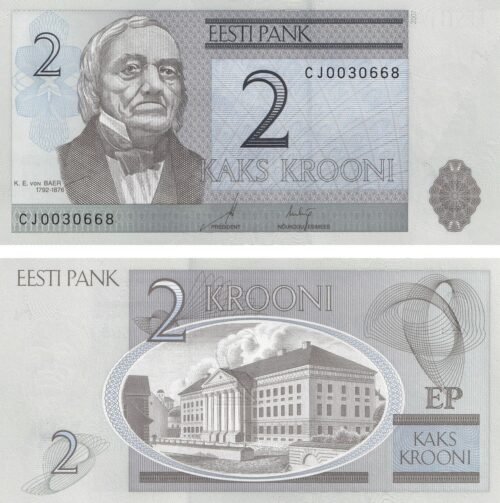
Design & Visual Identity
The kroon series is built on a disciplined system linking individuals to specific locations. The 2 krooni note features Karl Ernst von Baer alongside the University of Tartu and Narva Castle, positioned opposite Ivangorod as a clear East–West boundary marker. The 5 krooni presents Paul Keres with Toompea Castle in Tallinn, directly connecting intellectual achievement with state authority.
Higher denominations extend this structure through distinct environmental and cultural references. The 25 krooni note highlights the Tamme-Lauri oak, Estonia’s oldest known tree, while the 100 krooni features Lydia Koidula set against the North Estonian Klint, defining the country’s limestone coastline. The Three Lions coat of arms appears consistently as a watermark and design element, anchoring the series within Nordic heraldic tradition. Engraving precision, security threads, and microprinting maintain technical clarity across all issues.
Historical & Cultural Context
The kroon is defined by a clear historical interruption and restoration cycle. Originally issued during the interwar republic, it was suspended during Soviet incorporation and reintroduced in 1992 following the restoration of independence, re-establishing a national currency aligned with European standards.
The adoption of the euro in 2011 closed the kroon as a finite and complete system, creating a clearly bounded series shaped by both political disruption and national recovery.
For Collectors
For collectors, Estonia offers a compact and highly organized collecting field built on clearly identifiable motifs and a closed currency system. The Paul Keres 5 krooni, Toompea Castle, Tamme-Lauri oak 25 krooni, and Lydia Koidula 100 krooni notes form a coherent progression linking intellect, statehood, and landscape. This clarity, combined with its finite nature, positions Estonian banknotes as one of the most structured and balanced modern European series.
Quick Facts
Currency: Estonian Kroon
Issuer: Bank of Estonia