
Afghanistan
Afghanistan’s banknotes unfold as quiet witnesses to a nation shaped by endurance, where the Afghani carries the imprint of mountains, faith, and a cultural memory that persists through rupture and renewal. Within their designs, resilience is expressed not through declaration, but through symbols that remain constant across shifting eras.
Showing the single result
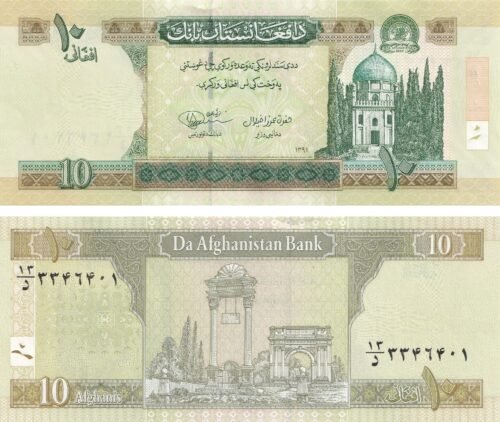
Design & Visual Identity
The visual language of Afghanistan’s banknotes is anchored in distinct architectural landmarks that define the nation’s identity. The Blue Mosque of Mazar-i-Sharif appears with its luminous tiled façade, embodying spiritual continuity, while the Citadel of Herat stands as a fortified testament to historical endurance. The Victory Arch of Paghman introduces a layer of state symbolism, linking monumental form with moments of political aspiration.
These elements are framed through Islamic geometric structures and refined calligraphy, creating compositions that balance ornament with clarity. Earth-toned palettes echo the surrounding landscape, while guilloche patterns, security threads, and microtext integrate modern technical precision into a traditionally grounded visual system. The result is a currency that communicates through both structure and symbolism, where each element is placed with deliberate restraint.
Historical & Cultural Context
The Afghani reflects a complex monetary history shaped by successive political transformations, from monarchy to republic, socialist governance, and prolonged conflict. During the late twentieth century, parallel monetary systems emerged, where different authorities issued banknotes of identical denominations, creating a fragmented currency landscape that mirrored the country’s division. This period of dual circulation was ultimately resolved through the 2002 monetary reform, which unified the Afghani and reset the national currency structure.
Subsequent issues introduced a more coherent visual and technical direction, supported by international security printers such as De La Rue and Goznak. While maintaining continuity in architectural motifs, these series incorporated enhanced anti-counterfeiting features, positioning the Afghani within a modern framework while preserving its cultural identity.
For Collectors
For collectors, Afghanistan offers a deeply layered field where banknotes reflect political transition, regional fragmentation, and eventual monetary unification. The Afghani series is distinguished by regime-specific variations, dual-circulation issues, and the presence of replacement notes and evolving security features. These banknotes are not defined solely by rarity, but by their ability to document one of the most complex monetary narratives of the modern era, making them essential for collectors focused on conflict economies and currency reform.