
Guinea-Bissau
Guinea-Bissau banknotes form a fragile and rare field, where the short-lived peso series reflects revolution, scarcity, and harsh circulation conditions.
1990–1993 | Final Peso Series
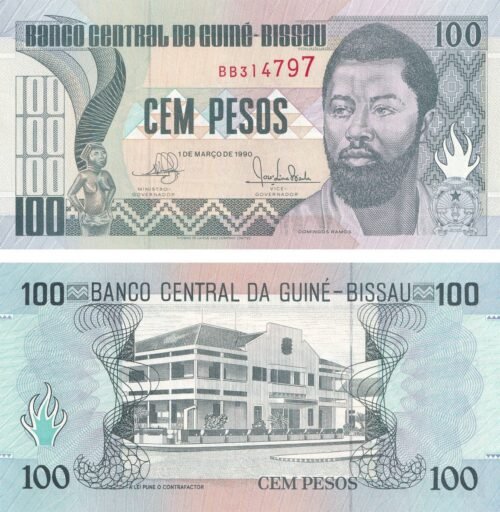
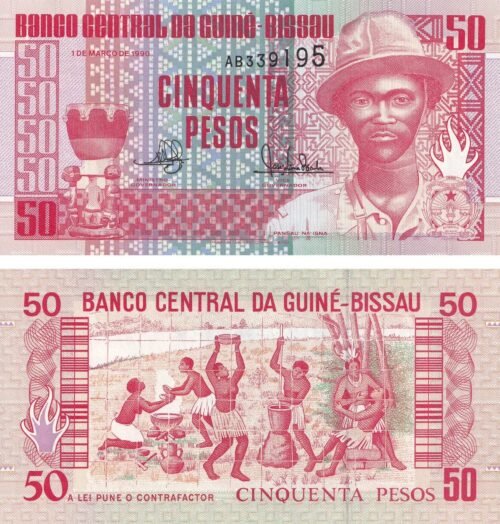
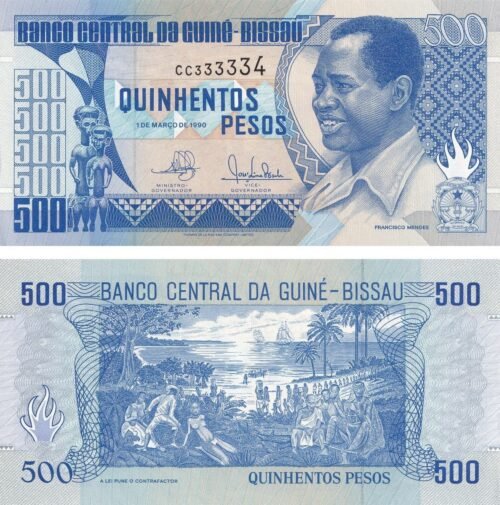
Design & Visual Identity
The defining centerpiece of the series is the 10,000 Pesos note, widely regarded as the “Holy Grail” of Guinea-Bissau numismatics. It uniquely combines the portrait of Amílcar Cabral with the independence fighter Pansau Na Isna, creating a dual-figure composition not repeated elsewhere in the series. As the highest denomination issued before the currency’s withdrawal, it represents the technical and symbolic peak of the Peso system and remains one of the most sought-after banknotes in the region.
Across all denominations, the portrait of Amílcar Cabral serves as the constant visual anchor, complemented by other key figures of the liberation struggle, including Domingos Ramos and Pansau Na Isna. Together, these figures form a structured revolutionary triad, transforming the currency into a visual record of Guinea-Bissau’s independence movement rather than a simple sequence of designs.
Historical & Cultural Context
The economic identity of the notes is expressed through precise agricultural and trade imagery. Cashew harvesting scenes dominate the visual field, reflecting Guinea-Bissau’s position as a major global exporter, while depictions of groundnut loading at the Port of Bissau anchor the currency in real commercial activity. These motifs provide collectors with concrete economic markers linked to identifiable production and export systems.
Geographically, the series extends into the Bijagós Archipelago and rural tabanca village life, offering a clear sense of place that distinguishes Guinea-Bissau from neighboring states. Coastal environments, fishing activity, and traditional settlement structures create a layered visual narrative rooted in both land and sea. The Peso Guineense system represents a closed and finite chapter, and due to tropical humidity, heavy circulation, and limited preservation, high-grade examples are exceptionally scarce, making uncirculated notes significantly rarer than comparable West African issues.
For Collectors
For collectors, Guinea-Bissau offers a tightly defined high-rarity field centered on the 10,000 Pesos Amílcar Cabral and Pansau Na Isna note, the broader revolutionary portrait series including Domingos Ramos, and the economic motifs of cashew harvesting and Bissau port trade. Combined with the extreme scarcity of well-preserved examples, these elements position the Peso Guineense among the most challenging and rewarding collections in African numismatics.
Quick Facts
Currency: Guinea-Bissau Peso
Issuer: Banco Nacional da Guiné-Bissau