
Hungary
Hungary banknotes present a royal narrative, where kings, reformers, and fortified castles define the structure of the modern forint.
2014–2025 | Revised Forint Series
Design & Visual Identity
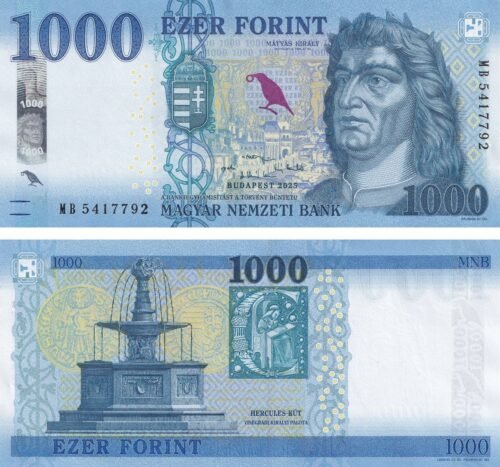
The modern forint series is anchored in clearly identified historical figures paired with specific architectural monuments. The 10,000 Forint note features Szent István (Saint Stephen), the founding king of Hungary, linked to the Esztergom Basilica, the principal seat of the Catholic Church in the country and one of the strongest symbols of Hungarian statehood. The 5,000 Forint note presents István Széchenyi, the great reformer of the 19th century, together with the Chain Bridge in Budapest, placing modernization, engineering, and civic ambition at the center of the series.
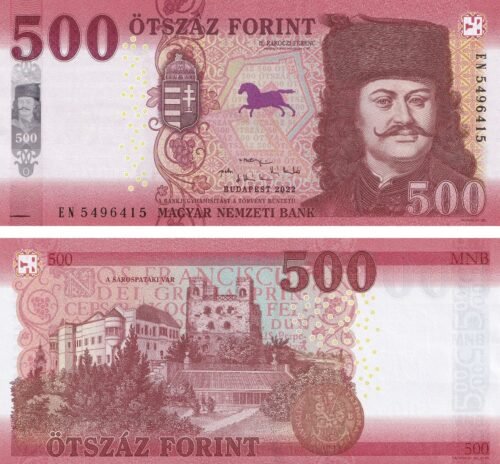
The lower denominations continue this structure through figures associated with resistance and scholarship. The 500 Forint note features Ferenc Rákóczi II and the Sárospatak Castle, tying the currency to Hungary’s anti-Habsburg struggle and aristocratic heritage. The 2,000 Forint note depicts Gábor Bethlen, whose role in supporting Transylvanian and Hungarian culture gives the series an intellectual and political dimension. These notes are executed with precise engraving, multicolor layouts, and detailed architectural backdrops that turn each denomination into a specific historical document rather than a generic portrait issue.
Historical & Cultural Context
A unifying feature of the modern Hungarian series is the Holy Crown of Hungary (Szent Korona), which appears as a central security element and watermark, linking every denomination to the continuity of the Hungarian state. This heraldic presence gives the series a consistent internal identity and distinguishes Hungarian notes from other modern European currencies that rely more heavily on abstract security symbolism.
The transition from older engraved issues to the modern forint series did not replace Hungary’s historical vocabulary but clarified it. Kings, reformers, castles, basilicas, and state symbols remained the fixed framework, allowing the notes to function as a structured gallery of national memory.
For Collectors
For collectors, Hungary offers a highly coherent field built around the Szent István 10,000 Forint note, the István Széchenyi 5,000 Forint with the Chain Bridge, and the recurring Holy Crown watermark that unifies the modern series. Combined with the Rákóczi and Bethlen issues, these elements create a collecting structure based on sovereignty, reform, and heraldic continuity, making Hungarian forint banknotes among the most historically disciplined issues in Central European numismatics.
Quick Facts
Currency: Hungarian Forint
Issuer: Hungarian National Bank