
Italy
Italy banknotes transform the lira into an engraved gallery, where artists, scientists, and architectural detail reach a high level of technical refinement.
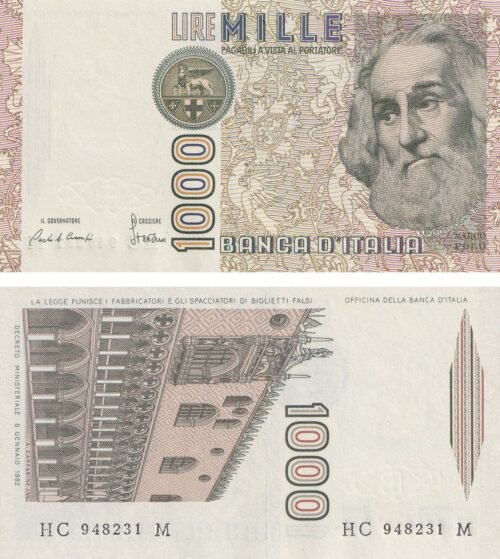
1982–1983 | Modified Lire Issue
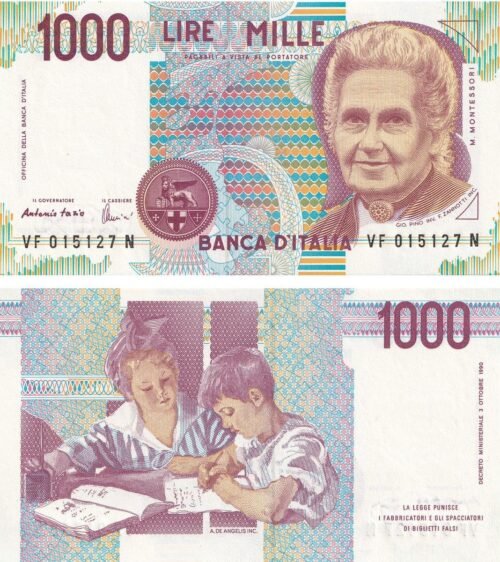
1990–1997 | Final Lire Series
Design & Visual Identity
The highest Italian lira denominations are defined by sculptural intaglio depth and museum-level image selection. The 500,000 lire note featuring Raphael stands at the summit of the series, with details from the School of Athens rendered in exceptionally deep engraving that gives the paper a carved, relief-like surface. The 100,000 lire note dedicated to Caravaggio brings Baroque drama into the series, while the 50,000 lire Bernini note, paired with the Triton Fountain, extends this language into sculpture and Roman urban design. Earlier 50,000 lire issues with Leonardo da Vinci remain equally important, adding manuscript, anatomical, and Renaissance study motifs to the visual field.
Lower denominations provide equally strong collector anchors. The 1,000 lire Maria Montessori note is one of the most recognizable Italian issues, linking the currency to educational reform and making one of the rare female-centered types in the series immediately accessible to collectors. The 10,000 lire Alessandro Volta note strengthens the scientific branch of the lira tradition. Across the series, dense guilloche backgrounds, tonal palettes reminiscent of stone, plaster, and Mediterranean architectural surfaces, watermark portraits, and finely controlled multicolor printing give Italian notes a distinctly sculptural finish rather than a flat graphic look.
Historical & Cultural Context
Italian banknotes are distinguished not only by who appears on them, but by how the imagery is executed. The series translates Vatican frescoes, Baroque fountains, Renaissance studies, and civic allegories into paper with unusual technical ambition, preserving the texture of painting and sculpture through line engraving. Older issues with Italia turrita and Venetian emblems provide an additional historical layer, connecting the republican series to earlier state symbolism and regional visual memory.
A second specialist field comes from replacement notes identified by X, W, or Z prefixes, which are closely followed by advanced collectors and add a technical rarity layer beyond standard type collecting. Because the lira is a completed pre-euro series, high-grade UNC examples of major denominations have become increasingly desirable as fixed objects within European numismatics.
For Collectors
For collectors, Italy offers one of Europe’s strongest closed paper-money traditions, built around the Raphael 500,000 lire, Caravaggio 100,000 lire, Bernini 50,000 lire with the Triton Fountain, Leonardo 50,000 lire, Montessori 1,000 lire, and specialist replacement notes marked by X, W, or Z prefixes. The combination of deep intaglio printing, Renaissance and Baroque masterworks, and a finite pre-euro structure makes Italian lira banknotes a core field for collectors seeking art, technical quality, and long-term scarcity.
Quick Facts
Currency: Italian Lira
Issuer: Bank of Italy