
Japan
Japan banknotes emphasize technical perfection, where fine line engraving, anti-counterfeiting features, and disciplined layouts define the yen.
1950–1958 | Reconstruction Yen Series
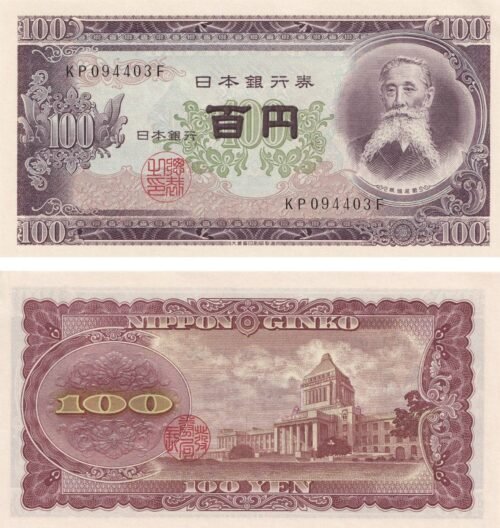
Design & Visual Identity
The modern yen series reaches a new technical frontier with the 2024 issues, defined by rotating 3D hologram portraits—the first application of this technology on circulating banknotes. These innovations are paired with sharply defined cultural anchors: Shibusawa Eiichi appears alongside Tokyo Station on the 10,000 yen, Tsuda Umeko is linked to delicate wisteria motifs on the 5,000 yen, and Kitasato Shibasaburo is accompanied by Hokusai’s Great Wave off Kanagawa on the 1,000 yen. Beneath these designs lies one of the most refined substrates in global currency: paper produced from mitsumata and abaca fibers, giving Japanese banknotes their characteristic cream tone, crisp structure, and exceptional tactile clarity.
Within this precise framework, the 2,000 yen note occupies a unique position, featuring the Shureimon Gate of Okinawa and remaining one of the least encountered denominations in circulation. Natural imagery complements architectural references, with Mount Fuji—often depicted with its reflection in Lake Motosu—serving as the most iconic landscape motif in the series. Watermark portraits, latent images, microprinting, and meticulously controlled intaglio engraving complete a design system defined by restraint and exact execution.
Historical & Cultural Context
Japanese banknotes are distinguished by the seamless integration of technical innovation and cultural selectivity. Rather than relying on visual density, the series achieves authority through precision: carefully chosen motifs, disciplined composition, and exceptional material quality. Tokyo Station, Mount Fuji, Shureimon Gate, and the Great Wave form a balanced visual structure where modern industry, natural landscape, regional identity, and classical art coexist without disruption.
This approach results in a currency tradition recognized not only for advanced anti-counterfeiting measures but for its physical presence. The stability of the paper, the sharpness of engraving, and the clarity of print give Japanese notes a refined tactile identity that sets them apart even in everyday handling.
For Collectors
For collectors, Japan offers a benchmark field defined by the 2024 hologram series, the Shibusawa Eiichi 10,000 yen with Tokyo Station, the Kitasato 1,000 yen with the Great Wave, and the elusive 2,000 yen featuring Shureimon Gate. Combined with Mount Fuji landscape issues and the distinctive mitsumata-based paper, these elements position Japanese yen banknotes among the most technically advanced and materially refined collectibles in world numismatics.
Quick Facts
Currency: Japanese Yen
Issuer: Bank of Japan