Ghanaian Cedi
The Ghanaian cedi reflects a monetary tradition rooted in ancient exchange, where modern currency evolves from the legacy of cowrie shells.
Quick Facts
Country: Ghana
Code: GHS
Symbol: ₵
System: Decimal (1 Cedi = 100 Pesewas)
Status: In circulation
Issuer: Bank of Ghana
The Story of the Ghanaian Cedi
The Ghanaian Cedi was introduced in 1965, replacing the Ghanaian Pound as part of a broader assertion of economic sovereignty. Its name derives from the Fante word for cowrie shells, a pre-colonial medium of exchange that shaped early West African trade systems. This etymology anchors the cedi in a deep monetary continuum stretching from shell currency to modern banknotes. A defining milestone came with the 2007 Ghanaian Cedi redenomination, when 10,000 old cedis were replaced by 1 new cedi under the “Cedi for a New Ghana” initiative, marking a fiscal rebirth after prolonged inflation and restoring clarity and confidence to the monetary system.
Design & Symbolism
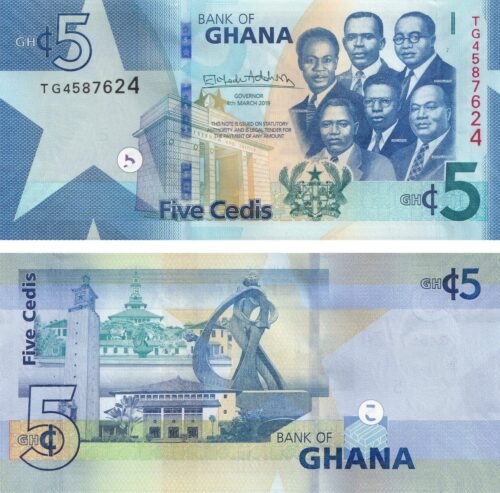
Ghanaian cedi banknotes are structured around philosophical iconography and national narrative. The central visual anchor is the collective portrait of the “Big Six,” the leaders of Ghana’s independence movement—an uncommon design choice that emphasizes shared legacy over individual prominence. The compositions are enriched with Adinkra symbols, most notably Gye Nyame, representing the supremacy of the divine, alongside intricate Kente cloth patterns that form the geometric backbone of the design. These elements create a layered visual language where symbolism, textile tradition and state history merge into a coherent system.
For collectors
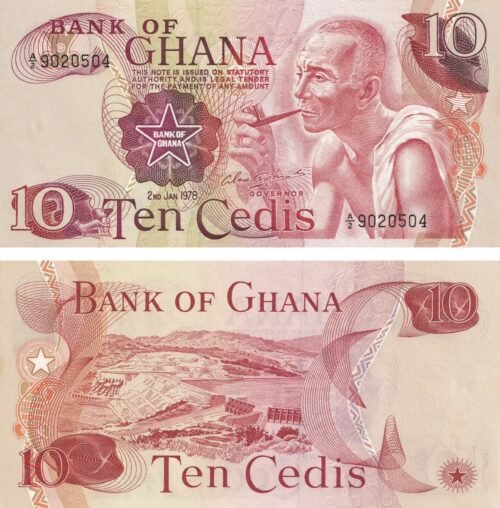
For collectors, the Ghanaian Cedi offers a compelling contrast between eras of numismatic scarcity and modern refinement. High-denomination notes from the pre-2007 “millionaire era,” such as 10,000 and 20,000 cedis, are increasingly rare in UNC condition due to mass withdrawal and destruction during redenomination. In contrast, the post-2007 and especially the 2019 series—featuring enhanced security such as SPARK Live elements and gold-toned features referencing Ghana’s “Gold Coast” heritage—represent a technically advanced and visually cohesive modern set. This transition from inflationary excess to structured design makes the cedi one of the most narratively complete currencies in West African numismatics.
The Ghanaian cedi remains in circulation, defined by the 2007 redenomination that restored monetary usability.