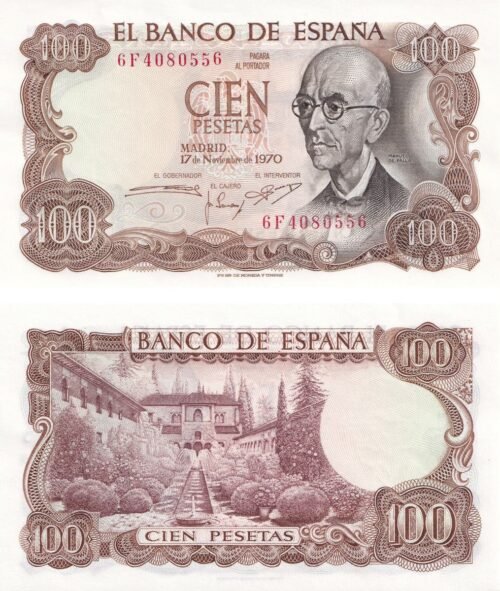
Bank of Spain
The Banco de España served as the issuing authority of the peseta, a currency system notably defined by refined engraving traditions and late-series modernization prior to euro adoption.
Quick Facts
Institutional Identity
The Banco de España served as the nation’s central monetary authority, overseeing a currency that combined institutional rigor with exceptional artistic execution. Produced by the Fábrica Nacional de Moneda y Timbre (FNMT-RCM) in Madrid, Spanish banknotes are renowned for their deep intaglio texture, precise line work and classical European security design.
Historical Evolution
The historical evolution of the peseta reflects Spain’s transformation from monarchy through political upheaval to modern European integration. Among its defining milestones is the 1992 series commemorating the 500th anniversary of Columbus’s voyage, widely regarded as one of the most beautiful thematic banknote series in Europe. This final generation of peseta notes marked the artistic peak of the currency before its transition to the euro.
Design Philosophy
Spanish banknote design is anchored in cultural and historical prestige. Figures such as Francisco de Goya and Miguel de Cervantes appear alongside explorers including Christopher Columbus, Hernán Cortés and Francisco Pizarro. FNMT production ensured exceptional engraving depth, refined guilloché structures and advanced security features, placing Spanish peseta banknotes among the highest-quality printed issues of their era.
For collectors
For collectors, Spanish peseta banknotes represent a closed and finite collecting field defined by artistic excellence. The flagship 10,000 Pesetas note featuring King Juan Carlos I and Prince Felipe stands as the pinnacle of modern Spanish engraving, while earlier Civil War issues offer rare and historically charged contrasts. With strong visual identity, limited surviving UNC quantities and world-class print quality, peseta banknotes remain a cornerstone of advanced European collections.