
Bank of Zaire
The Bank of Zaire (Banque du Zaïre) served as the issuing authority of a currency system shaped by centralized political control and subsequent monetary collapse.
Quick Facts
Institutional Identity
The Bank operated as the central monetary authority under President Mobutu Sese Seko, issuing currency within a highly centralized system marked by political control, economic decline, and accelerating inflation.
Historical Evolution
Established in 1971, the Bank replaced the Congolese franc with the zaire, but its most legendary episode came during the 1997 revolution, when the collapsing regime led to emergency issues where Mobutu’s portrait was physically punched out of existing 20,000 Zaire notes, creating the world-famous “faceless” banknotes.
Design Philosophy
Zairian banknotes are defined by striking political and ecological symbolism, combining Mobutu’s iconic leopard-skin image with representations of Congo’s unique wildlife, most notably the rare okapi, rendered in bold compositions and vivid Central African colour palettes.
For collectors
For collectors, the Bank of Zaire offers one of the most dramatic collecting narratives in Africa, spanning stable early issues to extreme hyperinflation notes reaching 5,000,000 Zaires, alongside the highly sought-after “cut-out Mobutu” emergency series that defines political numismatic rarity.
Explore Banknotes Issued by Bank of Zaire
-

Zaire 50 Zaires 1988, P-32, UNC
2,99 € -

Zaire 5 New Makuta 1993, P-48, UNC
2,49 € -

Zaire 10 New Makuta 1993, P-49, UNC
2,49 € -

Zaire 50 New Makuta 1993, P-51, UNC
2,49 € -

Zaire 1 New Zaire 1993, P-52, UNC
2,99 € -
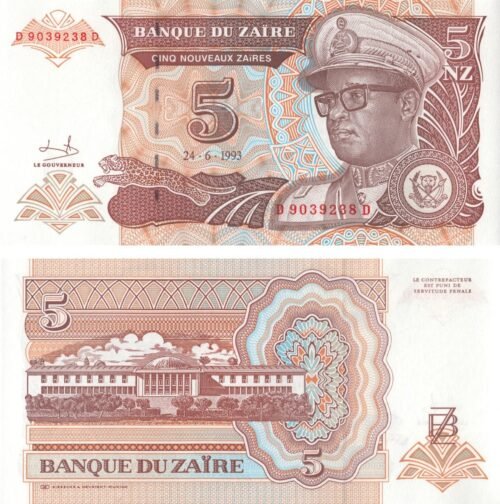
Zaire 5 New Zaires 1993, P-53a, UNC
2,99 € -

Zaire 10 New Zaires 1993, P-54, UNC
3,99 € -

Zaire 5000 New Zaires 1995, P-69, UNC
3,99 €