Guatemalan Quetzal
The Guatemalan quetzal stands as a rare monetary legacy where modern currency directly descends from pre-Columbian systems of value.
Quick Facts
Country: Guatemala
Code: GTQ
Symbol: Q
System: Decimal (1 Quetzal = 100 Centavos)
Status: In circulation
Issuer: Bank of Guatemala
The Story of the Guatemalan Quetzal
The Guatemalan Quetzal was introduced in 1925 under the Orellana reform, replacing the peso and establishing a sovereign currency rooted in historical continuity. Its name derives from the quetzal bird, whose feathers were used as a form of currency in pre-Columbian barter systems across Mesoamerica, creating a direct link between ancient and modern monetary practice. For decades, the quetzal maintained a near 1:1 parity with the US dollar, earning a reputation as a “hard” and stable currency within Latin America, a status that reinforced confidence in Guatemala’s financial system and long-term numismatic stability.
Design & Symbolism
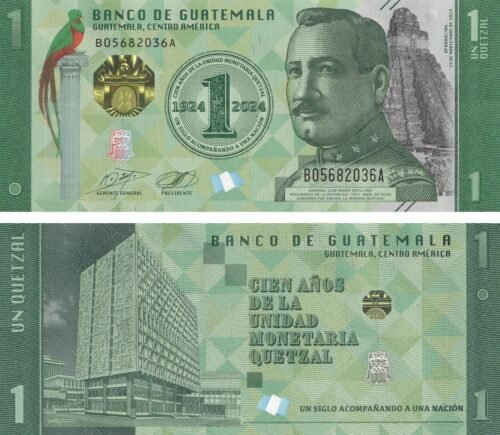
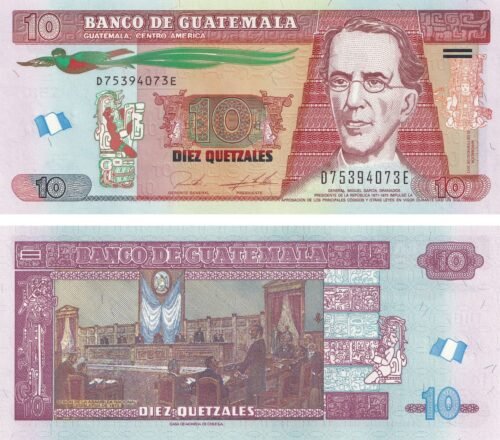
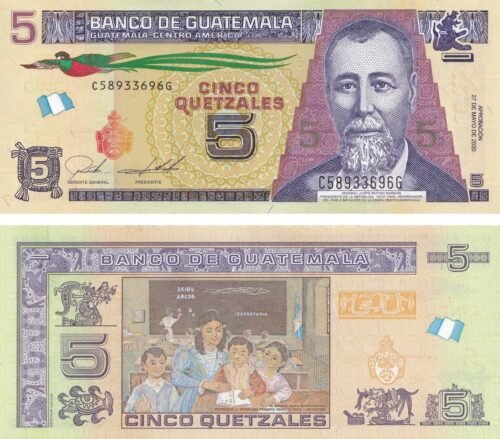
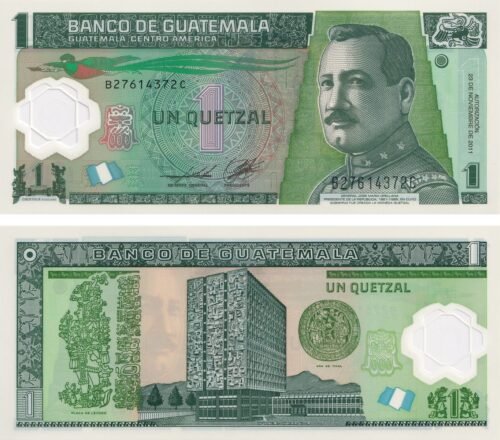
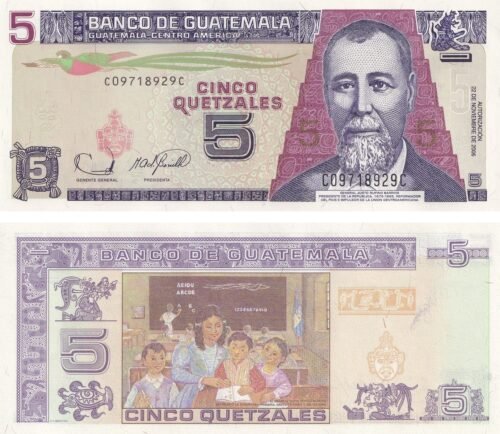
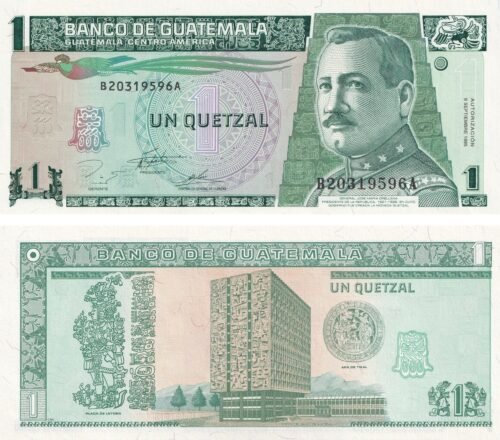
Guatemalan quetzal banknotes are distinguished by precise and highly specific iconography. Mayan heritage is not abstract but encoded directly into the design through glyph-inspired elements and the traditional Mayan numerical system of dots and bars. Architectural references include the Temple of the Great Jaguar (Temple I) in Tikal, one of the most iconic structures of the ancient world. These elements are combined with detailed engravings of national figures and institutional scenes, forming a layered composition where pre-Columbian civilisation and modern governance coexist within a structured visual framework.
For collectors
For collectors, the Guatemalan Quetzal offers a uniquely balanced field between historical symbolism and modern technical innovation. The bright green 1-quetzal polymer note is a key highlight, widely regarded as a must-have for polymer collectors due to its durability, colour intensity and advanced anti-copy features. Earlier issues printed by the American Bank Note Company (ABNC) are increasingly scarce in high-grade condition, adding depth and numismatic value to mid-20th-century series. This combination of Mayan glyphs, textile-inspired background patterns and long-standing monetary stability positions the quetzal as one of the most distinctive currencies in Latin American numismatics.
The Guatemalan quetzal remains in circulation, historically known for its long-standing stability in Central America.