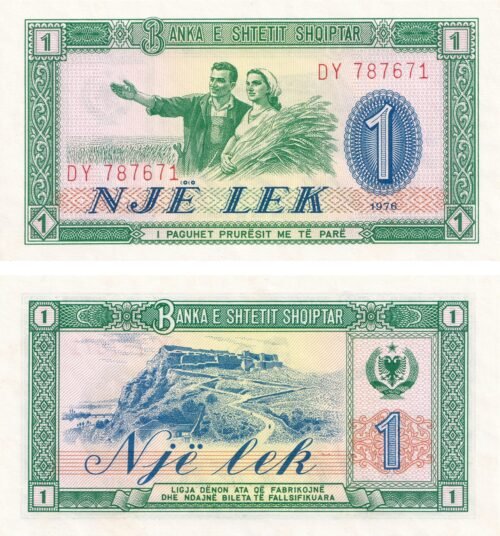
Bank of Albania
The Bank of Albania (Banka e Shqipërisë) operates as the central monetary authority overseeing a transition from post-communist instability toward a modern financial system, notably reflected in its adoption of polymer and hybrid banknote production aligned with European standards.
Quick Facts
Institutional Identity
The Bank of Albania functions as the central monetary authority responsible for issuing the lek, maintaining price stability and overseeing the national financial system. Its role extends beyond currency issuance to include regulatory supervision, liquidity management and the implementation of monetary policy within a transitioning economy.
Since the early 1990s, the institution has been instrumental in stabilizing Albania’s financial framework following the collapse of the centrally planned system. Through regulatory reforms and institutional strengthening, it has established a more resilient and transparent banking environment aligned with European standards.
Historical Evolution
Founded in 1925, the Bank of Albania has operated across multiple political and economic systems, adapting its functions to shifting national frameworks while maintaining continuity as the country’s monetary authority. Its evolution reflects the broader transformation of Albania’s financial system from centralized control toward a market-oriented structure.
In recent decades, the institution has focused on strengthening monetary governance, improving financial supervision and aligning operational standards with international central banking practices. This includes cooperation with global security printers and the adoption of advanced production and verification frameworks for national currency issuance.
Design Philosophy
Banknotes issued under the authority of the Bank of Albania are developed within a controlled institutional framework that prioritizes security, consistency and functional clarity. The design process follows defined standards to ensure recognizability across denominations while maintaining compatibility with modern anti-counterfeiting systems.
Security features such as microprinting, multi-layered watermarks and embedded threads are integrated as part of a broader verification system overseen by the central bank. The institution’s role is not in defining symbolic narratives, but in ensuring that each banknote meets strict technical, regulatory and operational requirements within the national and international monetary environment.
For collectors
For collectors, Bank of Albania issues provide a clear and structured collecting path, from early post-communist notes to the modern polymer series. The 2019–2022 redesign and the introduction of the 10,000 lekë note are key milestones. These banknotes are valued for combining historical subjects with modern production, making them relevant both for regional collections and for collectors focused on contemporary European currency development.