Bank of Russia
The Bank of Russia operates as the central monetary authority overseeing a currency system shaped by redenomination, state-controlled production and evolving commemorative issues.
Quick Facts
Institutional Identity
The Bank of Russia serves as the nation’s central monetary authority, overseeing monetary policy, financial regulation and currency issuance across one of the world’s largest and most complex economic landscapes.
Historical Evolution
Modern Russian monetary history is anchored in the 1998 redenomination, where 1,000 old rubles were replaced by 1 new ruble, marking the transition from post-Soviet hyperinflation to structural stability. A key numismatic feature is the visual continuity between the 1995 inflation series and the 1998 issues, where identical designs exist with three additional zeros—creating a distinctive “before and after” collecting framework. This transformation defines the boundary between Soviet-era legacy and modern Russian currency identity.
Design Philosophy
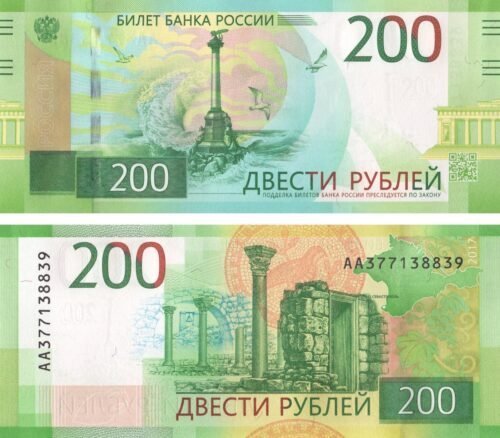
Russian banknotes are produced by Goznak, one of the world’s most advanced security printing institutions, known for exceptional intaglio depth, complex watermark systems and optically variable features such as colour-shifting security threads. The design language centres on monumental architecture and regional identity, with each denomination dedicated to a specific city—from Moscow and Saint Petersburg to Khabarovsk and Vladivostok. The 2017 introduction of the 200 and 2000 ruble notes marked a significant aesthetic shift, bringing brighter colour systems, modern typography and enhanced durability, including protective coatings designed for high circulation environments.
For collectors
For collectors, Russian rouble banknotes offer a varied field, combining circulating designs with commemorative issues. The vertical commemorative notes include the issue for the 2014 Sochi Winter Olympics, the 2015 Crimea/Sevastopol issue and the 2018 FIFA World Cup release. The Sochi note entered circulation on 30 October 2013 and is printed on cotton paper with an embedded polymer security stripe. Together with 5,000-rouble notes and issues from before and after redenomination, these banknotes offer opportunities to compare designs, materials and security features.