Central Bank of Bolivia
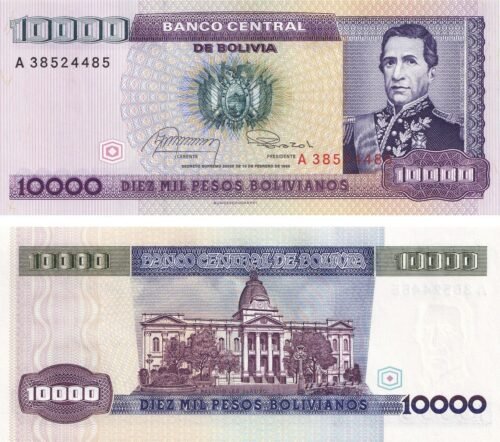
The Central Bank of Bolivia (Banco Central de Bolivia) operates as the central monetary authority overseeing a system shaped by one of the most extreme monetary resets of the 20th century, notably reflected in high-denomination hyperinflation issues and later stabilization series.
Quick Facts
Institutional Identity
The Banco Central de Bolivia functions as the sole issuing authority of the boliviano, operating within a system shaped by the legacy of hyperinflation and subsequent structural reform. Established in 1928, the institution’s defining moment came in 1987 when it replaced the collapsed peso boliviano at a ratio of 1,000,000 to 1, restoring monetary order through tightly managed issuance and transitional mechanisms.
Historical Evolution
During the 1987 reform, the Bank implemented a provisional currency phase involving the overprinting and controlled overstamping of existing peso notes and financial instruments to maintain liquidity while new banknotes were being produced. This transition represents a key institutional response to monetary collapse, demonstrating the Bank’s operational capacity under extreme economic conditions.
Design Philosophy
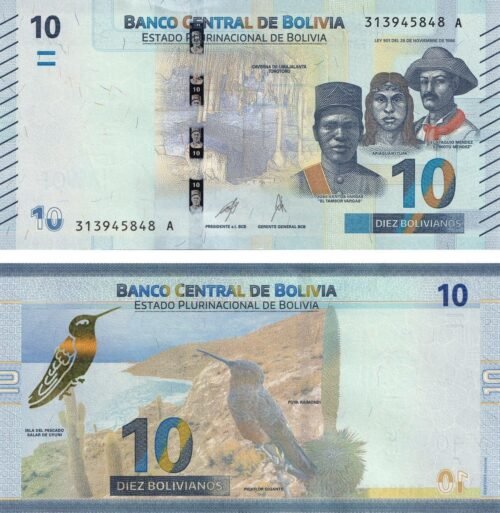
In its modern phase, the Bank introduced the 2018 “First Family of Banknotes of the Plurinational State”, marking a shift toward a new national identity framework. Produced in collaboration with international printers including Oberthur Fiduciaire and De La Rue, the series combines high-grade cotton substrate with advanced security elements such as Spark Live® optical features, multi-tone watermarks and complex microprinting, reflecting a deliberate institutional strategy to prioritise durability and anti-counterfeiting performance over polymer adoption.
For collectors
For collectors, banknotes issued by the Banco Central de Bolivia offer a sharply defined dual-era narrative, where hyperinflation-era remnants and provisional overprints contrast with technologically advanced modern series. The combination of a 1,000,000:1 reform, plurinational identity shift and high-security contemporary design creates a compelling and structurally rich field within Latin American numismatics.