Central Bank of Seychelles
The Central Bank of Seychelles operates as the central monetary authority overseeing a currency system defined by biodiversity-driven design, including distinctive wildlife-themed banknotes.
Quick Facts
Institutional Identity
The Central Bank of Seychelles serves as the island nation’s monetary authority, managing a currency that reflects both financial governance and ecological identity. In a country of limited population and circulation, each banknote becomes not just a medium of exchange, but a carefully curated representation of the islands’ natural and cultural uniqueness.
Historical Evolution
The historical evolution of Seychellois banknotes includes one of the most famous curiosities in global numismatics—the 1960s “SEX” note. On early 50 rupees issues featuring Queen Elizabeth II, a hidden word formed subtly within palm fronds created a lasting legend, transforming an otherwise standard colonial note into a globally recognized collector’s grail.
Design Philosophy
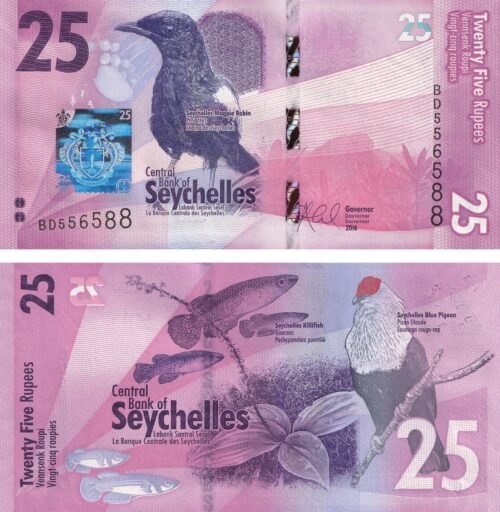
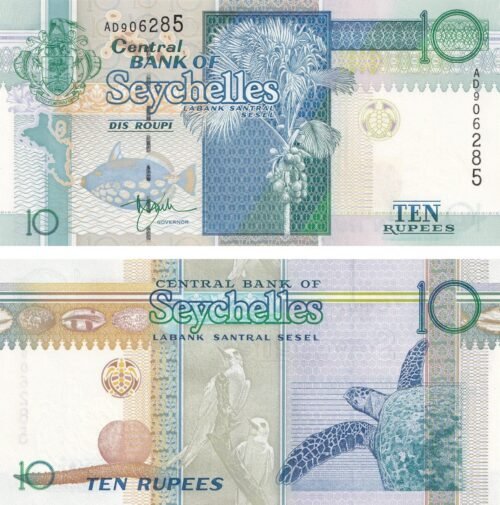
Modern Seychellois banknotes are widely regarded as some of the most visually striking in the world, built around a pure celebration of biodiversity. The flagship 500 rupees note featuring the Aldabra giant tortoise stands as a centerpiece of fauna-themed collections, while other denominations showcase vibrant marine life, endemic birds and tropical flora. The iconic Coco de Mer appears within design elements and security features, reinforcing the islands’ unique natural identity. Technologically, the series reflects adaptation to a demanding tropical climate, incorporating advanced substrates, protective coatings and polymer elements. The 2016 Independence series introduced dual-colour “Gemini” UV security features, adding both visual intrigue and technical depth.
For collectors
For collectors, Seychellois rupee banknotes represent a rare convergence of storytelling, rarity and visual impact. The “SEX” note remains one of the most famous anomalies in world paper money, while modern issues attract wildlife and colour-focused collectors. Limited circulation and strong thematic identity make high-grade examples especially desirable.