Eastern Caribbean Central Bank
The Eastern Caribbean Central Bank operates as a supranational monetary authority, notably defined by a shared currency system distributed across multiple island states with structured regional variation.
Quick Facts
Country: Eastern Caribbean States
Currency: Eastern Caribbean Dollar
Local name: Eastern Caribbean Central Bank
Institutional Identity
The Eastern Caribbean Central Bank (ECCB), established by the 1983 Treaty of Basseterre, issues the Eastern Caribbean dollar (XCD) for a monetary union of Caribbean states. Its system is anchored by a fixed exchange rate of 2.70 XCD = 1 USD, maintained since 1976, making it one of the longest-standing and most stable currency pegs in the world. This framework positions the ECCB as a supranational authority, combining monetary discipline with regional cohesion.
Historical Evolution
A defining numismatic feature of earlier ECCB banknotes is the country code system, where each note carries a specific identifying letter tied to its issuing territory: A (Antigua and Barbuda), D (Dominica), G (Grenada), K (Saint Kitts and Nevis), L (Saint Lucia), M (Montserrat), V (Saint Vincent and the Grenadines), U (Anguilla). Though visually identical, these coded variations create multiple collectible types within a single denomination, forming the foundation of Eastern Caribbean banknote specialization. This system applies to earlier paper issues and is absent from the modern polymer series.
Design Philosophy
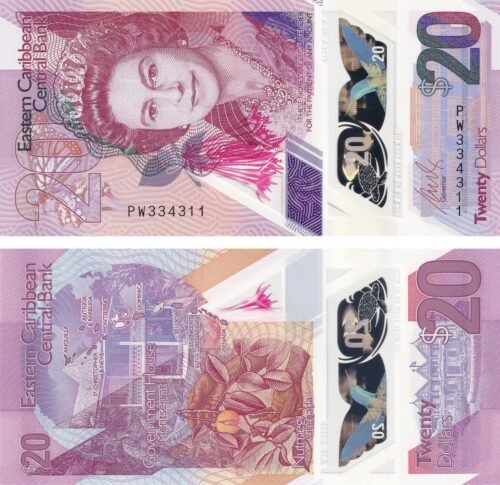
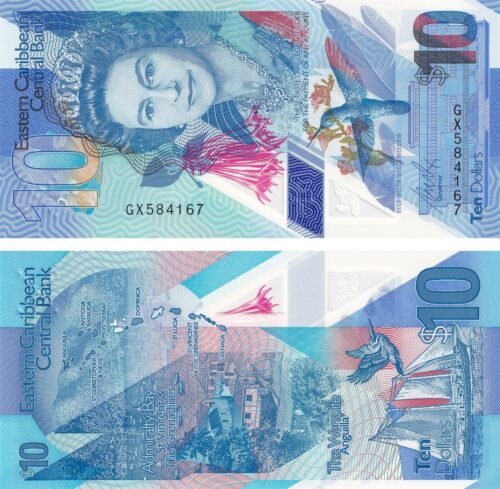
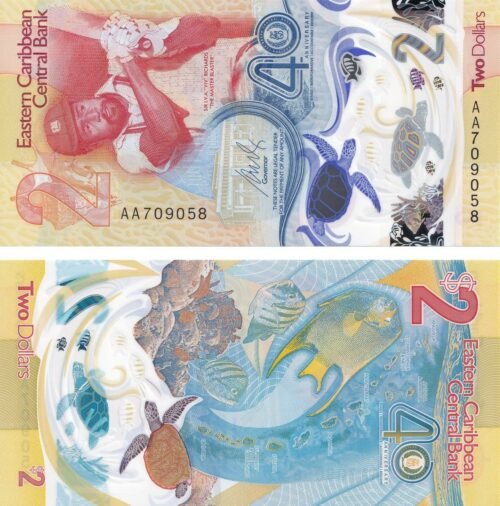
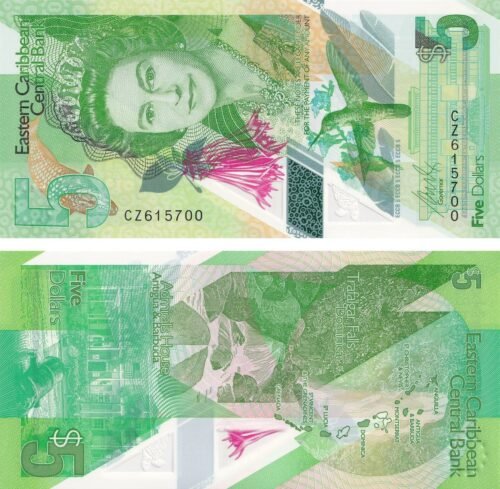
The modern era is defined by the 2019 polymer series, produced by De La Rue, introducing a fully vertical design across all denominations. These notes incorporate advanced security features including transparent polymer windows, holographic elements, refined intaglio printing and machine-readable structures, engineered for durability in tropical climates. The transition from Queen Elizabeth II to King Charles III marks a significant iconographic evolution within the series.
For collectors
For collectors, ECCB banknotes represent a uniquely layered collecting field where one currency expands into multiple variants through coded issuance. The contrast between paper series with country identifiers and the modern unified polymer issues, combined with the long-standing 2.70 peg, creates a refined and technically structured numismatic landscape.